

Elevate Your Look: The Ultimate Guide to Mixing Accessories
TL;DR:
- Accessories play a crucial role in completing an outfit and expressing personal style.
- Building a versatile accessory wardrobe around a hero piece and creating balanced contrasts enhances any look.
- Practicing intentional mixing and editing helps avoid cluttered styles and develops unique, polished outfits.
You spot a gorgeous outfit online and think, “That’s the one.” But when you recreate it at home, something feels off. The clothes are right, yet the whole look falls flat. Nine times out of ten, the culprit is accessories. Whether you pile on too many pieces and end up looking chaotic, or you keep it so minimal the outfit barely registers, getting the balance right can feel genuinely tricky. Understanding how accessories express your style is the first step toward building outfits that feel truly yours, and this guide will walk you through exactly how to do it.
Table of Contents
- What you need to start mixing accessories
- Step-by-step: How to mix accessories for any look
- How to mix accessories for different occasions
- Common mistakes when mixing accessories (and how to fix them)
- What fashion magazines won’t tell you about mixing accessories
- Find the perfect accessories and more at 16th Avenue
- Frequently asked questions
Key Takeaways
| Point | Details |
|---|---|
| Start with a hero piece | Choose a bold, focal accessory to anchor your look before adding others. |
| Mix contrasts, find cohesion | Balanced mixing involves both contrast and a unifying element for a put-together look. |
| Match setting and style | Adjust your accessory mix based on the occasion for best results. |
| Edit for impact | Less can be more—review your look and remove any elements that feel unnecessary. |
What you need to start mixing accessories
Before you can mix anything successfully, you need to know what you’re working with. Accessories fall into several broad categories: jewellery (necklaces, earrings, rings, bracelets), belts, scarves, hair pieces (clips, headbands, scrunchies), bags, and shoes. Each of these plays a different role in an outfit. Jewellery adds sparkle and personality. Belts define the waist and add structure. Scarves layer texture and colour. Bags and shoes anchor the whole look.
The single most important concept in accessory mixing is the hero piece. Think of it as the star of your accessory story. Everything else you add should support it, not compete with it. According to Vogue’s layering guide, the core mechanics involve selecting a focal or “hero” piece first, then layering complementary items with contrast in scale, texture, length, and metals to create balance and visual interest without clutter. Choose your bold statement earrings, your chunky chain necklace, or your standout belt, and build from there.
To build a solid accessory wardrobe, every woman should have these essentials:
- A simple gold or silver chain necklace in a delicate weight
- One pair of classic stud earrings and one pair of statement earrings
- A structured handbag in a neutral colour (black, camel, or tan)
- A versatile belt in black or brown leather
- A lightweight scarf that can double as a wrap or hair accessory
- A set of stackable rings or thin bracelets
- A watch or cuff for wrist interest
- One pair of classic and one pair of statement shoes
Pro Tip: Invest in at least five versatile neutral pieces (black, gold, silver, tan, white) and two or three bold statement pieces. Neutrals act as your supporting cast; statement pieces do the heavy lifting.
Knowing how to combine these is what accessorizing outfits made simple is all about. The table below breaks it down so you can reference it quickly.
| Accessory type | Best wardrobe pairings | When to use it |
|---|---|---|
| Delicate chain necklace | Blouses, V-necks, blazers | Everyday, office, casual |
| Statement earrings | Simple dresses, plain turtlenecks | Evening, events, dates |
| Structured handbag | Tailored trousers, midi dresses | Work, smart-casual |
| Wide belt | Wrap dresses, oversized shirts | Casual, bohemian looks |
| Silk scarf | Striped tops, solid coats | Travel, weekend, retro styling |
| Stackable bracelets | Off-shoulder tops, relaxed tees | Casual, festival, playful |
| Bold shoes | Minimalist outfits, monochrome looks | All occasions as a focal point |
Check out accessory inspiration for more ideas on which pieces deserve a spot in your rotation.
Step-by-step: How to mix accessories for any look
Now that you’ve assembled your tools, let’s put them into action with a proven, fashion-editor-approved method. The process is simpler than it looks once you have a framework to follow.
Vogue’s guide confirms that contrast creates visual interest through scale and texture mixing, but cohesion via a unifying element, such as a dominant metal or motif, distinguishes a polished look from a cluttered one. Intention matters far more than quantity.
Here’s the step-by-step process:
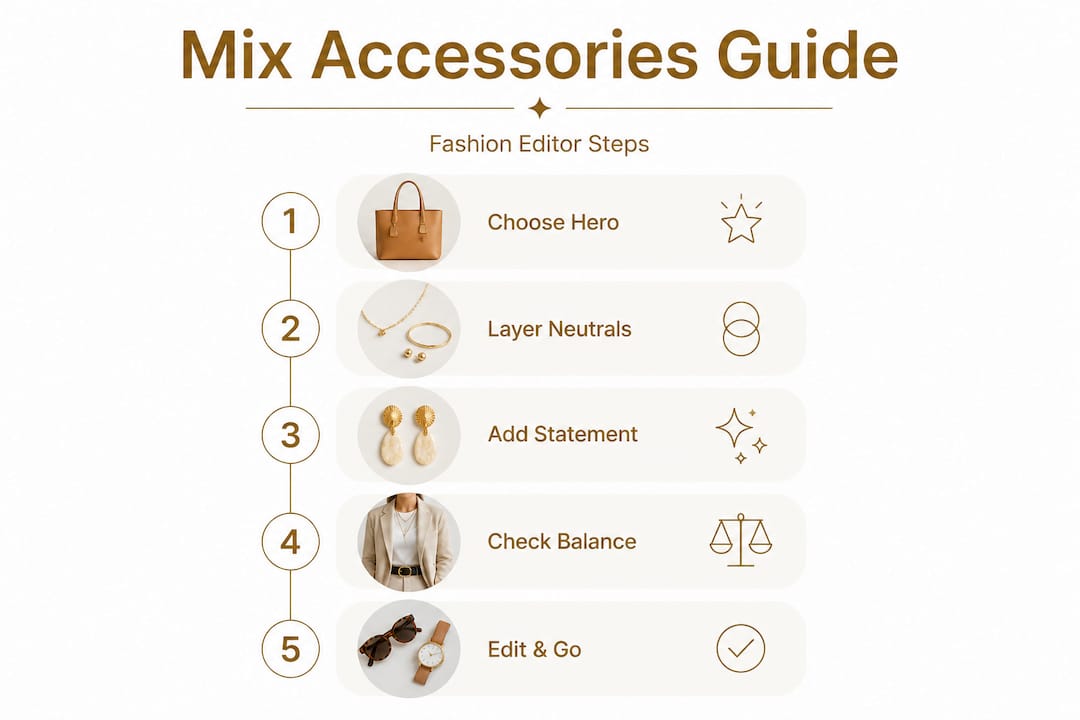
- Choose your hero piece. Decide which single accessory will anchor the look. It could be a bold necklace, a pair of dramatic earrings, or even a standout bag. Pick one.
- Build contrast around it. Add pieces that differ in scale, texture, or length. If your hero is a thick choker, layer a longer, finer chain beneath it. If you’re wearing large hoop earrings, keep your wrists minimal.
- Find your unifying element. Choose one metal tone (gold OR silver, or a deliberate mix if you’re experienced), one colour palette, or one motif (geometric, floral, mixed metals) to tie everything together.
- Check proportion. Larger frames and taller builds can carry bigger, bolder pieces. Petite frames often benefit from more delicate layering. This isn’t a rule, but it’s a useful starting point.
- Edit ruthlessly. Put on everything you intend to wear, look in a full-length mirror, and remove the piece that feels unnecessary. Often, taking one thing off is exactly what makes the look come together.
- Test for movement. Walk around, sit down, and do a quick shoulder roll. Accessories should feel comfortable and move naturally. If they’re distracting you, they’ll distract everyone else too.
Pro Tip: Group accessories in odd numbers for the most visually pleasing stacks. Three bracelets, five rings, or seven delicate necklaces feel more organic than even-numbered groupings. Stylists call this the “rule of odds,” and it genuinely works.
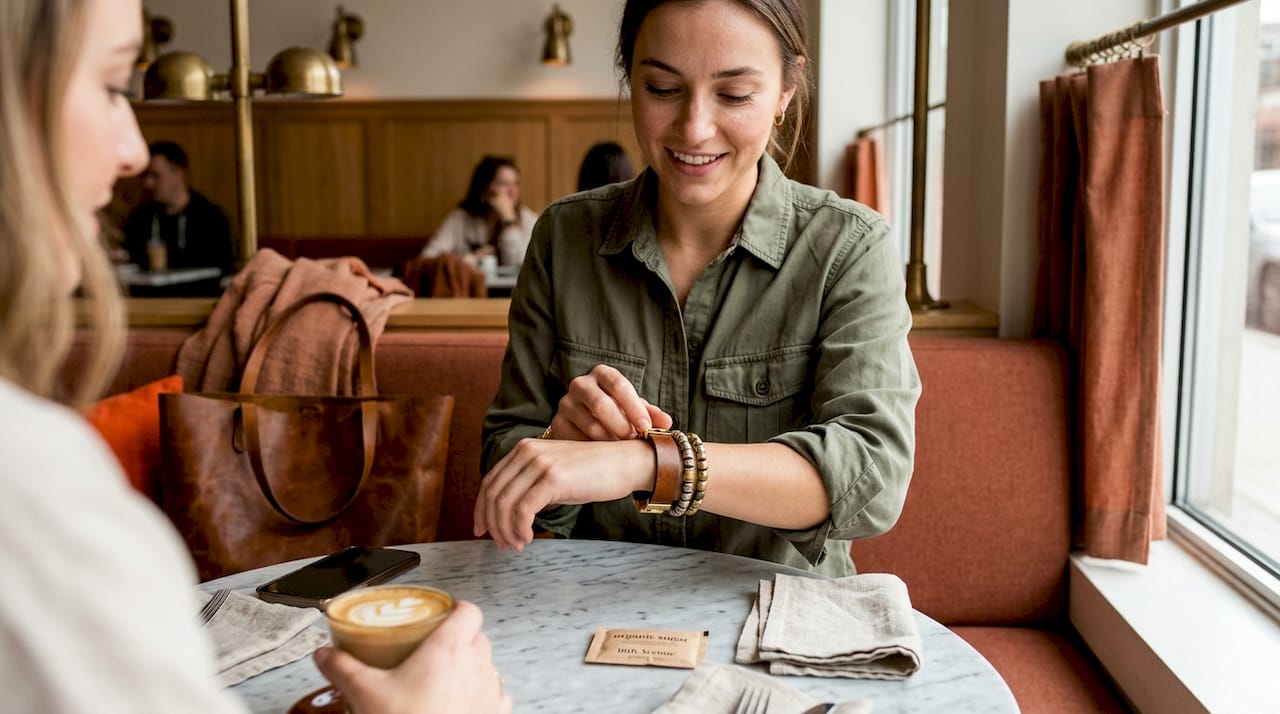
For quick reference, use this comparison table to plan your look by occasion:
| Setting | Hero piece | Supporting pieces | What to skip |
|---|---|---|---|
| Work | Thin chain or studs | Simple watch, structured bag | Loud bangles, oversized statement earrings |
| Casual | Stacked bracelets or hoops | Crossbody bag, simple ring | Heavy layering, overly formal pieces |
| Evening | Bold necklace or chandelier earrings | Clutch, one ring | Too many focal points |
For even more structured guidance, the step-by-step trendy style guide walks through complete outfit building, while the must-have accessories list gives you a curated starting point.
How to mix accessories for different occasions
With core strategies in hand, let’s cover how to shift your approach depending on the occasion and outfit. Reading the room matters. A maximalist stack of gold necklaces that looks stunning at a gallery opening can feel wildly out of place in a boardroom.
According to styling insight from Marie Claire’s accessories guide, the approach shifts significantly by setting: minimal and subtle pieces like studs and thin chains work best for professional environments, playful layering suits casual wear, and bold statement pieces shine in evening settings. Always adapt to neckline and body proportion.
Here’s a breakdown of what to do and avoid in each context:
Professional settings:
- Do wear small studs, thin chains, a classic watch, and a structured handbag
- Do keep jewellery toned down in shine (matte or brushed metals look polished)
- Don’t wear dangling statement earrings that catch on everything or loud bangles that click on keyboards
- Don’t mix too many prints or textures in your accessories
Casual settings:
- Do have fun. Layered necklaces, colourful scrunchies, stacked rings, and playful tote bags all belong here
- Do mix metals and textures freely
- Don’t default to boring. Casual doesn’t mean accessory-free
- Don’t ignore your footwear as a key accessory opportunity
Evening and formal settings:
- Do go bold with one spectacular piece, whether it’s chandelier earrings, a gemstone cuff, or a beaded clutch
- Do keep everything else paired back so your statement piece reads clearly
- Don’t wear daytime accessories to evening events (a canvas tote doesn’t belong at a gala)
- Don’t fear elegance, it doesn’t have to mean boring
“The best-dressed women don’t just wear accessories. They wear the right accessories for the right moment. Adapting your neckline, your palette, and your silhouette to the setting is what separates stylish from styled.”
For a full breakdown of accessorizing for any occasion, including guidance for everything from weekend brunches to black-tie events, there’s an entire guide dedicated to helping you build stylish looks for every occasion.
Common mistakes when mixing accessories (and how to fix them)
Even the most seasoned fashion lover can fall into certain traps. Here’s how to sidestep the most common ones and perfect your signature accessory mix.
The five biggest mistakes:
-
No focal point. When everything screams for attention, nothing gets it. Wearing three bold necklaces, statement earrings, and a stack of loud bracelets simultaneously leaves the eye with nowhere to rest. Fix: Decide on one hero piece and let everything else whisper.
-
Ignoring proportion. Wearing a chunky necklace with an equally chunky bracelet and a large bag can overwhelm the outfit. Fix: If one piece is large, keep the others small or mid-scale.
-
Mismatched metals without intention. Randomly mixing gold, silver, and rose gold can look haphazard. Fix: If you want to mix metals, do it deliberately. Choose one dominant metal and let the other appear once as an accent.
-
Dressing for the trend, not the moment. Chasing every new accessory trend without asking whether it suits you, your outfit, or the occasion leads to looks that feel costumey. Fix: Try essential fashion accessories as your foundation before adding trend pieces.
-
Forgetting proportion relative to your frame. A tiny bag on a larger frame can look almost comical. Equally, an enormous tote can swamp a petite figure. Fix: Test the accessory against your silhouette in a full-length mirror before you commit.
As Vogue’s guide notes, there’s no universal limit on accessories. Personal maximalism is absolutely possible (look at the iconic stylist Catherine Baba), but the key is to edit to one or two focal areas. Beginners especially benefit from keeping the “less is more” principle close to heart until the instinct for balance develops naturally.
Pro Tip: Before you leave the house, take a quick mirror selfie and look at it the way you would look at a photo of someone else. You’ll instantly see whether the accessories feel intentional or chaotic. If one piece jumps out as unnecessary, take it off.
“Editing is the secret skill of every great accessorizer. Anyone can add more. The real talent is knowing what to leave behind.”
What fashion magazines won’t tell you about mixing accessories
Here’s the honest truth that gets lost between glossy editorial pages: most accessory rules were written for a specific body type, a specific skin tone, and a specific cultural aesthetic. They weren’t written for you, specifically. The advice to “never mix metals” or “always remove one thing before leaving the house” is a guideline, not a law.
What actually matters is defining personal style from a place of genuine self-expression. When you mix accessories because they make you feel something, the resulting look has an energy that no rule-following can replicate. You can see it in the most memorable personal styles. They’re not technically perfect. They’re deeply intentional.
The trap most women fall into is waiting until they feel “stylish enough” to experiment. They stick to safe, minimal choices because they’re afraid of getting it wrong. But getting it “wrong” is actually how you find what works for you. Your third attempt at stacking rings will look better than your first, not because you learned the rules but because you learned your own eye.
The advice we’d genuinely give? Stop performing accessories and start wearing them. Pick pieces that feel like yours, not pieces that look like someone else’s well-dressed photo. The most compelling personal style isn’t copied. It’s collected, piece by piece, over time.
Mixing accessories with intention, rather than anxiety, is what produces truly polished results. Not a checklist. Not a formula.
Find the perfect accessories and more at 16th Avenue
Ready to turn inspiration into action? Everything you’ve read in this guide works best when you have the right pieces to play with.
At 16th Avenue, you’ll find a curated selection of fashion-forward pieces designed for exactly this kind of intentional styling. From trendy wool coats that become the perfect neutral backdrop for bold accessory stacks, to fashion sneakers that anchor casual layered looks with ease, the collection is built for women who want versatility and style in one place. Pair your new looks with the 24-piece makeup brush set to complete the whole picture, because great accessories deserve a finished face to match. Shop with free shipping to most destinations and discover your next hero piece today.
Frequently asked questions
How many accessories is too many?
There’s no universal limit, but focusing on one or two focal areas, such as ears or neck separately, helps prevent a cluttered look and keeps the overall style intentional.
Should accessories always match?
Mixing metals and textures creates genuine interest, but a single unifying element, like a dominant metal tone or repeated motif, is what keeps the look polished rather than random.
How do I mix accessories for work?
Choose subtle, minimal pieces such as studs or thin chains and keep your overall accessory count low to maintain a streamlined, professional appearance.
Is it okay to combine different metals or styles?
Absolutely. Combining metals and styles is a modern, confident approach to accessorizing. Just keep a sense of balance by letting one metal or style dominate so the look feels cohesive rather than accidental.
How can I experiment without looking overdone?
Edit your look right before heading out by taking a mirror selfie and removing one piece if the combination feels crowded. Less is rarely regretted.
Recommended
- Role of Accessories in Styling: Express Yourself – 16th Avenue
- Must-have accessories list for effortless style in 2026 – 16th Avenue
- Why Accessorize Looks: Unlocking Fashion Potential – 16th Avenue
- Role of Accessories in Fashion: Defining Personal Style – 16th Avenue
- How to Accessorize Dresses: Guide for Proms, Weddings & More 2025 - DressMeUpNY
- 5 Smart Ways to Style Cork Accessories for Any Look – The Cork Store