

Inclusive Sizing in Women's Fashion: Find Your Perfect Fit
- Inconsistent sizing in women’s fashion can be addressed through genuine inclusive design practices that consider proportional adjustments, fit testing, and construction changes. Many brands extend size ranges without real design work, leading to unreliable fit and consumer distrust. True inclusive sizing improves confidence, reduces returns, and offers garments crafted for diverse bodies, not just marketing labels.
You grab the same size you always wear, try it on at a different store, and suddenly nothing fits the same way. The waist pulls, the shoulders bunch, the hem lands somewhere unexpected. Sound familiar? Sizing inconsistency is one of the most frustrating parts of shopping for women’s clothing, and it affects women of every shape and build. Inclusive sizing promises something better, but only if it actually means what it claims. This article breaks down what inclusive sizing genuinely involves, how to tell real inclusion from marketing spin, and how to use that knowledge to shop with confidence.
Table of Contents
- What does inclusive sizing really mean?
- How inclusive sizing differs from extended sizing
- Why consistency and reliable fit matter to shoppers
- How inclusive sizing looks on the runway and in real life
- How to shop for inclusive sizing: tips for finding your best look
- The uncomfortable truth about inclusive sizing in fashion
- Discover fashion and beauty designed with everyone in mind
- Frequently asked questions
Key Takeaways
| Point | Details |
|---|---|
| True inclusive sizing | It begins with design for all body proportions, not only adding numbers to a size chart. |
| Fit consistency | Consistent sizing helps shoppers select clothes confidently and limits frustrating returns. |
| Spotting the difference | Genuine inclusive sizing involves investment in fit testing and construction, not just marketing. |
| Shop empowered | Understanding inclusive sizing helps you make choices that enhance your style and comfort. |
What does inclusive sizing really mean?
The phrase “inclusive sizing” gets thrown around constantly in fashion, but its meaning varies wildly depending on who’s using it. At its core, inclusive sizing empowers your style when brands approach it seriously, because it’s rooted in design, not just number ranges.
Inclusive sizing means designing garments for a broader range of bodies by including proportional adjustments to fit, cut, and construction across all sizes. It is not simply extending a size chart upward or downward. That distinction matters enormously.
Think about how a dress is made. A size 6 pattern is drafted with specific measurements for bust, waist, hips, torso length, and shoulder width. If a brand simply scales that same pattern up to a size 22 using a percentage-based formula, the final garment will not fit a size 22 body the way the original fits a size 6. The proportions shift in ways that a simple scale cannot predict or correct.
Genuine inclusive sizing addresses this through:
- Proportional grading: Adjusting measurements at specific points (bust, hip, waist spacing) rather than uniformly scaling up or down
- Separate fit testing: Fitting samples on a variety of body shapes across multiple size ranges, not just one fit model
- Construction changes: Altering seam placements, dart positions, or panel structures to accommodate the real shape of different bodies
- Fabric consideration: Choosing materials that behave appropriately across size ranges, since stretch and drape differ at larger and smaller dimensions
“Inclusive sizing is a design process that begins with body diversity as the starting point, not as an afterthought layered onto a narrow template.” This philosophy is what separates brands doing the real work from those offering a wider number range with no additional thought.
Body positivity in fashion is not just a social conversation. It requires brands to back up their messaging with genuine product development decisions that affect every woman who shops with them.
How inclusive sizing differs from extended sizing
Extended sizing and inclusive sizing are not the same thing, though they are frequently treated as interchangeable. This confusion is exactly what creates disappointment in the fitting room.
Extended sizing refers to offering a broader numerical range of sizes, such as running from XS to 5XL. It is a retail decision, not necessarily a design one. A brand can stock extended sizes while doing zero additional fit work. The result? Garments that fit the sample size well and get progressively less comfortable and flattering as the size increases.
True inclusive sizing requires product-development work including pattern development, fit testing, and construction changes. Adding sizes without that work is a marketing decision, not a design one.
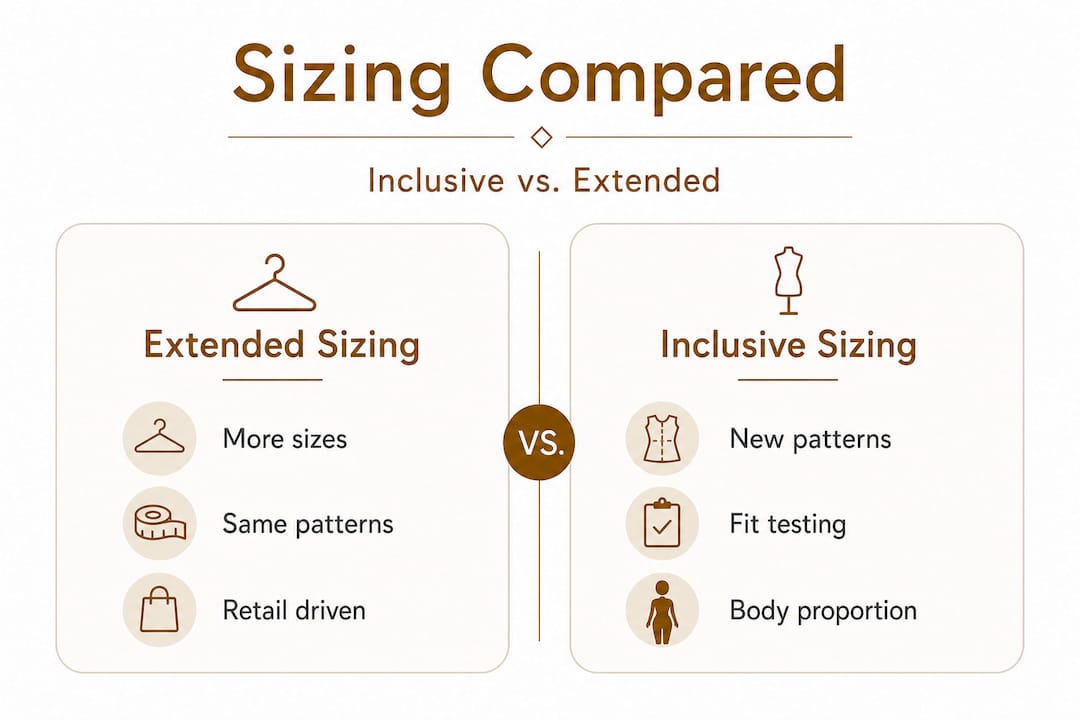
Here is a clear comparison to illustrate the difference:
| Feature | Extended sizing | Inclusive sizing |
|---|---|---|
| Size range | Wider numbers on a chart | Wider range with adjusted proportions |
| Pattern development | Single base pattern scaled up/down | Multiple fit blocks for different size ranges |
| Fit testing | May only use one fit model | Tested across many body shapes and sizes |
| Construction | Same across all sizes | Seams, darts, and panels adjusted per range |
| Shopper experience | Inconsistent, especially at larger sizes | More reliable, consistent fit |
| Marketing vs. substance | Often marketing-led | Design-led with validated results |
Brands that offer only extended sizing without inclusive design work often use it as a marketing label while delivering inconsistent fit, which builds real distrust among shoppers.
To evaluate a brand before you buy, look for these signals:
- Does the brand show multiple fit models across different body types, not just one?
- Is size-specific styling advice or measurement guidance provided on product pages?
- Does the brand mention fit testing or construction changes in their sizing information?
- Are reviews from shoppers across different sizes visible and searchable?
- Does the brand offer detailed measurement charts that go beyond generic XS to 3XL labels?
Pro Tip: When shopping online, search specifically for reviews from shoppers who share your measurements rather than your labelled size. Their actual body dimensions will tell you far more about whether a garment will fit you than a size designation will.
Understanding how fit transforms fashion styling is the first step toward building a wardrobe that works for your body every single time.
Why consistency and reliable fit matter to shoppers
One of the biggest, most underacknowledged problems in women’s fashion is that size labels are essentially meaningless across brands. Inclusive sizing means consistent fit across sizes, so that the same numeric size is more comparable within and across collections. Currently, that goal is rarely achieved.
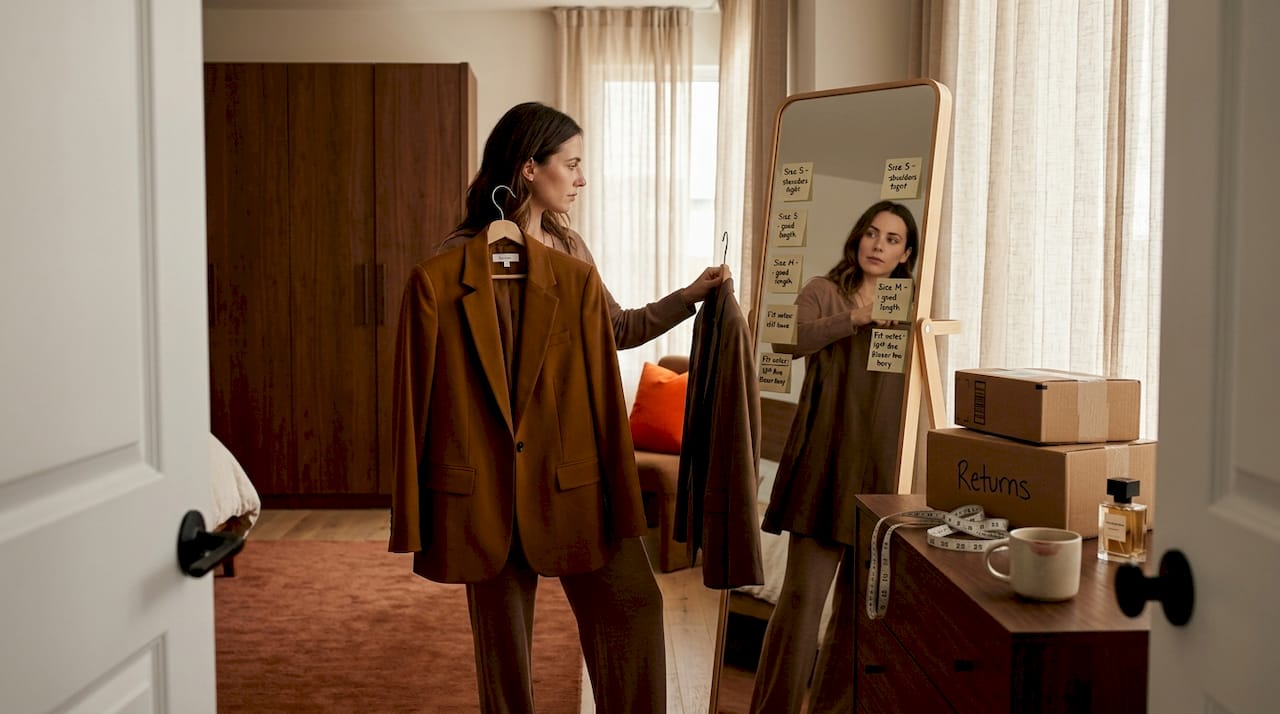
The frustration is real and it is widespread. A size 22 from one retailer bears no resemblance to a size 22 from another. This is not an exaggeration. It reflects the reality that each brand uses its own fit model, its own grading system, and its own set of aesthetic priorities, none of which are standardised across the industry.
This inconsistency has cascading effects on shoppers:
- Increased returns: When fit is unpredictable, shoppers order multiple sizes or return items more frequently, adding frustration and cost to the experience
- Lower confidence: Repeatedly finding that a size “doesn’t fit” when the issue is the garment’s construction can damage how women perceive their own bodies rather than the clothing
- Decision fatigue: Navigating size charts, reading dozens of reviews, and second-guessing purchases takes time and mental energy that shouldn’t be necessary
- Financial waste: Buying, returning, or keeping ill-fitting items that go unworn represents a real financial cost to shoppers
Here is a snapshot of how fit reliability tends to vary depending on the approach a brand takes:
| Brand approach | Fit consistency | Return rate tendency | Shopper satisfaction |
|---|---|---|---|
| Single pattern scaled up | Low | Higher | Often frustrating |
| Extended range, no fit testing | Moderate at small sizes only | Moderate to high | Mixed |
| Multi-block inclusive approach | High across all sizes | Lower | Generally positive |
| Community-tested fit validation | Highest | Lowest | Strongly positive |
Understanding how inclusive sizing empowers confidence goes beyond fashion theory. When clothing fits reliably, women spend less mental energy second-guessing themselves and more time expressing their personal style, taking risks with colour and silhouette, and enjoying the experience of getting dressed.
Style is not a reward for reaching a certain size. It is available right now, in garments built for your actual body.
How inclusive sizing looks on the runway and in real life
If you have ever watched a runway show and felt like the clothes had nothing to do with your wardrobe, there is data to explain exactly why. The gap between the runway ideal and the real-world shopper is still significant, even in 2026.
In Fall/Winter 2026, 97.6% of runway looks were straight-size (US 0-4), with only 2.1% being mid-size (US 6-12) and a mere 0.3% plus-size (US 14+). These numbers are striking not because the runway has never been diverse, but because despite years of industry conversation about representation, the numbers have barely moved.
“What we see on the runway shapes what buyers order, what stores stock, and ultimately what is available to shoppers. When 97% of runway looks represent less than 20% of the population, the disconnect is not subtle.”
What does this mean for you as a style-conscious shopper? A few things worth knowing:
- Trend interpretation is still filtered through a narrow lens. When the hottest seasonal silhouettes are shown exclusively on one body type, it can be harder to visualise how those trends translate to a broader range of bodies
- Demand for visible representation is growing. Shoppers who want trend-driven looks in sizes beyond straight-size are increasingly vocal and influential in driving brand decisions
- Independent and boutique labels are often leading the way. Smaller, more nimble brands are more frequently investing in genuine inclusive design precisely because their customer base demands it
- Shopping curated collections for style can be a smarter strategy than chasing runway trends directly. Curated retailers that test and select pieces with broader appeal save you the work of filtering out what simply won’t translate
The runway gap matters, but it does not have to define your wardrobe. Knowing what is actually happening in the industry helps you become a smarter, more discerning shopper.
How to shop for inclusive sizing: tips for finding your best look
Knowing the difference between genuine inclusion and marketing language gives you a real advantage. Here is how to put it into practice every time you shop.
Inclusive sizing functions as a methodology across the design-to-production pipeline, starting from body diversity, building proportional grading, and validating fit across sizes. When you know to look for that process, evaluating brands becomes much more straightforward.
Follow these steps when evaluating any retailer:
- Read the size guide carefully. A genuine inclusive sizing chart will include body measurements (bust, waist, hips, torso length) not just garment sizes or generic S/M/L designations.
- Look at the model and product photography. Are multiple body types represented? Is the same garment shown on different frame sizes so you can see how it drapes and fits in comparison?
- Search reviews by size, not just by star rating. Most platforms allow filtering by size purchased. Seek out reviewers who share your proportions.
- Check the brand’s returns policy. A brand confident in its fit typically offers straightforward returns or exchanges. Restrictive return policies can signal that fit issues are common.
- Look for transparency about construction. Brands that genuinely invest in inclusive design often talk openly about their process, fit sessions, or the adjustments made for different size ranges.
- Ask questions directly. Most reputable brands and boutiques have customer service teams who can answer detailed fit questions before you commit to a purchase.
Pro Tip: Take your own measurements once and record them somewhere accessible, such as a notes app on your phone. When shopping online, compare your measurements directly to the garment’s measurement chart rather than guessing based on the size label. This single habit can drastically reduce the likelihood of a poorly fitting purchase.
Staying on top of seasonal trends decoded is far more satisfying when you already know how to find pieces that will actually fit your body correctly, not just look good on a hanger.
The uncomfortable truth about inclusive sizing in fashion
Here is what most conversations about inclusive sizing avoid saying directly: the majority of brands using the term are doing so for marketing advantage, not because they have overhauled their design processes.
Meaningful inclusive sizing requires money, time, and a willingness to rethink how a garment is made from the ground up. That is genuinely hard work. It requires additional fit models, additional pattern iterations, and a commitment to testing that adds cost to production. Most brands, particularly at the fast-fashion end of the market, are not willing to absorb those costs. Instead, they extend their size charts, update their marketing language, and call it a day.
The damage this does is not just practical. When women invest in pieces labelled as inclusive and find the fit just as frustrating as anything else, it reinforces the false idea that the problem is their body rather than the garment. That narrative needs to end.
What we believe, and what drives how we approach curation, is that body positivity and inclusivity in fashion must be grounded in genuine design decisions. A brand that truly respects its customers builds those decisions in from the very beginning of the design process, not as a label applied at the end.
Shoppers have more power here than they realise. Choosing where to spend money based on which brands demonstrate genuine fit inclusion, asking pointed questions before purchasing, and being vocal in reviews about fit performance all put pressure on the industry to do better. Inclusive sizing done properly should be the standard, not a premium feature.
Discover fashion and beauty designed with everyone in mind
You deserve clothing and beauty products that work for your body and your style, not the other way around. At 16th Avenue, we curate pieces with real-world wearability in mind, from structured outerwear to everyday beauty essentials.
If you are looking to invest in a season-ready piece that combines structure and style, our women’s trendy woolen coat is a standout option for autumn and winter. And because great style is head-to-toe, our 24-piece professional makeup brush set gives you the tools to complete any look with confidence. Browse our full collection and discover fashion and beauty choices where inclusivity is a real commitment, not a buzzword. Free shipping is available to most destinations.
Frequently asked questions
Is inclusive sizing just plus-size clothing?
No, inclusive sizing means designing for the full spectrum of body types. It covers broader body ranges with proportional adjustments throughout, not simply adding larger numbers to a chart.
Why are clothing sizes so different between brands?
Each retailer uses their own fit models and grading systems, which leads to major variation. As the research shows, a size 22 from one retailer can bear no resemblance to a size 22 from another.
How can I tell if a brand is truly inclusive with sizing?
Look for evidence of real design work, because genuine inclusion requires pattern development, fit testing across multiple body types, and construction changes, not just a wider range of size labels.
Are beauty products included in inclusive sizing trends?
Yes, the inclusivity conversation extends into beauty. Brands are expanding shade ranges, developing formulas for diverse skin types, and designing tools that work across a wider variety of features and preferences.