


Role of clay masks: evidence-based benefits and use
Clay masks work by pulling surface oil off your skin and drying down into a stiff film, which makes shine and pore texture look better for a few hours to a day. That’s the whole trick. There’s no toxin extraction and no rebuilding of collagen happening under there, whatever the packaging implies.
- Oily or combination skin sees the biggest short-term payoff: less shine, a smoother finish under makeup, temporarily tighter-looking pores.
- Occasional use for texture or a pre-event glow works well for most skin types when the formulation is gentle.
- Very dry skin, rosacea, or active dermatitis should approach clay masks cautiously, or skip strong clays entirely, since drying and irritation risk is real.
The practical verdict: once or twice weekly is plenty for most people, and the moment a mask feels tight to the point of cracking, it’s time to wash it off.
Key Takeaways
Clay masks deliver reliable, short-term oil absorption and shine reduction, but no clinical evidence supports claims of detoxification or lasting sebum control.
| Point | Details |
|---|---|
| Short-term oil control works | Clay masks reduce surface sebum for a few hours, with effects rebounding after removal. |
| No “detox” mechanism exists | Tightening comes from surface dehydration, not extraction of internal toxins. |
| Match clay to skin type | Bentonite suits oily skin; kaolin suits dry or sensitive skin. |
| Frequency should stay moderate | One to two uses weekly prevents barrier damage for most skin types. |
| 16thavenue supports the full routine | Complementary moisturizers and gentle skincare picks help offset post-mask dryness. |
Table of Contents
- What are the proven benefits of clay masks for skin?
- How do clay masks actually work on skin?
- Which clay type suits your skin best?
- How should you apply a clay mask for best results?
- What does the research actually show, and where are the gaps?
- What side effects and precautions should you know?
- How do you choose the right clay mask?
- What conventional skincare advice gets wrong about clay masks
- Round out your routine with 16thavenue
- Frequently asked questions about clay masks
- Sources
What are the proven benefits of clay masks for skin?
Clay’s best-documented job is oil control. Applied to oily or combination skin, it visibly reduces shine, smooths the look of enlarged pores, and leaves a matte, refreshed texture immediately after rinsing. That’s the effect people actually notice in the mirror, and it’s the one backed by real measurement rather than marketing copy.
Some other claims are more preliminary. Laboratory and small clinical studies point to anti-inflammatory, photoprotective, and even wound-healing potential in certain clay minerals, but researchers studying bentonites and montmorillonites are clear that larger randomized trials are needed before those effects can be called established. Claims about scalp health or long-term sebum regulation from clay-based hair treatments sit even further out on the anecdotal end. Some worthwhile signal, not much proof yet.
Clinical callout: In a controlled in-vivo trial, clay-based formulations significantly reduced superficial sebum immediately after a two-hour application. The effect didn’t last.
That rebound matters more than most product descriptions let on:
- Oil reduction is real, but it’s a snapshot, not a fix.
- The tightening sensation people equate with “deep cleansing” is mostly surface dehydration, a mechanical effect, not evidence of pores being purged.
- Effects appear concentration-dependent, meaning a thicker or higher-clay-content formula acts more strongly, for better and worse.
So the honest way to describe clay masks: a genuinely useful, short-acting oil-control tool, layered with some promising but unproven extras.
How do clay masks actually work on skin?
Two mechanisms do almost all the work here, and they’re not the same thing. Adsorption means oil and debris stick to the surface of clay particles, similar to how a sponge traps crumbs on its outer layer. Absorption means the clay actually draws substances into its structure. Clays like bentonite and montmorillonite do a bit of both, thanks to their porous structure and what’s called cation exchange capacity, a chemical property that lets clay particles bind oils and some charged compounds sitting on your skin, as research on bentonite mineralogy shows.
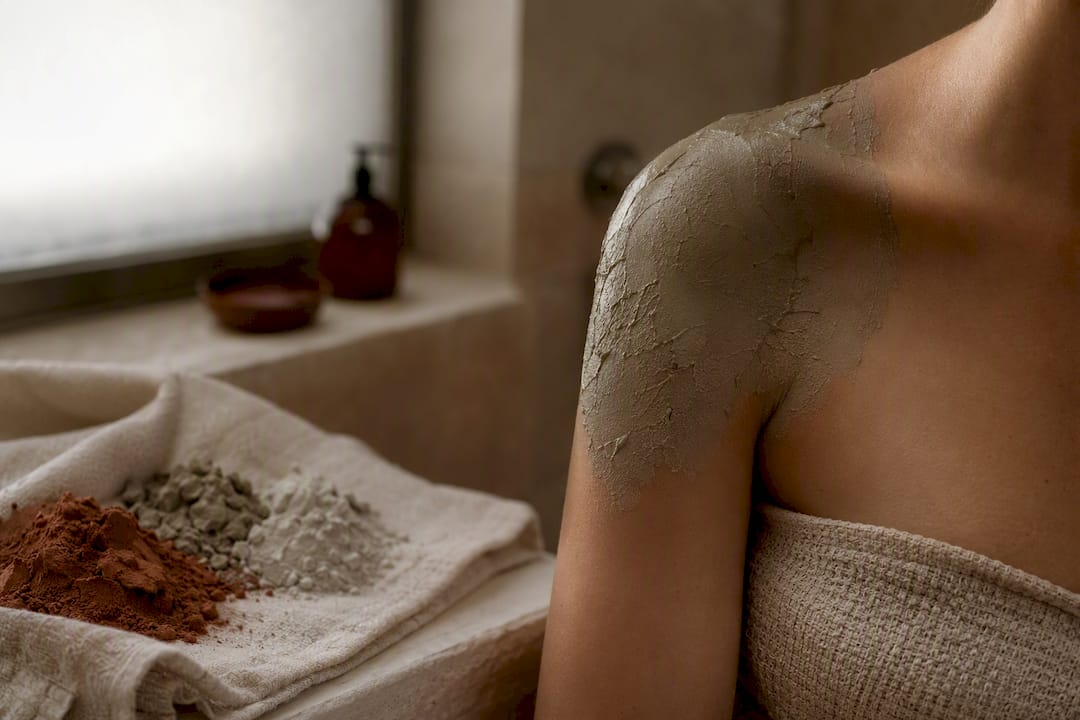
Then there’s film formation. As the wet clay dries, it shrinks and hardens into a thin, rigid layer across your face. That’s what produces the tight, “pulling” feeling, and it’s mechanical dehydration and restricted movement of the skin underneath, not deep extraction of anything.
Performance varies by mineralogy. Particle size, whether the clay is dominated by kaolinite or smectite, and even elemental content like iron oxide change how a clay behaves on skin, according to mineralogical analysis of clay-based formulations. Picture it as layers: your skin surface, a thin film of sebum and debris sitting on top, the clay drying into a crust over that film, and the end result being a temporarily mattified surface, nothing more, nothing less.
Pro Tip: Match contact time to clay strength and your skin’s tolerance. Strong bentonite clays can dry out sensitive skin in under ten minutes, while gentler kaolin formulations tolerate a longer sit. When in doubt, rinse early rather than waiting for a full crack.
Which clay type suits your skin best?
Not all clay is interchangeable, and picking the wrong one is the fastest way to end up with flaky, irritated skin instead of a smooth one.
Bentonite and montmorillonite are the heavy lifters. Both come from volcanic ash and carry strong oil-absorbing and cation-exchange properties, which is why they show up so often in acne-focused and oily-skin formulas. Kaolin is the gentler cousin, lower in absorption power, and generally the safer starting point for dry or sensitive skin. Green clay typically contains smectite, an expandable clay mineral with high sorption capacity, which explains why green clay masks often feel stronger than their marketing suggests. Red clay tends to carry more iron oxide, linked to some photoprotective potential, while black clay samples studied showed smaller particle size and a simpler mineral profile, giving a smoother application feel.
Particle size deserves its own mention. Finer particles spread more evenly and tend to feel less abrasive, a detail dermatology literature on clay composition ties directly to tolerability on facial skin.
| Clay Type | Typical Action | Best For |
|---|---|---|
| Bentonite | Strong oil absorption, high cation exchange | Oily, acne-prone skin |
| Montmorillonite | Strong sorption, potential anti-inflammatory action | Oily skin, occasional breakouts |
| Kaolin | Mild absorption, gentle texture | Dry or sensitive skin |
| Green clay | High sorption via smectite content | Oily to combination skin |
| Red clay | Moderate absorption, higher iron content | Normal to combination skin |
| Black clay | Fine particle size, smoother application | Combination skin, first-time users |
How should you apply a clay mask for best results?
Getting the technique right is what separates “smoother, less shiny skin” from “red, stinging skin.” Follow this order:
- Cleanse first. Apply clay to bare, dry skin so it can act directly on surface oil rather than fighting through leftover product.
- Apply a thin, even layer. Thick globs don’t work better, they just dry unevenly and pull harder on the skin underneath.
- Time it to the clay’s strength. Strong bentonite or green clay formulas: 5 to 10 minutes. Gentler kaolin blends: up to 15 minutes. Never wait until it fully cracks.
- Remove with lukewarm water, using your fingertips in gentle circular motions rather than scrubbing.
- Follow with a moisturizer, and sunscreen if it’s daytime, since freshly cleared surface skin has no oil buffer left.
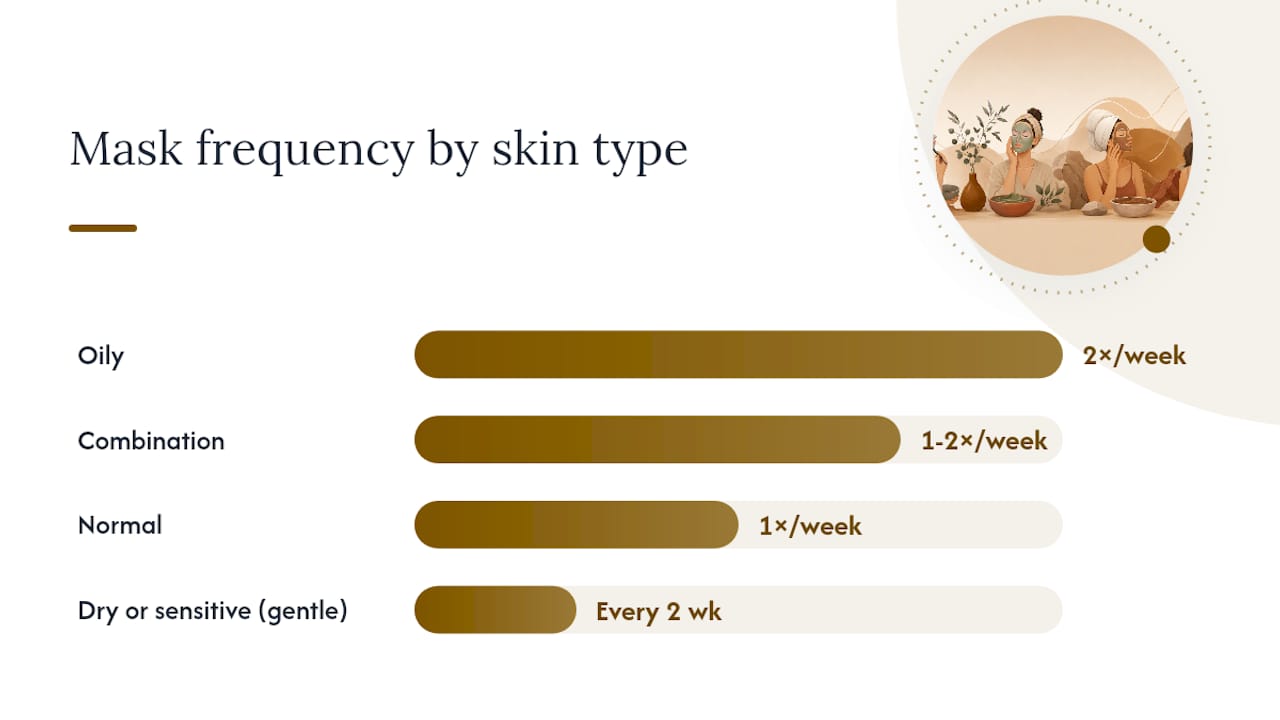
Frequency depends heavily on skin type and what else is in your routine. Consumer health guidance generally recommends one to two applications per week for oily or combination skin, and less often, or a gentler clay, for dry or sensitive types.
Statistic callout: the sebum-reduction effect researchers measured lasted roughly two hours before rebounding, which is the clearest evidence yet that clay masks are a short-term touch-up tool, not a standing fix for oil production.
| Skin Type | Suggested Frequency |
|---|---|
| Oily | Twice weekly |
| Combination | Once to twice weekly |
| Normal | Once weekly |
| Dry or sensitive | Every other week, gentler clay only |
Skip clay masks on the same day as strong exfoliants or retinoids. Stacking two drying or barrier-thinning steps in one day is how mild tightness turns into cracked, irritated skin.
What does the research actually show, and where are the gaps?
The clearest finding in the clinical literature is narrow but real: clay-based formulations produce a measurable drop in surface sebum shortly after application, with the effect scaling by clay concentration. What the same research does not show is anything close to lasting oil control.
By the four-hour mark, that oil-reduction advantage over control formulations had disappeared, and cutometry testing (a standard measure of skin firmness and elasticity) showed no detectable change from one application. Reviews of bentonite and montmorillonite report additional potential, anti-inflammatory action, photoprotective signals, in vitro and small-scale clinical work, but the authors themselves call for larger randomized trials before those findings graduate to firm recommendations.
A few limitations are worth knowing before you read any clay mask claim at face value. Consumer application times run shorter than lab conditions. Formulations vary wildly between brands. Placebo formulas containing plain polymers have shown mild sebum-emulsifying effects on their own, which muddies how much credit the clay itself deserves. And mineral testing has flagged variable trace heavy-metal content across clay sources, underscoring why product testing standards matter.
What side effects and precautions should you know?
Even gentle clays can cause problems if used wrong or on the wrong skin.
- Dryness and tightness are the most common complaints, especially with bentonite or green clay left on too long.
- Flaking and redness often show up on skin that’s already compromised, think eczema, rosacea, or a damaged moisture barrier.
- Stinging during application usually signals the barrier is too fragile for that clay’s strength right now.
- People using retinoids or exfoliating acids face a higher irritation risk when clay masks are added to the same routine, since both strip surface lipids.
Stop and see a clinician if you notice severe burning, blistering, or a rash that spreads beyond the mask area. For anyone managing sensitive or reactive skin day to day, it’s worth reading up on calming and barrier-supporting routines before adding clay into the mix at all.
How do you choose the right clay mask?
Start with the ingredient list, not the front-of-box claims. Look for the clay type named specifically, bentonite, kaolin, montmorillonite, smectite, rather than a vague “clay complex.” Check whether the formula includes strong actives like AHAs, BHAs, alcohol, or added fragrance, since those compound the drying effect.
Favour formulas with hydrating additives (glycerin, aloe) if your skin leans dry, and go fragrance-free if you’re sensitivity-prone. A few practical habits go a long way here:
- Patch-test on your inner arm 24 hours before a first full-face application.
- Start with the shortest recommended leave-on time and extend gradually.
- Choose gentler kaolin-based formulas first if your barrier feels compromised.
- Check for testing statements on heavy metals where a brand publishes them.
What conventional skincare advice gets wrong about clay masks
The biggest disconnect between clay mask marketing and actual research is the word “detox.” Skin doesn’t store toxins that a mask pulls out, and the tight, pulling sensation people treat as proof of deep cleansing is just dehydration. That single myth drives most of the overuse problems dermatology clinics see, people leaving masks on too long, using strong bentonite daily, or expecting a texture-fixing miracle from one application.
What actually matters is much simpler and less exciting: match the clay to your skin type, respect contact time, and treat this as a weekly maintenance step, not a treatment. The research on sebum rebound makes the ceiling here obvious. If you have oily skin and want visibly less shine for a day, a clay mask earns its place. If you’re expecting it to shrink pores permanently or replace a dermatologist’s acne plan, you’re asking a cosmetic tool to do clinical work. Prioritize the clay type first, the formulation second, and keep expectations sized to what a rinse-off mask can realistically deliver.
Round out your routine with 16thavenue
A clay mask only does its job well when the rest of your skincare lineup backs it up, gentle cleansers before, real moisturizer and sunscreen after. 16thavenue carries the beauty essentials that make that routine actually work, without needing to piece it together across five different stores. Whether you’re stocking up for a seasonal skin refresh or building your first proper routine around a weekly clay mask night, the curated beauty and skincare picks at 16thavenue are built for exactly this kind of layering.

Beyond skincare, 16thavenue’s seasonal collections mean you can shop your face routine and your wardrobe refresh in one place, including pieces like the women’s trendy autumn and winter woolen coat for the colder months ahead. Browse the current beauty lineup at 16thavenue and add a few gentle, barrier-friendly staples to your cart today.
Frequently asked questions about clay masks
Are clay masks effective for acne-prone skin? Clay masks can reduce surface oil and shine, which helps acne-prone skin look less congested short-term, but they don’t treat the underlying causes of acne and shouldn’t replace a dermatologist-guided treatment plan.
What is the best clay mask for acne? Bentonite and montmorillonite tend to perform best for acne-prone or very oily skin because of their strong oil-absorbing and cation-exchange properties, though patch testing first is always worth doing.
How often should you use a clay mask? Most people with oily or combination skin do well with one to two applications a week. Dry or sensitive skin should stretch that out further and choose a gentler clay like kaolin.
Do clay masks actually detox the skin? No. Clay masks absorb surface oil and debris; they don’t remove toxins from the body, and the tight feeling they leave behind is dehydration, not detoxification.
Can clay masks dry out sensitive skin? Yes, especially stronger clays like bentonite or green clay left on too long. Sensitive or barrier-compromised skin should stick to kaolin, shorten contact time, and follow immediately with a rich moisturizer.
This article is general information, not a substitute for advice from a qualified doctor. Consult a qualified healthcare professional about your own circumstances before acting on anything here.
Sources
- Clay-Based Cosmetic Formulations: Mineralogical Properties and Short-Term Effects on Sebum Regulation and Skin Biomechanics
- The potential cutaneous benefits of bentonites and montmorillonites
- The potential cutaneous benefits of bentonites and montmorillonites
- Relevant dermatology literature (PMC article)