


Co-ords in your wardrobe: versatile multipliers for women
TL;DR:
- Co-ords are wardrobe multipliers that offer versatile, coordinated outfits with high cost-per-wear value. They save time, reduce decision fatigue, and can be styled for casual, office, or evening occasions. Well-chosen sets in quality fabrics last longer and provide deliberate, intentional style choices.
Co-ords are wardrobe multipliers. A single matching set delivers an instant, considered outfit and, when you separate the pieces, generates several distinct looks from one purchase. That cost-per-wear value, combined with the daily relief of skipping the “what goes with what” decision, is exactly why co-ord sets have moved from trend to staple.
Here is what owning the right co-ords actually gives you:
- Instant polish with zero effort: top and bottom are already designed to work together.
- Mix-and-match potential: each piece pairs with existing separates, multiplying your outfit count without adding closet bulk.
- Capsule-wardrobe efficiency: one set covers casual, office, and evening occasions depending on how you style it.
- Higher cost-per-wear: the more outfits a piece generates, the lower its effective cost per use.
The sections below cover every practical angle: which types to buy, how to style them by occasion, which fabrics last, and how to avoid the common mistakes that make co-ords read as lazy rather than intentional.
Table of Contents
- What exactly is a co-ord set?
- Why co-ords belong in a modern wardrobe
- What types of co-ords suit different lifestyles?
- How to style co-ords for every occasion
- How to multiply outfits by mixing co-ord pieces
- Why fit matters more than the price tag
- Which fabrics last and how to care for them
- Research-backed reasons stylists treat co-ords as investments
- Are co-ords still in style for 2026?
- Key takeaways
- A considered take on co-ords
- 16thavenue: co-ords curated for real wardrobes
- Further reading and sources
What exactly is a co-ord set?
A co-ord set, short for co-ordinated set, is two or more garments designed from the same fabric, print, or colour story so they read as a deliberate outfit when worn together. The industry term is “co-ord” or “matching set,” though retailers also label them “twin sets,” “two-piece sets,” or simply “separates” — the naming is inconsistent, so always check whether the pieces are sold together or individually.
The most common formats you will encounter are:
- Top and trouser sets: the broadest category, ranging from casual linen to tailored suiting.
- Top and skirt sets: midi and mini lengths dominate, often in printed or tonal fabrics.
- Knit and lounge sets: matching ribbed or jersey pieces, typically for home or casual wear.
- Suit-inspired co-ords: blazer plus matching trousers or a skirt, cut in suiting fabrics.
- Three-piece sets: a top, bottom, and a co-ordinating outer layer such as a cardigan or blazer.
- Athleisure co-ords: matching leggings and sports bras or hoodies in technical or printed fabrics.
Some retailers sell each piece separately at a matched price point, which lets you size the top and bottom independently. That flexibility matters more than most buyers realise before they try on their first set.
Why co-ords belong in a modern wardrobe
The practical case for co-ords comes down to three things: they save time, they stretch your wardrobe further, and they look more considered than most people expect from a single purchase.
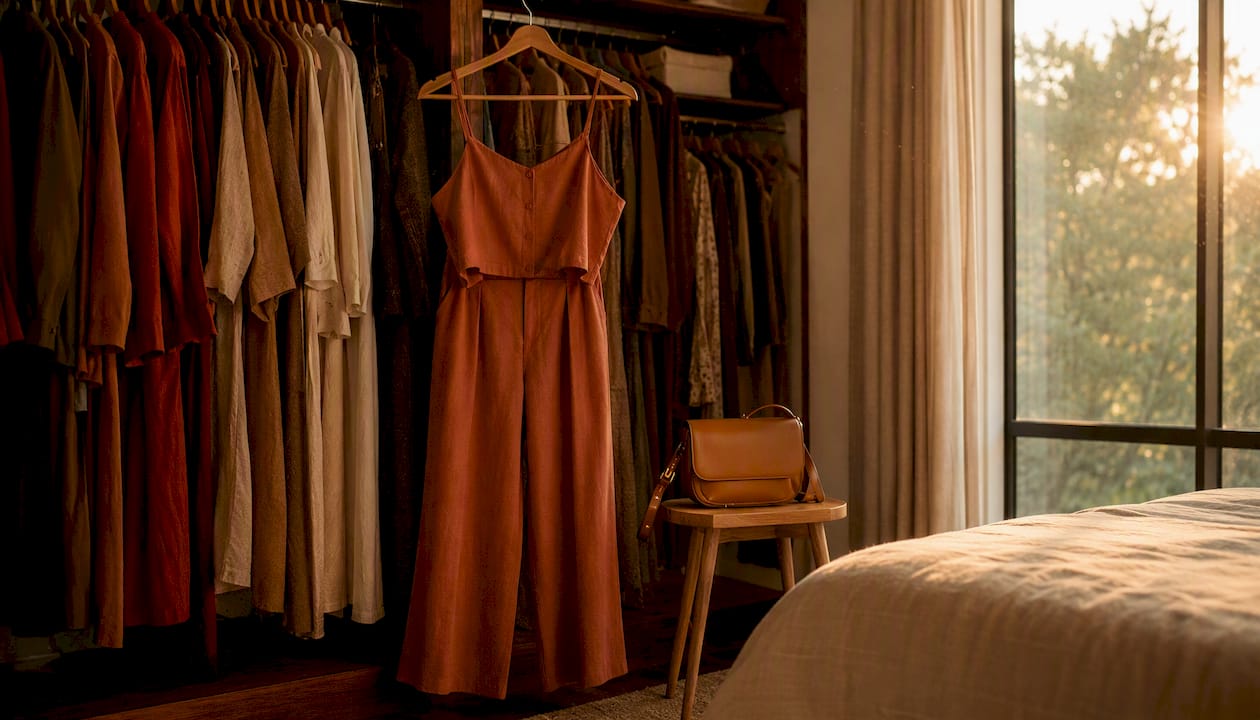
Stylists consistently cite decision-fatigue reduction as the primary driver of co-ord popularity. When the outfit is pre-solved, you eliminate one of the most energy-draining micro-decisions of the morning. The result is not just convenience; it is a more confident, polished appearance because you are not second-guessing the combination.
From a cost-per-wear perspective, industry analysis frames co-ords as high-value purchases precisely because each set can function as multiple distinct outfits when you mix the pieces with existing wardrobe items. A $120 co-ord worn as a set, then as a top with jeans, then as trousers with a blouse, effectively costs $24–$40 per outfit. That maths changes how you think about the initial price tag.
Co-ords also travel exceptionally well. Two pieces pack flat, coordinate automatically, and cover multiple occasions in a single trip. For anyone building a capsule wardrobe, a well-chosen co-ord is one of the most efficient additions you can make.
Pro Tip: When choosing a co-ord to invest in, prioritise fabric weight and structure over print novelty. A set in a refined linen or tailored knit will outlast three trendy printed sets and read more versatile across occasions.
What types of co-ords suit different lifestyles?
Suiting sets
Cut in structured fabrics — wool blends, ponte, or twill — suiting co-ords are the most formal option. A blazer-and-trouser set reads boardroom-ready as a pair and separates into a blazer over a dress or trousers with a silk blouse. Designers have moved co-ords firmly into elevated everyday dressing by using suiting fabrics that hold their shape through a full workday.
Skirt and top sets
These range from casual cotton to occasion-ready satin. A midi skirt co-ord in a neutral tone works for brunch, a work presentation, or a dinner depending on the shoe. Printed versions photograph well and support the tonal, monochrome aesthetic that reads polished on social platforms.
Trouser and top sets
The most versatile category. Wide-leg trouser sets in linen or crepe cover summer casual to smart-casual events. Straight-leg versions in a heavier fabric move easily from office to evening. Body shapes that prefer a longer line tend to favour this format because the unbroken vertical reads as elongating.

Knit and lounge sets
Matching ribbed sets are not just for the sofa. A well-cut knit co-ord in a neutral — camel, oatmeal, charcoal — works for weekend errands, casual Fridays, or layered under a coat for a pulled-together winter look. The key is fit: a sloppy knit reads loungewear; a fitted or structured knit reads intentional.
Athleisure co-ords
Printed two-piece athleisure sets, like the Fashion Skinny Athleisure Printed Two Piece Set at 16thavenue, cover gym sessions, active weekends, and casual outings. The printed versions separate well: the top pairs with plain leggings; the leggings work under an oversized tee.
Printed versus solid
Solid co-ords mix more easily with existing separates. Printed sets make a stronger standalone statement but require more thought when separating. A rule of thumb: if the print is bold, treat the set as a unit; if it is tonal or subtle, the pieces separate freely.
How to style co-ords for every occasion
Casual and weekend
Linen trouser co-ords with flat sandals or low-wedge sneakers and a canvas tote. Keep accessories minimal: a single gold chain or a woven bag is enough. The set does the work.
Office and smart-casual
A suiting co-ord with a fitted blouse underneath, block-heeled mules, and a structured bag. Alternatively, a knit set with tailored trousers swapped in for the matching bottom if the original is too casual for your workplace.
Evening and events
A satin or crepe skirt co-ord with strappy heels and statement earrings. Swap the matching top for a silk cami if the original top reads too casual. The skirt carries the occasion; the top is interchangeable.
Travel and weekenders
A solid-colour trouser set in a wrinkle-resistant fabric (ponte or a polyester blend) packs flat and arrives looking pressed. Wear the set on the plane; separate the pieces across three days of outfits.
Seasonal dressing
Summer calls for linen, cotton, or lightweight crepe. Winter co-ords work best in knit, wool blend, or heavier ponte. Layering a wool coat over a knit co-ord is one of the cleanest winter looks you can put together in under two minutes.
Pro Tip: The single fastest way to make one co-ord feel like three outfits is footwear. Sneakers read casual, block heels read office, strappy sandals read evening. Change the shoe; change the occasion.
- Casual: sneakers or flat sandals + canvas tote
- Office: block heels or loafers + structured bag
- Evening: strappy heels + statement earrings
- Travel: white trainers + crossbody bag
How to multiply outfits by mixing co-ord pieces
Co-ords increase capsule wardrobe flexibility because each piece recombines with existing separates, reducing the need for extra purchases. The logic is straightforward: treat the top as a standalone blouse and the bottom as a standalone skirt or trouser.
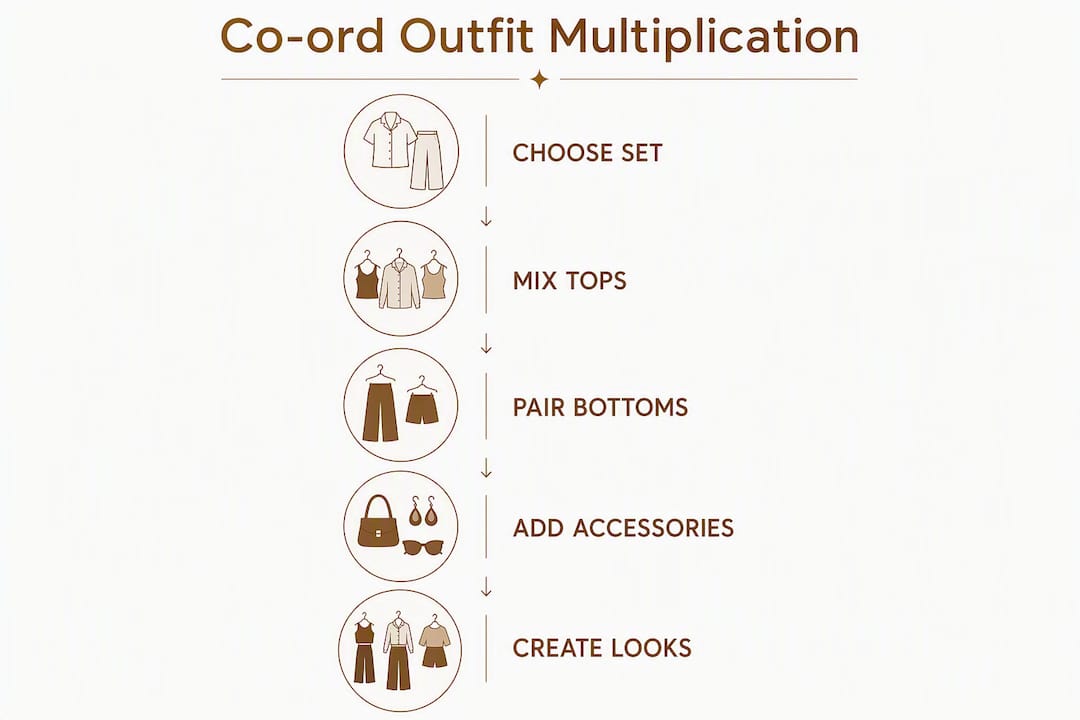
| Co-ord piece | Pairs with | Occasion |
|---|---|---|
| Co-ord blazer | Dark jeans + white tee | Smart-casual weekend |
| Co-ord blazer | Matching trouser (as set) | Office or formal event |
| Co-ord trouser | Silk blouse or fitted knit | Office or dinner |
| Co-ord top/blouse | Midi skirt in a complementary tone | Brunch or casual work |
| Co-ord skirt | Fitted turtleneck or denim jacket | Autumn casual |
| Knit co-ord top | Wide-leg trousers in a neutral | Weekend smart-casual |
Before buying, run this quick checklist to confirm a co-ord will mix well with what you already own:
- Colour depth: does the set’s tone sit in a neutral, or does it clash with your existing palette?
- Pattern scale: a bold print limits mixing; a subtle or tonal print multiplies it.
- Fabric weight: a heavy suiting fabric pairs with other structured pieces; a lightweight linen pairs with casual separates.
Organising your closet by garment weight and length makes mixing far easier. Reserve one zone for double-hang pieces (tops and trousers) and another for long-hang items so co-ord pieces stay visible and accessible.
Why fit matters more than the price tag
Proportion is the difference between a co-ord that looks intentional and one that looks like you grabbed the first thing you found. A cropped top with a high-waist bottom creates waist definition and a clean silhouette. A longline top works best with straight or wide-leg trousers that balance the volume. Avoid pairing a boxy top with a full skirt unless you are deliberately going for an oversized editorial look.
Sizing guidance: if the top and bottom are sold as a fixed set, size to whichever piece is harder to alter. Trousers are easier to take in at the waist than a structured blazer is to let out at the shoulders. When pieces are sold separately, size each independently.
Simple tailoring adjustments can transform a ready-to-wear co-ord into something that looks made for you. A hem shortening, a waist take-in, or a shoulder adjustment costs less than most people assume and adds more perceived value than a more expensive set worn at the wrong fit.
Try-on checklist before buying:
- Shoulders sit at the natural shoulder point, not drooping.
- Waistband sits at your natural waist or hip without gaping.
- Trouser hem grazes the top of your foot or hits your preferred break.
- No pulling across the bust or hips when standing naturally.
Which fabrics last and how to care for them
Fabric choice determines how a co-ord looks after six months of wear, not just on the first day.
| Fabric | Breathability | Drape | Best season | Laundering |
|---|---|---|---|---|
| Linen | Excellent | Relaxed, natural | Spring/Summer | Machine wash cold; air dry; iron while damp |
| Cotton | Good | Casual, soft | Year-round | Machine wash; tumble dry low |
| Silk | Moderate | Fluid, luxurious | Spring/Summer | Hand wash or dry-clean; hang dry |
| Tailored knit | Moderate | Structured | Autumn/Winter | Hand wash cold; lay flat to dry |
| Wool blend | Low | Structured, warm | Autumn/Winter | Dry-clean or hand wash cold; lay flat |
| Polyester blend | Low | Smooth, wrinkle-resistant | Year-round | Machine wash; tumble dry low |
Care habits that protect your investment:
- Store knit co-ords folded, never hung, to prevent stretching.
- Steam rather than iron silk and delicate fabrics to avoid shine marks.
- De-pill knit sets after every few wears with a fabric shaver.
- Wash co-ords inside-out to protect surface colour and print.
- Dry-clean structured suiting sets at least once per season.
For a deeper look at how fabric properties affect comfort and longevity, the 16thavenue guide on fabrics covers the key differences in plain terms.
Research-backed reasons stylists treat co-ords as investments
The cost-per-wear argument is not just marketing language. If a co-ord generates three to five outfits, the per-outfit cost drops significantly compared with buying three separate pieces to achieve the same variety. Industry commentary frames this as smart shopping: consumers who understand the maths are more willing to pay for better fabric because they see the set as buying multiple outfits at once.
Decision-fatigue research supports the stylist consensus. Reducing the number of daily choices, even small ones like outfit selection, preserves mental energy for higher-stakes decisions. A co-ord removes one step from the dressing process entirely.
When is a co-ord an investment versus a novelty purchase? An investment co-ord is in a neutral or versatile colour, made from a fabric that holds its shape, and cut in a silhouette that works for at least two occasions. A novelty purchase is a bold seasonal print in a synthetic fabric that only works as a set. Both have a place, but only one belongs in a capsule wardrobe.
Are co-ords still in style for 2026?
Yes, and the reasons are structural rather than trend-driven. Monochrome co-ords photograph well and support the quiet-luxury aesthetic that has dominated editorial and social media styling for the past two years. That visual logic does not expire with a season.
The most common criticism is that co-ords look lazy. Fashion experts counter that fabric and fit are the deciding factors: a well-fitted set in a structured fabric communicates intention; a baggy set in a thin synthetic communicates the opposite. Three quick fixes address the lazy-co-ord problem:
- Structured fabric: choose ponte, linen, or a suiting blend over thin jersey or polyester.
- Tailored fit: one small alteration (a hem or waist take-in) changes the entire read of a set.
- Purposeful accessories: a polished hairstyle and one deliberate accessory make the set read intentional rather than effortless.
The role of trends in fashion matters here too: co-ords have moved past trend status into a wardrobe category with staying power, much like the blazer or the wrap dress.
Key takeaways
Co-ords are the highest-efficiency wardrobe purchase available to women who want versatility, lower cost-per-wear, and less daily decision-making.
| Point | Details |
|---|---|
| Co-ords multiply outfits | One set generates multiple distinct outfits when pieces are mixed with existing separates. |
| Fabric and fit decide everything | Choose structured fabrics and size carefully; one small alteration changes the entire look. |
| Footwear changes the occasion | Sneakers, block heels, or strappy sandals shift the same co-ord from casual to formal. |
| Capsule wardrobe efficiency | Co-ords reduce the need for extra purchases by functioning as modular, interchangeable pieces. |
| 16thavenue for curated co-ords | 16thavenue’s collections include athleisure, seasonal, and occasion co-ords with free shipping to most destinations. |
A considered take on co-ords
The conventional wisdom says co-ords are a shortcut. I think that framing misses the point entirely. A shortcut implies you are cutting corners; a co-ord, chosen well, is the opposite. It is a deliberate decision to spend your attention on something other than whether your top matches your trousers.
What most articles on this topic underestimate is the compounding effect. The first time you wear a co-ord as a set, you get one outfit. The second time you wear the top with jeans, you get a second. By the time you have separated the pieces across a month of dressing, you have extracted genuine value from a single purchase in a way that three impulse buys could never match. That is not laziness. That is editing.
The mistake I see most often is buying a co-ord for the print and ignoring the fabric. A bold floral in a thin polyester will look dated in one season and feel uncomfortable in two. A tonal linen set or a tailored knit in a neutral will still be earning its keep three years from now. Buy for the fabric first, the silhouette second, and the print last.
16thavenue: co-ords curated for real wardrobes
16thavenue carries co-ords that are chosen with exactly this kind of wardrobe logic in mind: pieces that work together and apart, in fabrics that hold up across seasons.
The athleisure printed two-piece sets cover active and casual occasions. The seasonal collections include knit and suiting-adjacent options for autumn and winter, and the footwear range, including low-wedge sport sneakers, pairs directly with casual co-ords for a complete look. Free shipping to most destinations means the cost-per-wear calculation starts working in your favour from the first order. Browse the full women’s collection at 16thavenue.ca and filter by set to find co-ords that fit your lifestyle and existing wardrobe.
Further reading and sources
The following sources informed this guide. Each is worth reading for additional depth on the specific angle noted.
- Why co-ord sets are trending in 2026 — Times of India: industry framing on cost-per-wear and the smart-shopping argument for matching sets.
- Matching set outfits 2026: ultimate co-ord style guide — Looqs.me: stylist commentary on decision-fatigue, capsule-wardrobe integration, and occasion styling.
- Are co-ord sets stylish or lazy? — NDTV Shopping: expert rebuttal of the lazy-co-ord criticism, with fit and fabric guidance.
- Why the co-ord set is a classic and versatile fashion staple — The Nod Mag: editorial perspective on quiet luxury, photogenic appeal, and fabric upgrades.
- Master closet organisation: layout and zoning guide — Home Organize Hacks: practical closet zoning advice for storing and accessing co-ord pieces.
- How to mix sustainable pieces into stylish outfits — CITI-ZEN-THEORY: partner guide on integrating sustainable separates and matching pieces into everyday outfits.
- How to build a capsule wardrobe — 16thavenue: practical strategies for building a modular wardrobe where co-ords play a central role.
- How to organise your wardrobe — 16thavenue: storage and organisation tips for keeping co-ord pieces visible and easy to pair.