


Layering in spring: your practical style guide
Layering in spring does three things at once: it keeps you comfortable as temperatures swing significantly during the day, it preserves the shape and intention of your outfit as pieces come off, and it adds visual depth that a single garment simply cannot. The role of layering in spring is equal parts function and fashion.
- Temperature control: thin, breathable layers handle cool mornings and warm afternoons without bulk.
- Outfit integrity: each piece works on its own, so shedding the outer layer reveals a complete look underneath.
- Visual depth: texture and proportion contrasts create dimension that makes an outfit feel considered.
The quickest rule to remember: build around the rule of three — base, mid, outer — and choose every piece to stand alone.
Key takeaways
Spring layering works best as a deliberate system built on the rule of three, breathable fabrics, and pieces that each look complete on their own.
| Point | Details |
|---|---|
| Rule of three | Build every outfit with a fitted base, a relaxed mid, and a structured outer layer. |
| Fabric priorities | Choose merino, cotton, or linen for breathability; reserve technical shells for rain and wind. |
| Interchangeability | Every piece should look complete alone so removing a layer never breaks the outfit. |
| Packability | Thin, compressible layers handle wider temperature swings and fit in any bag. |
| 16thavenue picks | Browse seasonal coats, breathable tops, and sneakers at 16thavenue.ca to build your spring capsule. |
Table of Contents
- Why does layering matter so much in spring?
- Core principles that make spring layering work
- Which fabrics actually perform in spring?
- What are the essential spring layers to own?
- How do you choose the right transitional jacket?
- How do you make layered outfits look intentional?
- Layering for real spring activities
- Spring layering dos, don’ts, and the 3-3-3 idea
- Your spring capsule wardrobe checklist
- What most spring layering advice gets wrong
- Spring layers worth having in your wardrobe
- Sources
Why does layering matter so much in spring?
Canadian spring is genuinely unpredictable. A Monday morning in April can feel like late February, and by Thursday you’re eating lunch outside in a light shirt. That range is exactly why spring layering techniques favour several thin, breathable layers over a single heavy garment. One thick coat solves the morning but ruins the afternoon.
The functional case is straightforward: layers trap and release heat as conditions change, and breathable fabrics manage moisture so you don’t arrive at work damp. But the fashion case is just as strong. A well-built layered outfit has proportion, texture contrast, and colour interest that a single piece rarely achieves. Think of a fitted white tee under a slouchy linen overshirt under a cropped denim jacket. Remove the jacket at the café, and the look still holds. That interchangeability is the whole point.
Scenario-wise, consider the classic Canadian spring commute: you leave home in a trench, peel it off on the subway, and arrive at the office in a knit and a collared shirt that look intentional together. Or a weekend walk where a light vest over a long-sleeve tee handles the wind without overheating you on the uphill. Layering outfits for spring are built for exactly these micro-transitions.
Core principles that make spring layering work
The rule of three is the clearest framework: base layer (closest to skin), mid layer (insulation and texture), outer layer (weather and structure). It works because each layer has a defined job, which prevents the outfit from becoming a pile of clothes.
- Fit hierarchy: start fitted at the base, go relaxed at the mid, and add structure at the outer. A slim tee under a slightly oversized cardigan under a tailored trench reads as intentional. The same tee under a bulky sweater under an oversized coat reads as cold and confused.
- Proportions: length contrasts do the heavy lifting. A cropped jacket over a longer shirt creates a visual break that adds interest. Conversely, a long cardigan over slim trousers balances volume at the top with clean lines below.
- Packability: prioritise thin, warm layers that compress into a bag. A merino base and a compressible vest take up almost no room and handle a 12-degree temperature swing without drama.
Esquire’s spring 2026 layering guide makes a point that stylists repeat constantly: every piece should perform independently. If removing the outer layer wrecks the outfit, the system has failed.
Pro Tip: Swap a bulky mid-layer sweater for a lightweight vest. You get core warmth without sleeve bulk, which means your outer layer sits cleaner and your arms stay free for warmer moments.
Which fabrics actually perform in spring?
Fabric choice determines whether your layers breathe, pack down, and survive a sudden shower. The table below covers the six materials that show up most consistently in spring layering advice.
| Fabric | Breathability | Warmth-to-weight | Packability | Best use |
|---|---|---|---|---|
| Cotton | Good | Low | Moderate | Base layers, casual tees, overshirts |
| Linen | Excellent | Very low | Moderate | Warm-day bases, overshirts in late spring |
| Merino wool | Good | High | Excellent | Base or light mid-layer across all spring temps |
| Lightweight wool | Moderate | High | Good | Mid-layer knits, cardigans |
| Silk | Excellent | Low | Excellent | Dress bases, lightweight blouses |
| Technical shell | Variable | None | Excellent | Outer layer for rain and wind |
Fjällräven’s layering guidance highlights wool’s unusual versatility: thin merino can cool or insulate depending on its weight, which makes it one of the few fabrics that earns a place in both the base and mid-layer slots. A 150g merino tee in April, a 200g merino crew in March — same fibre, different job.
For blends, a cotton-linen mix gives you the structure of cotton with linen’s airflow, which is useful for overshirts in May. On care: merino and lightweight wool should be hand-washed or machine-washed on a delicate cycle in cold water and laid flat to dry. Technical shells wipe clean with a damp cloth and need occasional DWR re-treatment to maintain water resistance.
What are the essential spring layers to own?
A capsule wardrobe approach keeps spring layering practical. You don’t need twenty pieces; you need the right twelve.
Base layers:
- Fitted white and navy cotton tees (the backbone of every formula)
- One thin merino long-sleeve in a neutral (grey, oatmeal, or black)
- A collared button-down in light cotton or a cotton-linen blend
Mid layers:
- A fine-knit cardigan in a neutral or a muted earth tone
- A lightweight vest (quilted or knit) for core warmth
- An overshirt or “shacket” in chambray or brushed cotton
Outer layers:
- An unlined trench coat (cotton twill, belted)
- A cropped denim jacket
- A lightweight utility jacket or blazer
Accessories:
- A lightweight cotton or modal scarf (doubles as a wrap on cold mornings)
- A cap or wide-brim hat for sunny afternoons
- A compact umbrella that fits in a tote
Three outfit formulas:
- Work commute: merino long-sleeve + fine-knit cardigan + unlined trench + ankle trousers + white sneakers. Remove the trench at the office; the cardigan and merino read as a complete look.
- Weekend brunch: fitted tee + overshirt (worn open) + cropped denim jacket + straight-leg jeans + loafers. Roll the denim jacket sleeves for a deliberate finish.
- Rainy day errand run: cotton tee + quilted vest + technical shell + slim trousers + closed-toe sneakers. The vest handles warmth; the shell handles weather.
For seasonal dresses that integrate into these formulas, layering over a spring dress with a cardigan or denim jacket is one of the fastest ways to extend a single piece across the whole season.
How do you choose the right transitional jacket?
The outer layer is where most spring layering decisions go wrong. People either choose too heavy (a winter puffer that can’t be worn past 10°C) or too light (a paper-thin shell that does nothing against wind). The right transitional jacket sits between those extremes.
Checklist before you buy:
- Lining: unlined or very lightly lined only. A fully lined jacket traps heat and limits the temperature range it works across.
- Shoulder room: try it on over a mid-layer. You need enough room to move without the jacket riding up or pulling across the back.
- Length: a jacket that hits at the hip works with most proportions. Longer coats (mid-thigh) need slimmer layers underneath to avoid bulk.
- Collar and closure: a high collar or a button-through placket blocks wind without needing a scarf. Useful for March and early April.
- Water resistance: coated cotton or a technical shell handles light spring rain. Full waterproofing is overkill unless you’re spending hours outside.
On material trade-offs: cotton twill (the classic trench fabric) is breathable and looks polished but needs re-treating to stay water-resistant. A technical shell is lighter and genuinely waterproof but reads as more casual. Coated cotton splits the difference — structured enough for the office, weather-ready enough for a rainy commute.
How do you make layered outfits look intentional?
The gap between “I’m wearing a lot of clothes” and “that outfit is considered” usually comes down to texture contrast and colour discipline.
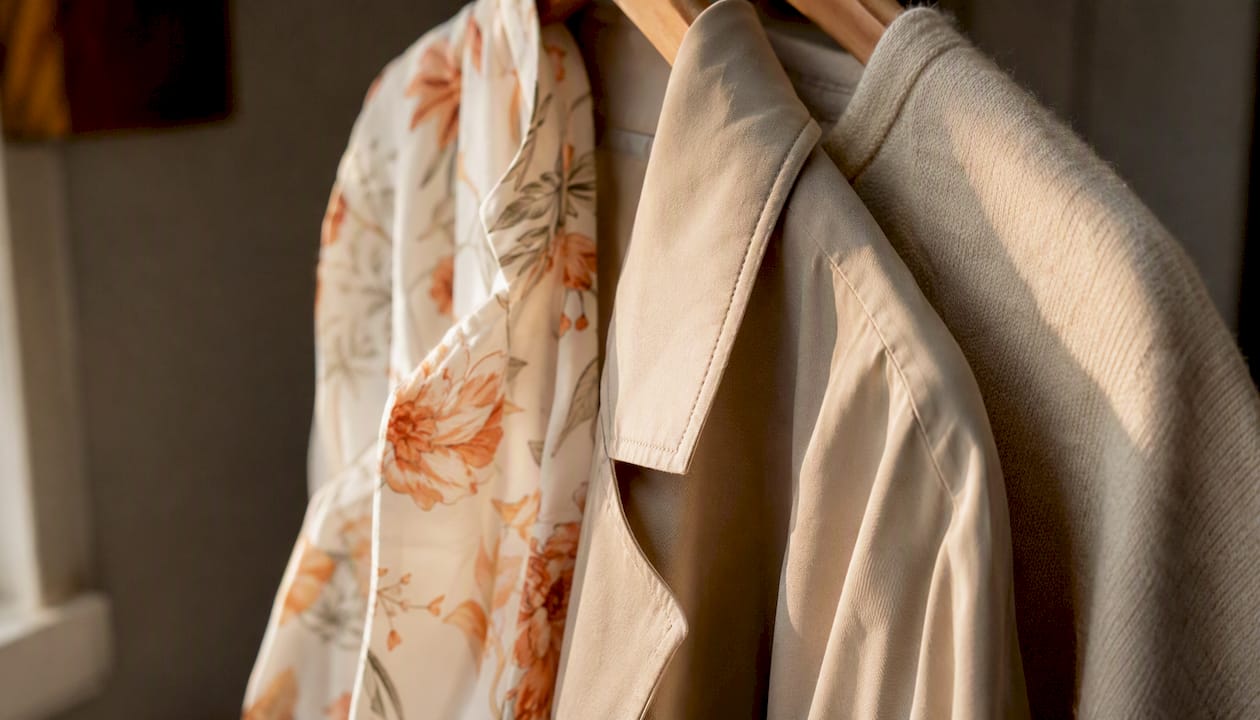
Vogue’s spring 2026 runway coverage shows designers at Prada, Miu Miu, and Bottega Veneta using doubled shirts, vests, and scarves to create texture and colour plays that feel deliberate rather than accidental. The takeaway for everyday wear: pick two or three textures that contrast, not compete. A smooth cotton tee under a slubby linen overshirt under a structured denim jacket works because each surface is different. Three knitwear pieces stacked together just look heavy.
Colour strategies:
- Tonal dressing: build the whole outfit in one colour family (cream, camel, tan) and let texture carry the interest.
- One statement piece: keep the base and outer neutral, then let the mid-layer (a rust cardigan, a cobalt vest) do the work.
- Neutrals as anchors: white, grey, and navy absorb almost any accent colour, which makes them the safest base choices for spring.
On proportions: the half-tuck (tucking the front of a shirt while leaving the back out) creates a deliberate asymmetry that reads as styled. Rolling the sleeves of an outer layer to reveal the mid-layer cuff underneath adds a refinement detail that costs nothing. These small moves are what separate a layered outfit from a bundled one.
Layering for real spring activities
Commute: a breathable cotton or merino base, a thin mid (cardigan or overshirt), and a packable trench or light puffer. Carry a compact umbrella. The key is that the mid-layer looks complete when you arrive and peel off the outer.
Rainy and muddy days:
- Water-resistant outer (coated cotton or technical shell)
- Quick-dry mid (synthetic fleece or a tightly woven overshirt)
- Closed-toe shoes with some grip; avoid suede entirely
Active outdoor days: Outside Online’s spring layering guide is clear on this: moisture-wicking base, a light insulating mid (fleece or thin puffer vest), and a breathable soft-shell outer for wind. Cotton fails here because it holds moisture; merino or a synthetic base is the better call.
Travel and packing: compress everything. A merino tee, a thin knit, and a packable shell take up a fraction of the space of a single wool coat and cover a wider temperature range. Prioritise pieces that don’t wrinkle badly — merino and technical fabrics both recover well from a bag.
Pro Tip: Before a trip, photograph your planned outfit combinations. Three minutes of prep saves twenty minutes of staring at a suitcase in a hotel room.
Spring layering dos, don’ts, and the 3-3-3 idea
Do:
- Use the rule of three (base, mid, outer) as your default starting point
- Keep the base layer fitted so it doesn’t bunch under mid-layers
- Choose breathable fabrics — cotton, linen, merino — at every level
- Match footwear to the outfit’s register (sneakers with casual layers, loafers or ankle boots with tailored ones)
Don’t:
- Stack more than three volumes in the same zone (e.g., a wide tee under a boxy cardigan under an oversized coat)
- Mix more than two or three textures — beyond that, the outfit reads as cluttered
- Ignore accessories; a scarf or hat is a layer too, and it affects the overall proportion
- Treat the outer layer as the only weather tool — the mid-layer is where real temperature management happens
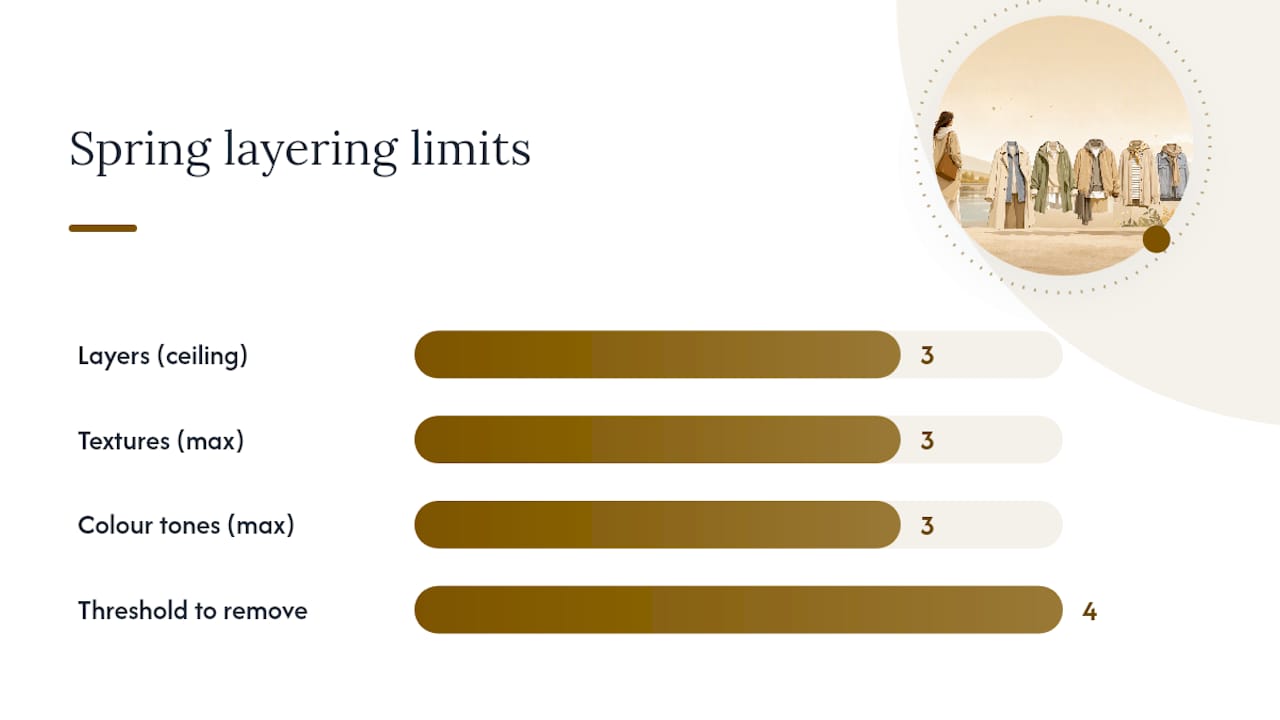
The 3-3-3 idea is a useful shorthand: three layers, three textures, three colour tones. It’s not a rigid rule, but it gives you a mental checklist before you leave the house. If you’re at four of any category, something probably needs to come off or swap out. Break it deliberately when you know why — a monochrome outfit intentionally ignores the colour rule, and that’s a choice, not a mistake.
How many layers are too many? Three is the practical ceiling for most spring days. A fourth layer usually adds bulk without adding warmth or style value. The exception is a very thin scarf or a lightweight vest that compresses flat — those barely register as a layer.
What if removing a layer ruins the outfit? That’s the signal that the mid-layer isn’t working independently. Fix it by choosing a mid that has its own collar, structure, or colour interest — a cardigan with interesting buttons, an overshirt in a contrasting texture — so it reads as a complete piece on its own.
Your spring capsule wardrobe checklist
A capsule wardrobe built for spring layering doesn’t need to be large. Ten to twelve versatile pieces can generate well over a dozen distinct outfits.
The list:
- 2 fitted base tees (white, navy or grey)
- 1 thin merino long-sleeve
- 1 cotton or cotton-linen button-down
- 1 fine-knit cardigan (neutral)
- 1 lightweight vest (quilted or knit)
- 1 overshirt or shacket
- 1 unlined trench or utility jacket
- 1 cropped denim jacket
- 1 lightweight modal or cotton scarf
- 1 cap or wide-brim hat
- 2 footwear options (white sneakers + ankle boots or loafers)
Six of those pieces — the two tees, the merino, the button-down, the cardigan, and the trench — can be combined into at least twelve distinct outfits by varying what goes under what and which accessories come along. That’s the math behind a capsule: fewer decisions, more looks.
On sustainability: buying two well-made merino tops lasts longer and costs less per wear than buying six cheap cotton ones that pill after a season. Choosing seasonal collections thoughtfully means fewer impulse purchases and a wardrobe that actually works together.
What most spring layering advice gets wrong
Spring layering gets treated as a weather problem when it’s really a wardrobe architecture problem. Most guides tell you what to wear; fewer tell you why the system works, which means readers follow the advice once and then improvise badly the next time conditions change.
The runway ideas from Vogue’s spring 2026 coverage are genuinely useful here, not because you should wear Prada’s doubled shirting to the grocery store, but because the underlying logic — each piece working harder, texture doing the job that volume used to do — translates directly. A single interesting mid-layer (a textured knit, a printed overshirt) does more for an outfit than three plain pieces stacked together.
The other thing people underestimate: the base layer is the most important piece in the system, not the outer. If the base is the wrong fit or the wrong fabric, no amount of interesting outerwear fixes it. A fitted merino or cotton tee that sits well on its own is the foundation everything else depends on.
Spring layers worth having in your wardrobe
The pieces that make spring layering work — breathable bases, versatile mid-layers, and a structured outer — are exactly what 16thavenue carries across its seasonal collections. Whether you’re looking for a lightweight women’s coat that handles cool spring mornings with structure, or comfortable sneakers that pair with every layered look from commute to weekend walk, the range is built for exactly this kind of mix-and-match dressing.

Free shipping to most destinations means you can build out your spring capsule without the usual friction. Browse the current collection at 16thavenue and start with the two or three pieces your wardrobe is actually missing.
Sources
- 11 Ways to Master the Art of Layering, Inspired by the Spring 2026 Shows | Vogue
- How to Layer Outfits in Spring 2026—A Guide for Men | Esquire
- Spring layering solves unpredictable weather problems | Rolling Out
- Layer Up: Your Go-To Guide for Transitional Spring Weather | Maria Personal Shopper
- Your guide to layering for spring | Outside Online
- How to layer for spring | Fjällräven