


The role of shopping trends in 2026: a consumer guide
TL;DR:
- Shopping trends now drive more consumer purchases through AI tools and peer recommendations than traditional brand reputation.
- Retailers investing in data, value offerings, and mobile checkout systems outperform those slow to adapt to these shifts.
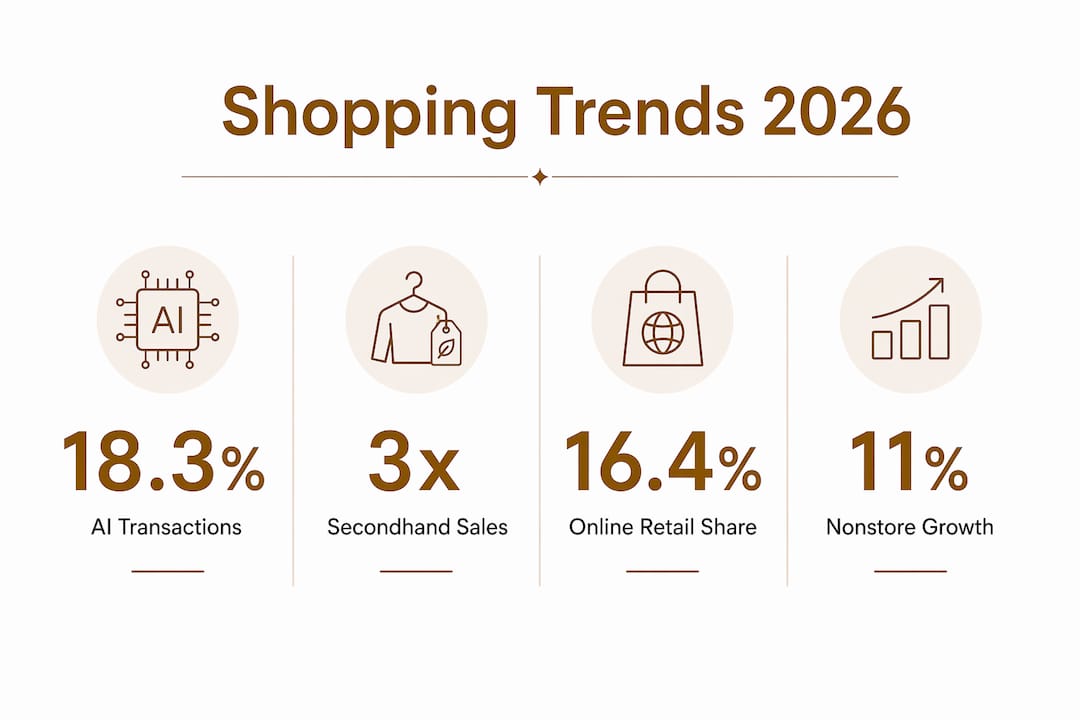
Shopping trends are defined as recurring shifts in consumer purchasing behaviour that signal where demand is moving and why. The role of shopping trends has never been more consequential: AI-influenced transactions jumped from 4.1% of online purchases in Q2 2024 to 18.3% by Q2 2026, a structural change that reshaped how shoppers discover and evaluate products. At the same time, only 21% of consumers now rank brand reputation among their top purchase criteria, while 40% credit peer recommendations as their primary discovery source. These numbers tell a clear story: the forces driving purchase decisions have fundamentally changed, and understanding them gives shoppers a real advantage.
How do shopping trends influence consumer purchasing behaviour?
Shopping trends shape what consumers buy, when they buy it, and how much they are willing to pay. The shift is not subtle. Peer networks and AI tools now outrank brand prestige as trust signals, and that changes everything from product discovery to final checkout.
AI is shortening the path to purchase
93% of consumers aged 18–24 regularly use AI tools for product research. That figure explains why AI search interfaces like Google AI Mode and ChatGPT Shopping are driving higher conversion rates and faster decisions. Shoppers who once spent days comparing options now receive curated shortlists in seconds. Retailers that understand this shift invest in AI-driven product discovery to stay visible in these new search environments.

Conscious consumerism is reshaping demand
Secondhand clothing sales are growing three times faster than traditional retail. That growth reflects a genuine values shift, not just a budget response. Gen Z and Millennials are over four times more likely to rent products than Boomers, at 30% versus 7%. Circular economy models, rental platforms, and resale markets are no longer niche. They are mainstream channels that any trend-aware shopper should factor into their buying decisions.
Value prioritisation over brand prestige
Economic uncertainty is producing a paradox: consumers feel personally healthy but pessimistic about the broader economy. 69% rate their personal health positively, yet 47% view the economic outlook negatively. That tension pushes shoppers toward price competitiveness and practical value. The benefits of trend-conscious shopping become clearest here: shoppers who track trends can time purchases, identify durable styles, and avoid paying a premium for items that will be irrelevant within a season.
Key consumer behaviour shifts in 2026:
- Peer recommendations now outrank brand advertising as a discovery source
- AI tools compress research time from days to minutes for younger shoppers
- Rental and secondhand channels are growing faster than traditional retail
- Price sensitivity is rising even among shoppers who feel financially secure
- Cost-per-wear thinking is replacing impulse-driven purchasing for trend items
Pro Tip: Before buying a trend piece, divide the price by the number of times you realistically expect to wear it. If the cost-per-wear exceeds what you would pay for a coffee, reconsider the purchase.
How are retailers adapting their strategies to shopping trends?
Retailers that translate shopping trends into concrete operational changes are outperforming those that do not. The gap between leaders and laggards is widening, and the separating factor is speed of adaptation.
Data and AI investment as a competitive tool
Retailers investing in customer experience and data infrastructure are outperforming peers in both growth and loyalty metrics. Improving product data quality is not a back-office task. It directly affects whether a product appears in AI-generated search results. Retailers that enrich product descriptions, add structured data, and maintain accurate inventory signals are capturing traffic that others miss entirely.
Value-driven retail is gaining ground
Online retail comprised 16.4% of total U.S. retail sales by mid-2026, with nonstore retailers growing nearly 11% year-over-year. Warehouse clubs, discount chains, and private-label offerings are all gaining share as shoppers prioritise price. Retailers that ignore this shift and rely solely on brand positioning are losing ground to formats that deliver clear, immediate value.
Mobile and payment experience matter more than ever
58% of online purchases complete on mobile devices. A slow or complicated mobile checkout is not a minor inconvenience. It is a direct revenue leak. Retailers are responding by simplifying checkout flows, adding buy-now-pay-later options, and reducing the number of steps between product discovery and payment confirmation.
Retail adaptation priorities in 2026:
- Enriching product data to improve visibility in AI search results
- Expanding discount, warehouse, and private-label offerings for price-sensitive shoppers
- Optimising mobile checkout to reduce abandonment
- Curating wellness-focused product assortments in physical retail
- Investing in delivery speed and inventory positioning as differentiators
Pro Tip: When evaluating an online retailer, check whether their product pages include detailed descriptions, size guides, and multiple images. Retailers that invest in product data quality tend to deliver better post-purchase experiences too.
How does the impact of shopping trends vary across consumer segments?
Shopping trends do not affect all consumers equally. Age, income, geography, and economic confidence all shape how a given trend lands. Retailers that treat their customer base as a single group consistently misread demand.
| Consumer segment | Primary trend driver | Key behaviour |
|---|---|---|
| Gen Z (18–26) | AI tools and peer networks | Uses AI for research; favours rental and resale |
| Millennials (27–42) | Value and conscious consumption | Balances quality with price; active in secondhand markets |
| Boomers (59+) | Brand trust and familiarity | Less likely to rent; slower AI adoption |
| Price-sensitive shoppers | Economic uncertainty | Prioritises discount formats and private labels |
| Wellness-focused shoppers | Health and lifestyle alignment | Seeks product assortments that reflect personal values |
The generational divide in conscious consumerism is particularly striking. Gen Z and Millennials are driving the circular economy’s growth, while Boomers remain anchored to traditional retail formats. This is not simply a preference difference. It reflects fundamentally different relationships with ownership, sustainability, and digital tools. Retailers serving multiple age groups need distinct messaging and channel strategies for each segment.
Economic uncertainty adds another layer of complexity. Shoppers who feel financially squeezed are not abandoning quality. They are redefining value. Peer recommendations and social proof now carry more weight than advertising claims, because they feel more trustworthy when budgets are tight. Understanding this dynamic helps both shoppers and retailers make smarter decisions about where trust is actually built.
What are the practical ways to use shopping trend analysis?
Shopping trend analysis is the practice of tracking pattern shifts across channels to make better buying or selling decisions. For consumers, it means avoiding impulse purchases and building a wardrobe or lifestyle that holds value. For retailers, it means staying ahead of demand rather than reacting to it.
For consumers: shop with a framework
- Conduct a seasonal wardrobe audit. Before buying anything new, assess what you already own. A seasonal wardrobe audit reveals gaps and prevents duplicate purchases driven by trend excitement rather than genuine need.
- Apply the cost-per-wear calculation. Divide the item price by realistic wears. A $200 coat worn 80 times costs $2.50 per wear. A $60 trend top worn twice costs $30 per wear. The cost-per-wear framework makes the better investment obvious.
- Use a cooling-off period. A 48-hour wait between seeing a trend item and purchasing it reduces emotionally driven buys. Most impulse purchases feel less urgent after two days.
- Track cross-channel appearances. A trend that appears on social media, in mid-range retail, and at multiple price points is likely to last. A trend that only appears in one channel is probably a fad. Cross-channel monitoring is the most reliable way to distinguish the two.
- Prioritise peer input over advertising. Given that 40% of consumers now discover products through peer recommendations, actively seeking out honest reviews from people with similar tastes and budgets delivers better results than relying on brand messaging.
For retailers: build systems that respond to trends
Retailers that translate shopping trends into customer experience improvements consistently outperform those that treat trends as a marketing concern only. Practical steps include enriching product data for AI search visibility, testing mobile checkout flows monthly, and monitoring secondhand and rental market growth as a signal of shifting ownership preferences.
Pro Tip: Follow three or four trusted style accounts across different price points. When all of them feature the same item or silhouette within the same month, that is a reliable signal that the trend has real staying power.
Understanding the fashion shopping workflow behind trend adoption also helps consumers make faster, more confident decisions with fewer returns.
Key takeaways
Shopping trends directly determine consumer behaviour and retail strategy, and the consumers who understand this dynamic shop smarter, spend less, and build more durable wardrobes.
| Point | Details |
|---|---|
| AI is reshaping discovery | AI-influenced transactions reached 18.3% of online purchases by Q2 2026, compressing decision times. |
| Peer trust outranks brand reputation | Only 21% of consumers prioritise brand reputation; 40% rely on peer recommendations for product discovery. |
| Conscious consumerism is mainstream | Secondhand sales grow three times faster than traditional retail, driven by Gen Z and Millennials. |
| Value beats prestige in uncertain times | Economic pessimism pushes shoppers toward price competitiveness, discount formats, and private labels. |
| Frameworks reduce impulse buying | Cost-per-wear calculations and cooling-off periods help consumers evaluate trends before committing. |
Why I think most shoppers are still underestimating these shifts
The speed of change in consumer behaviour right now is genuinely surprising, even to those of us who follow retail closely. The jump from 4.1% to 18.3% AI-influenced transactions in two years is not a gradual evolution. It is a structural break. Most shoppers have not caught up to what that means for how they should be researching and buying.
What I find most interesting is the conscious consumerism angle. The growth of rental and secondhand markets is often framed as a sustainability story, and it is. But it is also a financial intelligence story. Shoppers who embrace circular economy models are not just reducing waste. They are getting better value per dollar spent, and they are building more flexible wardrobes in the process.
The uncomfortable truth for retailers is that brand loyalty is no longer something you inherit from a previous generation of customers. You earn it continuously, through product quality, price transparency, and the kind of peer-validated trust that no advertising budget can manufacture. Retailers who understand this are investing in the right places. Those who do not are losing ground quietly, one AI search result at a time.
For shoppers, the practical takeaway is straightforward. The tools and frameworks exist to shop with real intention. Using them is not about being restrictive. It is about getting more from every purchase.
— Glenville
Trend-aligned picks at 16thavenue
16thavenue curates women’s fashion with conscious shopping in mind, which means pieces that earn their place across multiple seasons rather than disappearing after one.
The women’s trendy autumn and winter woolen coat is exactly the kind of investment that performs well under a cost-per-wear calculation. Classic construction, durable fabric, and a silhouette that holds up across seasons make it a clear choice for shoppers prioritising lasting value. For everyday comfort that aligns with the wellness-focused shopping shift, the low wedge sport sneakers offer breathable, non-slip support without sacrificing style. Both pieces reflect the kind of trend-conscious, value-driven buying that 2026 shoppers are actively seeking.
FAQ
What is the role of shopping trends for everyday consumers?
Shopping trends signal where consumer demand is moving, helping shoppers make more informed decisions about what to buy, when to buy it, and how much to spend. Understanding these patterns reduces impulse purchases and improves long-term value from every dollar spent.
How do shopping trends affect sales for retailers?
Retailers that align their product offerings and marketing with prevailing shopping trends consistently outperform those that do not. AI-driven personalisation, mobile checkout optimisation, and value-focused assortments are the three areas with the clearest impact on conversion and loyalty in 2026.
What are the most important emerging shopping trends right now?
The three most significant emerging trends are AI-assisted product discovery, the growth of secondhand and rental markets, and a shift toward value-driven purchasing over brand prestige. All three are accelerating simultaneously and reinforcing each other.
How can I tell if a shopping trend will last?
Track the trend across multiple channels, including social media, mid-range retail, and multiple price points. A trend with broad, sustained cross-channel presence is likely to hold. One that appears only in a single channel or at a single price point is usually a short-lived fad.
Why are peer recommendations replacing brand advertising as a trust signal?
Consumers trust people with similar tastes and budgets more than they trust brand messaging, particularly during periods of economic uncertainty. With 40% of shoppers crediting peer recommendations as their primary discovery source, personal networks now function as the most credible form of product endorsement available.