


Types of beauty masks: your complete skin care guide
Beauty masks fall into six main categories, each built around a specific skin need: sheet, hydrogel, clay and mud, cream and overnight, peel-off, and targeted masks. Knowing which type suits your skin is the fastest way to stop wasting money on masks that feel good but do nothing useful.
The six main types of beauty masks explained
Each category works differently, and the gap between them is not just marketing. Here is a quick breakdown before we go deeper:
- Sheet masks: Thin fibre or cellulose sheets soaked in serum, focused on hydration and brightening.
- Hydrogel masks: Jelly-like two-piece masks that form a second-skin seal, allowing deeper ingredient absorption.
- Clay and mud masks: Powder-based or paste formulas that draw out oil and impurities from pores.
- Cream and overnight masks: Thick, occlusive formulas that repair the skin barrier while you sleep.
- Peel-off masks: Film-forming gels that lift surface debris and dead skin cells when peeled away.
- Targeted masks: Patches and spot treatments designed for specific zones like the under-eye area, chin, or individual blemishes.
Common active ingredients span all six types: hyaluronic acid and collagen for hydration, kaolin and bentonite for cleansing, retinol and vitamin C for anti-ageing, and salicylic acid for blemish control. The right choice always comes down to your skin type and what you are actually trying to fix. You can explore how these fit into a broader routine in this beauty product category guide.
Hydrating and soothing masks: sheet and hydrogel formats
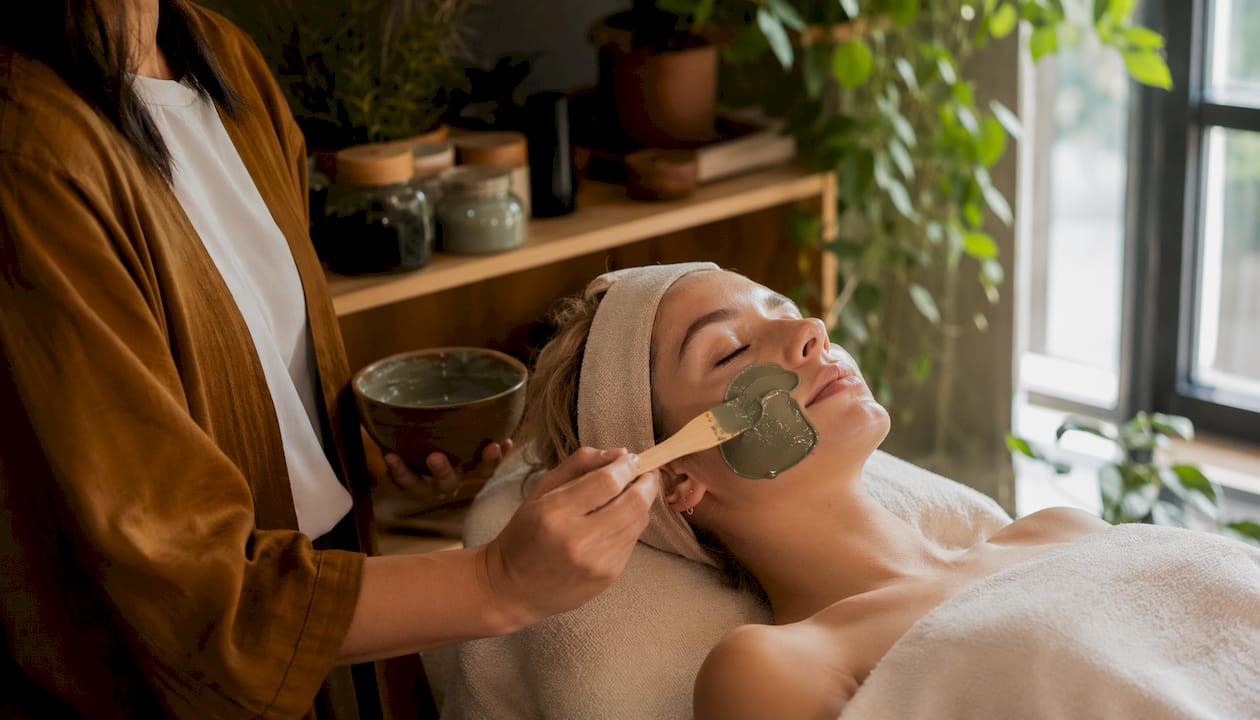
Sheet masks and hydrogel masks are the two formats most associated with K-beauty, and they share a core purpose: flood the skin with moisture fast. The difference lies in how each one delivers that moisture and how long the effect lasts.
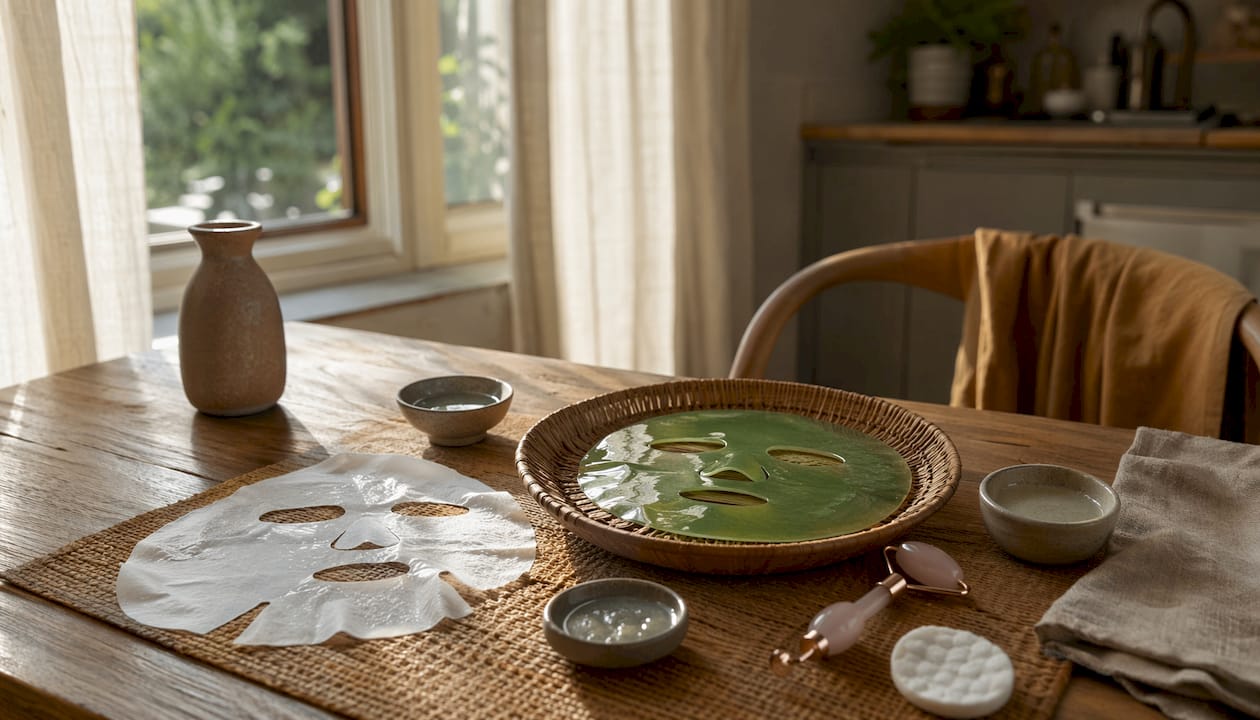
Sheet masks
Sheet masks are single-use fibre or cellulose sheets cut to fit the face, saturated in a serum-like essence. They originated in Korea and became a global staple because they are mess-free and work in about 15–20 minutes. The sheet itself acts as a physical barrier that slows evaporation, which helps the essence absorb rather than simply sitting on the surface.
Key ingredients to look for:
- Hyaluronic acid for deep moisture binding
- Niacinamide for brightening and pore minimising
- Aloe vera for calming redness and irritation
- Collagen for a temporary plumping effect
Sheet masks suit dry, dehydrated, and sensitive skin best. Use them two to three times per week, or daily if the formula is gentle and your skin is very dry.
Hydrogel masks
A hydrogel mask is a two-piece jelly mask that contours closely to the face and holds its essence in place longer than a standard cellulose sheet. The occlusive layer it forms allows ingredients like hyaluronic acid and collagen to penetrate more effectively. Hydrogel masks are a particularly good fit for sensitive or dehydrated skin because the format prioritizes hydration and close skin contact over stronger active ingredients.
Pro Tip: After removing a sheet or hydrogel mask, pat the remaining essence into your skin rather than rinsing. Follow immediately with a moisturiser to seal everything in.
Both formats offer hydrating but short-lived benefits compared to a consistent daily routine, so treat them as a boost rather than a replacement for your regular moisturiser.
Deep-cleansing and clarifying masks: clay, mud, and peel-off
If hydrating masks are about adding, deep-cleansing masks are about removing. They pull excess oil, debris, and dead skin from the surface and pores, which is why they tend to feel tighter and more intense on the skin.
Clay and mud masks
Clay masks have been used in Ayurvedic and traditional medicine for centuries. Modern formulas typically use kaolin, a mild white clay suited to most skin types, or bentonite, a more absorbent clay better suited to oily and acne-prone skin. Both work by binding to sebum and surface impurities, then lifting them away when the mask is rinsed off. Mud masks follow a similar principle but often include mineral-rich ingredients from volcanic or marine sources, adding trace elements alongside the cleansing action.
Charcoal masks
Activated charcoal masks target oily and acne-prone skin by drawing out impurities and excess oil from the pores. Dermatologist Dr. Hadley King notes that clay and charcoal masks can be great for absorbing excess oil and that salicylic acid or fruit enzymes can help with acne and clogged pores. Charcoal formulas are often combined with kaolin or bentonite to amplify the purifying effect.
Peel-off masks
Peel-off masks form a film on the skin that, once dry, peels away cleanly and takes surface debris and some dead skin cells with it. They offer a mild exfoliating effect and can temporarily tighten the appearance of pores. Most skin types can use them, but anyone with sensitive or reactive skin should check the formula carefully. Overuse, more than twice a week, can strip the skin barrier and cause irritation.
Precautions for deep-cleansing masks:
- Limit clay and charcoal masks to once a week for oily skin, and once every two weeks for combination or normal skin.
- Avoid leaving clay masks on until they crack completely dry, as this can dehydrate the skin.
- Do not apply peel-off masks over active breakouts or irritated skin.
- Always follow a deep-cleansing mask with a hydrating moisturiser to restore balance.
Targeted masks for specific skin concerns
Targeted masks work differently from full-face formats. They are designed for a specific zone or concern, applied only where needed, and often left on for a shorter time. Think of them as spot treatments in mask form.
Under-eye masks
Under-eye patches address the most delicate skin on the face. Common concerns they target include puffiness, dark circles, and fine lines. Ingredients like caffeine help constrict blood vessels to reduce puffiness, while peptides and hyaluronic acid plump the thin skin around the eye. Because the under-eye area is sensitive, avoid formulas with retinol or strong acids unless the product is specifically formulated for that zone.
Spot patches
Hydrocolloid spot patches are small adhesive circles placed directly on a blemish. They work by absorbing fluid from the spot overnight, which flattens it and reduces redness. Salicylic acid versions go a step further by actively breaking down the blockage inside the pore. These are one of the most practical targeted treatments available, and they also protect the blemish from being touched.
Exfoliating masks
Exfoliating masks use alpha hydroxy acids (AHAs) like glycolic or lactic acid, or beta hydroxy acids (BHAs) like salicylic acid, to dissolve the bonds between dead skin cells. The result is smoother texture and a brighter complexion. Retinol-based masks work more gradually, stimulating cell turnover over time. Vitamin C masks address uneven tone and dullness. For targeted treatments addressing fine lines or blemishes, specialty skincare devices can complement mask use as part of a broader routine.
Typical ingredients by concern:
- Fine lines and wrinkles: retinol, peptides, hyaluronic acid
- Dark circles and puffiness: caffeine, niacinamide, vitamin K
- Acne and blemishes: salicylic acid, tea tree oil, benzoyl peroxide
- Dullness and uneven tone: vitamin C, glycolic acid, niacinamide
Use targeted masks as needed rather than on a fixed schedule. Exfoliating masks with AHAs or BHAs should not exceed two applications per week to avoid over-exfoliation.
How often should you use each type of mask?
Frequency is where most people go wrong with masks. Using a clay mask every day will dry out even oily skin. Using a hydrating sheet mask once a month will not move the needle on dehydration. Each format has a rhythm that works.
- Sheet masks: Two to three times per week, or daily if the formula is gentle and your skin is very dry.
- Hydrogel masks: Two to three times per week; some formulas are designed for overnight use.
- Clay and charcoal masks: Once a week for oily or blemish-prone skin; once every two weeks for combination skin.
- Cream and overnight masks: Two to three nights per week, or nightly during dry winter months.
- Peel-off masks: Twice a week at most.
- Targeted patches and exfoliating masks: As needed for spots; exfoliating masks no more than twice a week.
Application tips for best results:
- Always apply masks to freshly cleansed skin so there is no barrier between the formula and your skin.
- Use a gentle cleanser first, then tone if that is part of your routine, before applying the mask.
- Follow every mask with a moisturiser, even after a hydrating sheet mask, to lock in the benefits.
- Patch test any new mask on the inside of your wrist or behind the ear before applying it to your full face.
For homemade beauty masks, patch testing is especially important. Apply a small amount, wait 24 hours, and watch for redness or irritation before using the mask on your face. Homemade formulas also require careful attention to pH: maintaining a skin-friendly pH between 5 and 5.5 keeps the formula safe and preserves the effectiveness of any natural preservatives you use.
What dermatologists and skincare experts say about mask effectiveness
The honest picture from dermatologists is more measured than most mask marketing suggests. Masks provide a short-term concentration of actives but are supplemental to the core routine of cleansing, moisturising, and sun protection. They do not replace any of those steps.
The science behind why masks work at all comes down to occlusion. A mask held against the skin for 10–30 minutes forms a barrier that slows evaporation and concentrates active ingredients at the skin surface, improving absorption. Remove the mask too early and you lose much of that benefit. Leave it on too long and the sheet can start to re-absorb moisture from the skin.
Masks offer an intensive supplement to your routine, not a shortcut around it. The real work of healthy skin happens daily, through consistent cleansing, moisturising, and protection from UV. A well-chosen mask amplifies that foundation. Korean-inspired formats, particularly biocellulose and hydrogel, have pushed active ingredient delivery further than traditional sheet materials, but even these work best on skin that is already well cared for. Understanding how your skin’s cellular health functions at a deeper level helps explain why consistency always outperforms any single treatment.
The practical takeaway: pick masks that address a real gap in your routine, use them at the right frequency for their format, and do not expect them to compensate for skipping moisturiser or sunscreen.
Discover more at 16thavenue

16thavenue carries a curated selection of beauty and skincare products alongside its fashion collections, making it easy to build a routine that covers both. Whether you are looking for your next skincare addition or want to refresh your wardrobe, explore the full range at 16thavenue.ca. For a broader look at what is worth adding to your kit this year, the 2026 beauty essentials guide is a good place to start.
Key takeaways
Choosing the right facial mask comes down to matching the format and its active ingredients to your specific skin type and concern.
| Point | Details |
|---|---|
| Six main categories | Sheet, hydrogel, clay/mud, cream/overnight, peel-off, and targeted masks each address distinct skin needs. |
| Frequency matters | Clay masks work best once a week; sheet and hydrogel masks can be used two to three times per week. |
| Masks are supplemental | Dermatologists confirm masks boost but do not replace daily cleansing, moisturising, and sun protection. |
| Occlusion drives absorption | Masks held on for 10–30 minutes form a barrier that concentrates actives and improves ingredient penetration. |
| Patch test first | Apply any new or homemade mask behind the ear and wait 24 hours before using it on your full face. |