


What is closed-loop fashion: a guide for conscious consumers
TL;DR:
- Closed-loop fashion recycles garments into new textiles of the same quality, preventing textile waste. It requires designing for disassembly, advanced recycling technology, and active consumer participation to succeed. Supporting brands with transparent recycling practices and returning worn clothes help close the sustainability gap.
Closed-loop fashion is a regenerative system where garments are designed from the start to be recycled back into new textiles of equal quality, keeping materials in continuous circulation rather than ending up in landfill. The industry term for this is circular fashion, and it represents a fundamental shift away from the linear “take-make-dispose” model that has defined clothing production for decades. The fashion industry generates 92 million tons of textile waste every year, and less than 1% of that is recycled in a true closed-loop process. That gap is exactly why understanding closed-loop sustainable fashion matters now more than ever.
What is closed-loop fashion and how does it differ from linear models?
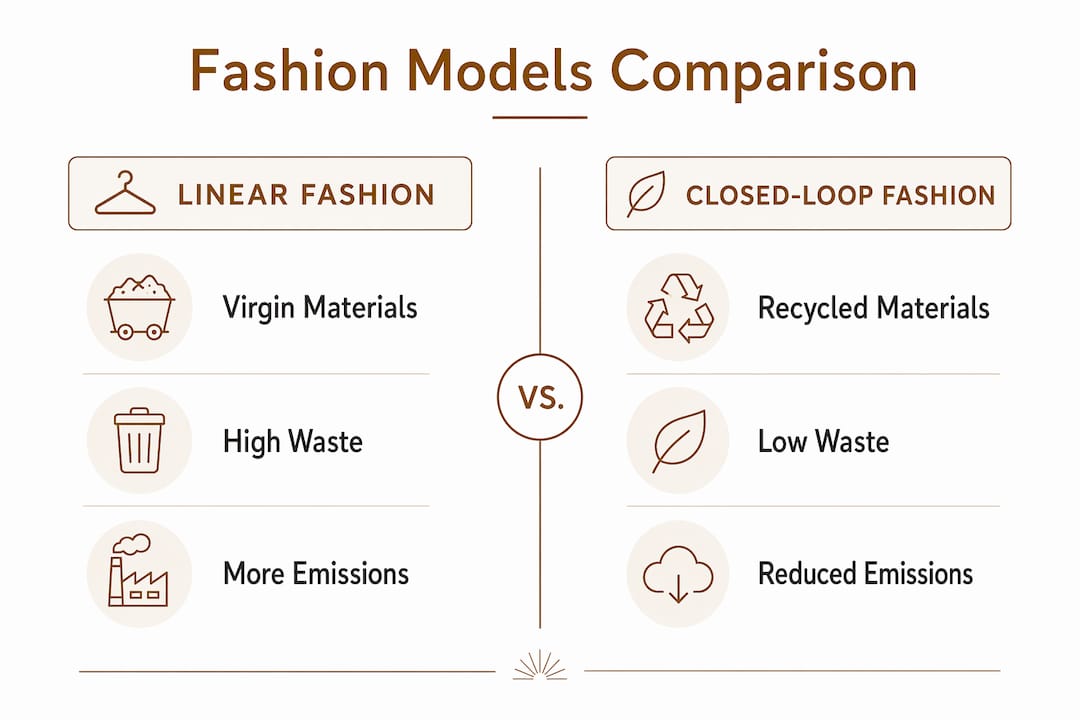
Closed-loop fashion is defined as a system where every garment is designed for disassembly, collected after use, and recycled into fibres that meet the same quality standard as virgin materials. This is fundamentally different from the linear model, which extracts raw resources, manufactures clothing, and discards it after a short use period. The linear model treats textiles as single-use goods. Closed-loop treats them as permanent resources.
Open-loop recycling sits between these two extremes, and it is often confused with true circularity. In open-loop systems, old garments are downcycled into lower-grade products like insulation, industrial rags, or stuffing. The material leaves the fashion system entirely and cannot re-enter it as a garment. Closed-loop recycling, by contrast, maintains material quality for new garments, which is what makes it genuinely regenerative.
The table below shows the core differences between these three models.
| Model | Material source | End-of-life outcome | Sustainability impact |
|---|---|---|---|
| Linear | Virgin raw materials | Landfill or incineration | High waste, high emissions |
| Open-loop recycling | Post-consumer textiles | Downcycled to lower products | Reduces waste but exits fashion system |
| Closed-loop | Recycled textiles | Re-enters fashion as new garments | Lowest waste, preserves material value |
Pro Tip: When a brand claims to be “recycling” your old clothes, ask whether those fibres return as garments or get downcycled into something else. Only the first option qualifies as closed-loop.
The fast fashion model accelerates the linear problem by compressing garment lifecycles to weeks rather than years. Between 10% and 40% of garments produced are never even sold, generating pre-consumer waste before a single customer touches them. Closed-loop systems address both pre-consumer and post-consumer waste by treating every stage of the garment lifecycle as a resource recovery opportunity.
What are the design and technology challenges in closed-loop fashion?
Closed-loop fashion systems begin at the design stage, requiring garments engineered for disassembly and mono-material construction. This is where most brands fall short. The majority of garments on the market today are made from blended fibres, such as a cotton-polyester mix, which current recycling technology cannot effectively separate. A garment that cannot be separated into its component fibres cannot be recycled back into virgin-quality material.
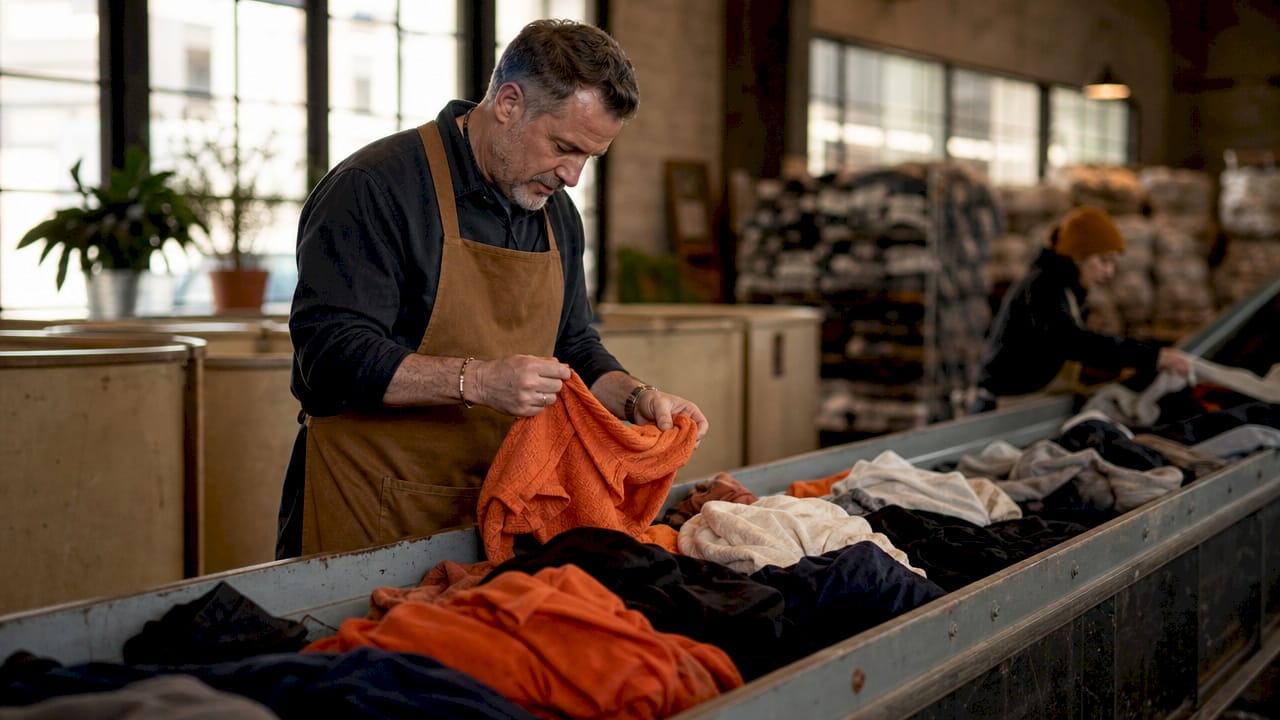
Polyester alone accounts for approximately 71 million metric tons of annual global production. That scale makes polyester recycling one of the most pressing technical challenges in the industry. Loop Industries has developed Infinite Loop™ technology, a textile-to-textile recycling process that breaks polyester down to its molecular building blocks and rebuilds it to virgin quality. This is one of the few technologies that genuinely closes the loop on synthetic fibres.
The key design and technology requirements for true circularity are:
- Mono-material construction. Garments must use a single fibre type or fibres that can be chemically separated without quality loss.
- Disassembly-ready components. Zippers, buttons, and trims must be removable without damaging the base fabric.
- Take-back infrastructure. Brands need physical or digital systems to collect worn garments from consumers.
- Chemical recycling capacity. Mechanical recycling degrades fibre length with each cycle; chemical recycling restores original quality.
- Supply chain traceability. Recyclers need to know exactly what a garment is made of before processing it.
Technology alone cannot solve circularity. Consumer behaviour and system logistics are equally critical. A brand can invest in the best recycling technology available, but if consumers do not return garments through take-back programmes, the system has no raw material to work with.
Pro Tip: Check garment labels before you buy. A 100% single-fibre label, whether pure wool, pure cotton, or pure polyester, signals that the garment has a realistic path into a closed-loop recycling stream.
What are the benefits of closed-loop fashion for the environment?
Circular fashion reduces reliance on virgin materials, lowers emissions across the supply chain, and stabilises raw material supply against resource price volatility. These are not abstract claims. Each benefit connects directly to a measurable problem in the current linear system.
Virgin material extraction for textiles consumes enormous quantities of water, land, and energy. Cotton farming, for example, is one of the most water-intensive agricultural activities in the world. When recycled fibres replace virgin cotton or polyester, those extraction costs disappear from the supply chain. Brands that build closed-loop supply chains also protect themselves from commodity price swings, because their raw material comes from their own product returns rather than global commodity markets.
The environmental data tells a clear story.
| Environmental factor | Linear fashion | Closed-loop fashion |
|---|---|---|
| Textile waste generated | 92 million tons/year | Near-zero with full adoption |
| Closed-loop recycling rate | Less than 1% of textiles | Target: majority of fibres |
| Pre-consumer waste | 10–40% of production unsold | Reduced through demand-driven design |
| Virgin material dependence | High across all fibre types | Significantly reduced |
Sustainable fashion initiatives including rental, resale, and repair models extend garment life before recycling even becomes necessary. These hybrid approaches reduce the total volume of garments entering the recycling stream, which matters because even the best recycling technology has an energy cost. The most sustainable garment is one that stays in use as long as possible before being recycled.
The importance of sustainable fashion extends beyond individual garments. Systemic adoption of closed-loop models across the industry would fundamentally change how raw materials flow through the global economy.
How can consumers and brands participate in closed-loop fashion?
Consumer participation is critical to closing the loop. Without garment returns, recycling technology has no feedstock. The most direct action a consumer can take is to return worn clothing through brand take-back programmes rather than discarding it.
Brands are building the infrastructure to make this possible. Chanel uses recycled thread in luxury tweeds and replaces plastic reinforcements with recycled leather components, demonstrating that closed-loop principles apply even at the highest end of the market. These component-level innovations show that circularity does not require sacrificing quality or craftsmanship.
Consumers who want to support circular fashion can take these steps:
- Return garments through take-back schemes. Brands like H&M, Patagonia, and Eileen Fisher operate in-store collection points.
- Buy mono-material garments. Single-fibre clothing has a clear recycling pathway.
- Choose rental and resale first. Renting or buying secondhand extends garment life before recycling becomes the next step.
- Support repair services. A repaired garment delays the need for recycling and reduces total resource consumption.
- Research brand circularity claims. Look for brands that disclose their recycling technology partners and take-back infrastructure, not just vague sustainability language.
Sustainable shopping practices align naturally with closed-loop principles. Buying less, buying better, and returning worn items are the three consumer behaviours that make the system function. The benefits of sustainable fashion compound when consumers and brands act together rather than waiting for the other side to move first.
Slow fashion consumption habits reinforce closed-loop systems by reducing the volume of garments that need to be processed at end of life. Fewer garments produced means fewer garments to recycle, which makes the entire system more manageable.
Key takeaways
Closed-loop fashion is the only model that keeps textile materials at their original quality indefinitely, and it requires design for disassembly, chemical recycling technology, and active consumer participation to function.
| Point | Details |
|---|---|
| Definition of closed-loop fashion | Garments are designed for disassembly and recycled back into equal-quality fibres, not downcycled. |
| Scale of the problem | The industry generates 92 million tons of textile waste annually, with less than 1% recycled in a closed-loop process. |
| Design comes first | Mono-material construction and disassembly-ready components are required before recycling technology can work. |
| Consumer role is non-negotiable | Take-back programmes only function when consumers return garments; the system has no feedstock without participation. |
| Hybrid models extend impact | Rental, resale, and repair reduce the volume entering recycling streams, lowering the total energy cost of circularity. |
The uncomfortable truth about circular fashion progress
I have followed sustainable fashion closely for years, and the gap between industry claims and actual closed-loop infrastructure is still wide. Brands announce circularity commitments regularly, but the hard question is always the same: where does the garment actually go when you return it?
The honest answer, for most brands today, is that returned garments are sorted, and a fraction ends up in genuine textile-to-textile recycling. The rest gets downcycled or, in some cases, still ends up in landfill. That is not a reason for cynicism. It is a reason to ask harder questions and support the brands that can answer them with specifics, not marketing language.
What gives me genuine optimism is the technology side. Loop Industries’ Infinite Loop™ process and similar chemical recycling advances are solving problems that mechanical recycling never could. The infrastructure is being built. The design standards are becoming clearer. What lags behind is consumer awareness and the willingness to change purchasing habits.
The most powerful thing you can do right now is not to buy a “sustainable” product. It is to return the clothes you already own through a take-back programme, buy secondhand before buying new, and choose organic and natural fabrics that have established recycling pathways. The system needs your participation to function. That is not a burden. It is leverage.
— Glenville
Sustainable style worth keeping at 16thavenue
Closed-loop fashion starts with buying pieces designed to last and made from materials that can re-enter a recycling stream. 16thavenue carries women’s fashion built for longevity, not disposability.
The Women’s Trendy Autumn and Winter Woolen Coat is made from wool, a natural mono-material fibre with one of the strongest recycling and composting pathways in fashion. For everyday movement, the Women’s Casual Low Wedge Breathable Non-Slip Comfort Sport Sneakers offer durability that resists the fast-fashion replacement cycle. Choosing pieces you wear for years rather than seasons is the first step every conscious consumer can take right now.
FAQ
What is closed-loop fashion in simple terms?
Closed-loop fashion is a system where garments are designed to be recycled back into new clothing of the same quality, keeping textile materials in continuous use rather than sending them to landfill.
How does closed-loop fashion differ from regular recycling?
Regular recycling in fashion is usually open-loop, meaning old garments are downcycled into lower-grade products like insulation. Closed-loop recycling returns fibres to the fashion system at their original quality.
Why is less than 1% of fashion truly closed-loop?
The main barriers are blended fibre construction, limited chemical recycling infrastructure, and low consumer participation in take-back programmes. Most garments today are not designed for disassembly.
What can I do to support closed-loop fashion?
Return worn garments through brand take-back schemes, buy mono-material clothing, choose rental or resale before buying new, and prioritise brands that disclose their specific recycling technology and infrastructure.
Is closed-loop fashion the same as sustainable fashion?
Closed-loop fashion is one model within the broader category of sustainable fashion. Sustainable fashion also includes ethical labour practices, organic materials, and slow consumption habits, all of which complement but do not replace closed-loop recycling systems.
Recommended
- Sustainable fashion benefits: What every woman should know – 16th Avenue
- What is slow fashion: stylish, sustainable choices in 2026 – 16th Avenue
- Sustainable shopping explained: Make eco-friendly fashion choices – 16th Avenue
- Why sustainable fashion matters: cut emissions by 44% in 2026 – 16th Avenue