


What is designer collaboration in fashion: 2026 guide
TL;DR:
- Designer collaborations combine creative ownership between designers and brands to produce unique products. They unlock new markets, generate press, and offer consumers authentic designer experiences at accessible prices. Clear legal agreements and measurable goals are essential to maximize their value and success.
A designer collaboration is a creative partnership where two or more parties, typically a designer and a brand or retailer, share authorship, creative direction, and commercial intent to produce something neither could make alone. It is not a commission. It is not a logo licence. Both sides bring creative equity to the table, and the result carries both identities.
Why it matters right now:
- Collaborations give designers access to new audiences and distribution channels without building infrastructure from scratch.
- Brands gain creative credibility and the kind of press coverage that paid advertising rarely generates.
- Retailers stock products with a built-in story, which drives sell-through on limited drops.
- Consumers get access to designer thinking at price points that would otherwise be out of reach.
Table of Contents
- What is a designer collaboration, exactly?
- What are the real benefits of a designer collaboration?
- What legal and commercial issues should you address before signing?
- How do you actually start a designer collaboration?
- How do you measure whether a collaboration worked?
- What do 2026 collaborations actually teach us?
- What does this mean for Canadian e-commerce retailers like 16thavenue?
- Key takeaways
- Why collaborations are the most underrated tool in fashion retail
- Useful sources
What is a designer collaboration, exactly?
Collins Dictionary defines collaboration as the act of working together to produce something, and a designer as a person whose job is to design. Put those together and you get the industry term: a design partnership, where shared creative ownership is the defining feature.
Marq’s design collaboration guide describes it as an immersive process where stakeholders from design, development, content, and marketing combine ideas to turn a concept into a finished product. That immersive quality is what separates a true collaboration from other commercial arrangements.
How it differs from similar models:
| Model | Who controls creative direction | Who owns the IP |
|---|---|---|
| Designer collaboration | Shared between both parties | Negotiated; often co-owned or licensed |
| Work-for-hire | Brand or client | Brand or client entirely |
| Licensing | Licensor (designer) | Designer retains; brand pays royalties |
| Influencer product drop | Brand | Brand; influencer lends name only |
| Co-branding | Both brands | Each retains own IP |
Common formats in fashion include limited capsule collections (a defined number of pieces, short run), licensed lines (designer aesthetic applied to a broader assortment), and fully co-designed collections where the designer is involved from sketch to shelf.
What are the real benefits of a designer collaboration?
The business case is straightforward: collaborations create value that neither party generates alone.
For designers:
- Visibility in retail channels and markets they do not yet serve.
- Revenue from royalties or flat fees without carrying production risk.
- Portfolio credibility that attracts the next partner.
For brands and retailers:
- Sell-through lift on limited drops, because scarcity and story drive urgency.
- Earned media coverage that paid campaigns rarely match.
- Brand heat: association with a respected creative name shifts perception.
For consumers:
- Access to a designer’s aesthetic at accessible price points.
- Products with a genuine narrative, not just a logo.
Diversity of perspective is a key ingredient here. Collaborations that bring genuinely different creative worldviews together tend to produce work that surprises the market, which is exactly what generates press coverage and social engagement. The Stella McCartney × Jeff Koons partnership illustrates this: when creators share a deep aesthetic purpose rather than simply lending names to each other’s platforms, the result carries meaning for consumers well beyond the novelty of the drop.
Understanding the role of trends in fashion also matters here. Collaborations that land at the right moment in a trend cycle can accelerate adoption and generate the kind of cultural conversation that keeps a product relevant long after the launch week.

What legal and commercial issues should you address before signing?
Core legal checklist:
- IP ownership: who owns the designs, patterns, and trademarks created during the collaboration?
- Licensing terms: is the brand licensed to use the designer’s name, and for how long?
- Royalty splits or flat fees: what percentage of net sales goes to the designer, or is it a one-time payment?
- Exclusivity: can the designer work with a competing brand during and after the collaboration?
- Territory: which markets is the collection sold in, and who controls distribution in each?
- Duration: when does the agreement start and end, and what happens to unsold inventory?
Revenue models in practice:
Flat fees offer the designer certainty but cap upside. Royalties align incentives but require transparent sales reporting. Revenue share models split gross margin after production costs, which works well when both parties are taking production risk. Hybrid models, a modest flat fee plus a royalty, are increasingly common in mid-market collaborations.
Canadian-specific notes: Cross-border manufacturing between Canada and the United States is governed by the Canada-United States-Mexico Agreement (CUSMA). If goods are produced in the U.S. or Mexico for sale in Canada, tariff treatment depends on rules of origin. The Canadian Intellectual Property Office (CIPO) handles trademark and copyright registration in Canada. For contracts involving both parties, Canadian lawyers recommend specifying the governing province explicitly, since contract law varies between common-law provinces and Québec’s civil law system.
Pro Tip: The clause most often missing from early-stage collaboration agreements is a creative approval right for the designer. Without it, the brand can alter the final product after the designer signs off on samples. Insist on a written approval right tied to the production sample, not just the sketch.
How do you actually start a designer collaboration?
Start-up checklist:
- Define your goals: revenue target, audience reach, press coverage, or all three. Vague goals produce vague briefs.
- Identify the right partner: look for creative alignment first, audience overlap second. A mismatch on values produces a product that satisfies neither fan base.
- Draft a creative brief: one page, covering the collection’s concept, target customer, price architecture, and key deliverables.
- Set governance: who has final approval at each phase, and what happens when the parties disagree?
- Agree on a timeline with buffer: add 20% to every phase estimate. Manufacturing delays are the rule, not the exception.
- Get legal review before any creative work begins.
Red flags to watch for:
- Audiences that do not overlap at all.
- A brief that describes a mood but not a customer.
- A partner who cannot name their manufacturer or lead times.
- Royalty discussions that happen after creative work has started.
Pro Tip: Schedule a weekly 30-minute check-in between the designer and the brand’s product lead throughout the prototyping phase. Teams that communicate frequently catch fit and quality issues early enough to fix them without blowing the timeline.
How do you measure whether a collaboration worked?
Top KPIs for capsule collections:
- Sell-through rate: percentage of units sold within the first 8–12 weeks. A healthy capsule targets 70–80% sell-through in that window.
- Sell-in: total units ordered by retail buyers before launch, a leading indicator of trade confidence.
- Revenue and gross margin: absolute revenue against the collaboration’s production and marketing costs.
- Earned media value: press coverage and social mentions converted to an advertising equivalent.
- Social engagement: reach, saves, and shares on launch content, not just likes.
- New customer acquisition cost: how much did the collaboration cost to bring in a net-new buyer?
Post-mortem template:
- Goals set vs. outcomes achieved (by KPI).
- Top three things that worked.
- Top three things that did not.
- One process change for the next collaboration.
- One creative learning.
MasterClass notes that iterative review practices, built into the process from ideation onward, reduce the gap between expected and actual outcomes at launch. Teams that run structured mid-project reviews consistently report fewer surprises at the post-mortem stage.
What do 2026 collaborations actually teach us?
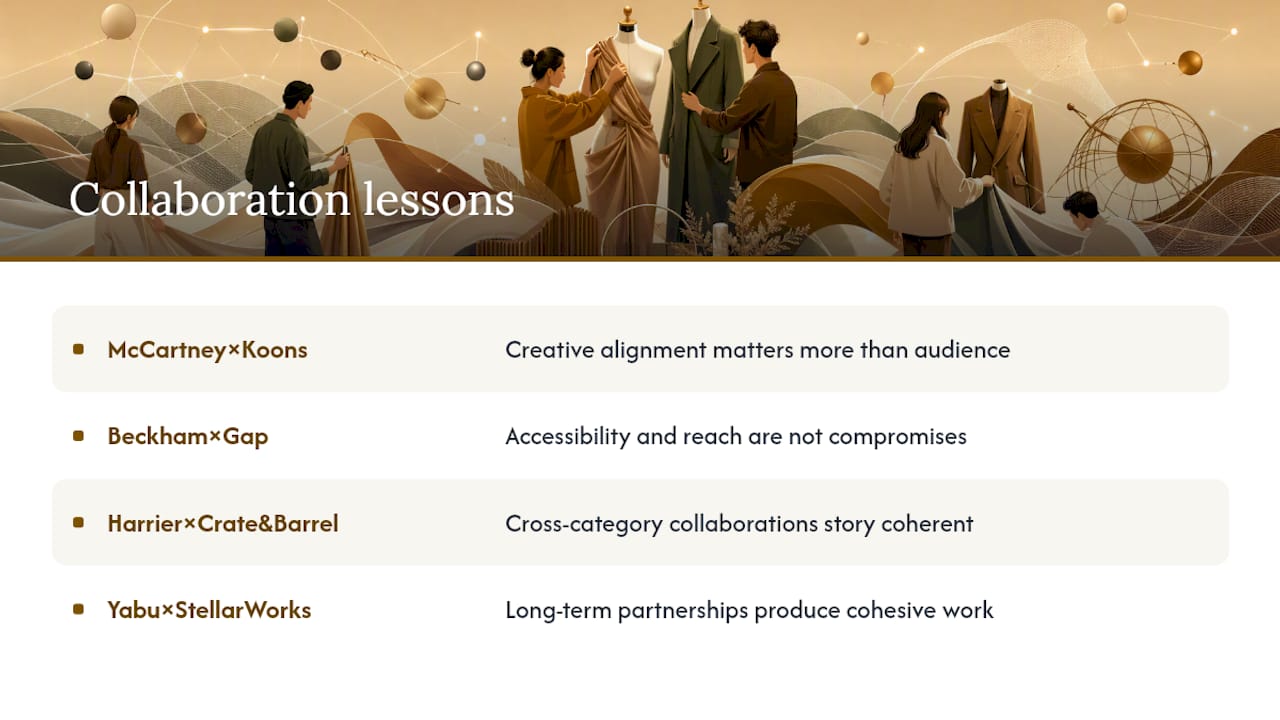
Stella McCartney × Jeff Koons (designer × artist): Shared aesthetic purpose produced a collection with genuine cultural weight. The lesson: creative alignment matters more than audience size. For small Canadian retailers, this model suggests that a local designer paired with a visual artist can generate press coverage that outperforms the collection’s commercial scale.
Victoria Beckham × Gap (designer × mass retailer): A 38-piece collection that remixed Beckham’s aesthetic into Gap’s heritage assortment. The lesson: accessibility and reach are not creative compromises. Mid-market Canadian retailers can apply this model by partnering with emerging local designers to bring editorial credibility to everyday assortments.
Laura Harrier and Tiffany Howell × Crate & Barrel (fashion creatives × home retailer): Fashion-trained designers translated their aesthetic into a home collection through narrative-led design. The lesson: cross-category collaborations work when the story is coherent. A fashion retailer can apply this by partnering with a designer whose references span categories.
Yabu Pushelberg × Stellar Works (studio × manufacturer, long-term): The Timothy Dining Collection, unveiled at 3daysofdesign 2026, is the product of years of creative dialogue. The lesson: long-term partnerships produce more cohesive work than one-off drops. Canadian retailers building supplier relationships should think in multi-season terms, not single capsules.
What does this mean for Canadian e-commerce retailers like 16thavenue?
Designer collaborations are one of the most effective tools a Canadian DTC retailer has for driving sell-through on curated assortments, because the story is already built into the product.
Retailer checklist for stocking collaborative collections:
- Marketing tie-ins: build editorial content around the collaboration’s story, not just the product. A curated collections approach consistently outperforms product-only campaigns on engagement.
Pro Tip: When writing product descriptions for collaborative pieces, lead with the designer’s creative reference, not the product’s technical specs. “Inspired by Beckham’s tailoring archive” sells the piece before the customer reads the fabric content.
16thavenue’s approach to fashion merchandising already prioritises editorial storytelling, which makes it well-positioned to carry collaborative collections that require narrative context to convert browsers into buyers. The Women’s Trendy Autumn and Winter Woolen Coat is a strong example of the kind of piece that benefits from a collaborative framing, where the design story elevates the product above its category.
Key takeaways
Designer collaborations work when shared creative ownership, clear contracts, and measurable KPIs are in place from the start.
| Point | Details |
|---|---|
| Shared authorship defines it | A true collaboration means both parties hold creative equity, not just a name licence. |
| Six to nine months is realistic | Capsule collections from first conversation to shelf typically take six to nine months minimum. |
| IP and approval rights are non-negotiable | Secure written creative approval rights tied to the production sample before any work begins. |
| Sell-through is the primary KPI | Target 70–80% sell-through within 8–12 weeks to confirm the collaboration performed commercially. |
| Story drives retail conversion | Editorial framing in product descriptions and campaigns consistently outperforms product-only marketing for collaborative drops. |
Why collaborations are the most underrated tool in fashion retail
The conventional wisdom treats designer collaborations as a luxury-brand tactic, something reserved for houses with the budget to court a Koons or a Beckham. That framing misses the point entirely.
The collaborations that generate the most durable value, for designers and retailers alike, are the ones built on genuine creative alignment rather than borrowed prestige. A Canadian emerging designer paired with a mid-market retailer who actually understands her aesthetic will outperform a name-drop partnership where the creative brief was written by a marketing committee. The Yabu Pushelberg and Stellar Works relationship is the clearest proof: years of honest creative dialogue produced a collection that neither party could have made alone, and it shows in every detail.
What most retailers underestimate is how much the post-mortem matters. The brands that run structured reviews after every collaboration, documenting what worked and what did not, compound their learning over time. The ones that skip it repeat the same timeline delays and inventory miscalculations on the next drop. The process is the competitive advantage, not the designer’s name.
Useful sources
- Designers Benefit by Working Collaboratively
- Stella McCartney and Jeff Koons
- Collaboration in design: The key to creating effective content - Marq
- Design Collaboration Guide: 3 Benefits of Collaborative Design - MasterClass
- What is collaborative design — SOLIDWORKS
- Victoria Beckham’s Gap collaboration — Vogue
- Laura Harrier and Tiffany Howell collaboration with Crate & Barrel — Architectural Digest
- Yabu Pushelberg and Stellar Works Timothy collection — Surface Magazine
- Collins Dictionary definition for designer collaboration
This article is general information, not legal or commercial advice. Confirm current IP, tax, and contract rules with a qualified Canadian legal professional before entering any collaboration agreement.