


What is ethical beauty? A clear guide for 2026
TL;DR:
- Ethical beauty encompasses animal welfare, ingredient sourcing, packaging responsibility, and transparent brand practices. Consumers should look for verified certifications, assess packaging sustainability, and prioritize continuous improvement over perfection. Progress in ethical beauty relies on transparency, consumer advocacy, and incremental changes in routines and industry standards.
Ethical beauty gets thrown around constantly in product descriptions, brand missions, and Instagram captions. But what is ethical beauty, exactly? Most people assume it simply means “natural” or “eco-friendly,” and that assumption leads to frustrating, expensive mistakes at the checkout. The truth is more layered. Ethical beauty covers animal welfare, ingredient sourcing, packaging responsibility, worker rights, and brand transparency, all at once. This guide breaks down every dimension so you can move from confused to confident, and actually practise the values you already hold.
Table of Contents
- Key takeaways
- Defining ethical beauty: core principles
- Why packaging matters more than you think
- Spotting trustworthy ethical beauty brands
- Practical tips for ethical beauty in your routine
- My honest take on ethical beauty
- Explore ethical beauty at 16thavenue
- FAQ
Key takeaways
| Point | Details |
|---|---|
| Cruelty-free ≠ vegan | A product can be cruelty-free but contain animal-derived ingredients, or vice versa. |
| Packaging is half the story | Sustainable packaging choices, from recycled plastics to refill systems, significantly shape a brand’s ethical footprint. |
| Certifications over claims | Third-party certifications like Leaping Bunny and COSMOS carry far more weight than self-declared “clean” labels. |
| Greenwashing is rampant | Vague language without metrics is a red flag. Look for published impact reports and supplier transparency. |
| Small swaps add up | Transitioning incrementally, one product at a time, is more sustainable than overhauling your entire routine overnight. |
Defining ethical beauty: core principles
At its most foundational level, the definition of ethical beauty refers to beauty products and practices that consider the full impact of a product on animals, people, and the planet. Not just the formula in the bottle. The entire chain from raw material sourcing to the moment you toss the empty container.
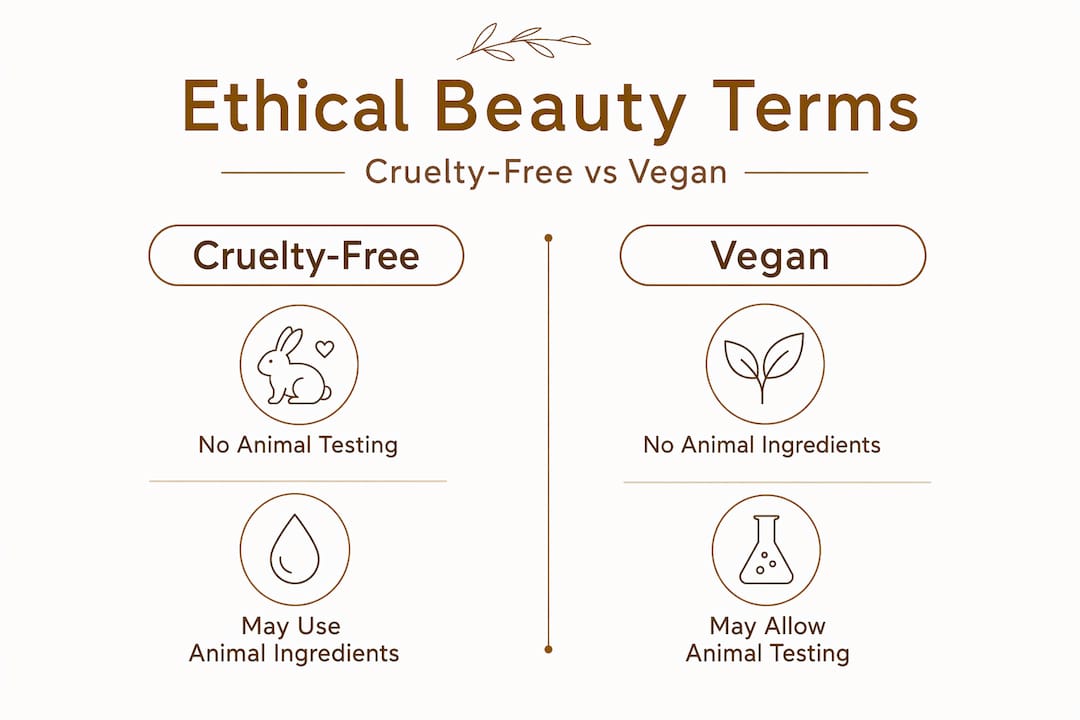
Two terms cause the most confusion: cruelty-free and vegan. They are not the same thing. Cruelty-free means no animal testing at any stage of production, while vegan means no animal-derived ingredients were used. A lipstick can be vegan, containing no beeswax or carmine, yet be tested on animals in a market that requires it. Conversely, a moisturiser can be cruelty-free but still contain lanolin or collagen. Understanding this distinction is the starting point for understanding ethical cosmetics.
Ethical sourcing adds another dimension entirely. It asks where ingredients come from, and whether the communities and ecosystems involved are treated fairly. Shea butter sourced from West Africa should ideally support fair wages for the women who harvest it. Palm oil, used in countless formulations, carries serious deforestation risk unless sourced from certified sustainable suppliers. These considerations fall under ethical beauty standards because they affect real people and real environments, not just policy language.
Transparency ties everything together. A brand that genuinely lives ethical beauty practices will tell you what is in their products, where those ingredients come from, and what their goals are for improvement. Vague claims like “natural” or “conscious” without any data behind them are marketing, not ethics.
Pro Tip: When evaluating a new brand, search for their sustainability or impact page before reading any product description. If it does not exist, that absence tells you something.
Here is what to look for when assessing any product’s ethical credentials:
- Cruelty-free certification: Verified by organisations like Leaping Bunny, not just a self-applied label
- Vegan status: Confirmed ingredient list free of animal derivatives
- Fair trade or ethical sourcing: Especially relevant for ingredients like shea, cocoa butter, or mica
- Environmental impact disclosures: Carbon footprint data, water usage, or supply chain audits
- Clear ingredient lists: Without euphemisms or blanket proprietary blends that obscure what you are actually applying
Why packaging matters more than you think
Most shoppers focus on the formula and forget the container. But packaging is one of the largest contributors to beauty’s environmental problem, and regulators are starting to respond with serious consequences.
The EU mandates all packaging must be 100% recyclable by 2030, with up to 30% recycled content required in plastic jars and shampoo bottles. Non-compliance triggers fines and market removal starting August 2026. North American brands selling into European markets are scrambling to adapt. The ripple effect is already visible in how brands reformulate their packaging strategies globally.
Here is a quick comparison of the most common sustainable packaging materials, along with honest trade-offs:
| Material | Sustainability upside | Key trade-off |
|---|---|---|
| Recycled plastic (PCR) | Diverts waste, lower production emissions | Quality varies; not all PCR is food-grade safe |
| Glass | Infinitely recyclable, premium perception | Heavier glass can mean a larger carbon footprint due to shipping weight |
| Bio-based plastics | Renewable feedstocks, lower extraction impact | Often not recyclable in standard streams |
| Mono-material packaging | Easier to recycle as a single stream | Limits design flexibility for multi-component items |
| Refillable systems | Reduces waste and carbon by up to 70% | Requires consumer behaviour change and infrastructure |
The refill model deserves special mention. Research shows 65% of consumers are more likely to buy from brands that offer refill options, and the environmental payoff is significant. Brands like those offering concentrated formats and reusable outer packaging are setting the new standard for what ethical beauty practices actually look like at scale.
Lightweighting, or reducing the overall material volume of a package without compromising function, is another strategy gaining traction. Less material means less energy to produce, less weight to ship, and less waste to manage at end of life.
Pro Tip: Look for the chasing arrows recycling symbol on packaging, but go further. Check whether your local municipality actually processes that material type. A product labelled “recyclable” is only as good as the recycling infrastructure available to you.
For a broader understanding of how eco-conscious choices extend across your lifestyle, the 16thavenue guide on sustainable shopping choices offers practical context that connects beauty with everyday purchasing decisions.
Spotting trustworthy ethical beauty brands
The importance of ethical beauty is increasingly recognised, and the market has responded. But so has greenwashing. Knowing how to read a brand critically is now a consumer skill, not an optional extra.
Credible ethical beauty brands share a few consistent habits. They publish impact reports and disclose supplier lists, and they set multi-year targets instead of one-off claims. Annual sustainability reports, even imperfect ones, signal a brand that is accountable to something beyond marketing.
Certifications provide a layer of independent verification that self-declared claims simply cannot. Here is what the major ones cover:
- Leaping Bunny: Requires brands to eliminate animal testing at all stages, including third-party suppliers and all markets sold into. This is a higher bar than most consumers realise.
- COSMOS and Ecocert: Focus on organic and natural ingredient content, with standards for processing and environmental impact.
- Fair for Life: Addresses fair trade and social responsibility across the supply chain.
- B Corp: Broader business ethics certification covering governance, worker treatment, community, and environment.
A brand selling into markets that legally require animal testing cannot genuinely claim cruelty-free status, regardless of what their packaging says. Third-party certifications like Leaping Bunny audit full supply chains specifically to catch these gaps.
Common greenwashing red flags include vague phrases like “eco-conscious formula,” green-coloured packaging with no substantive environmental claim, and marketing that highlights one ethical attribute while ignoring others. A brand that is cruelty-free but ships in non-recyclable single-use plastic, or sources mica from unverified supply chains, has not earned the ethical beauty label wholesale.
“Avoid vague eco-friendly claims without metrics. Look for third-party certifications like COSMOS, Ecocert, B Corp to validate ethical beauty attributes, as these certifications address different aspects, from organic content to fair labour.”
The most honest brands do not claim perfection. They show you where they are, where they are going, and what obstacles they face. That kind of dialogue with consumers is itself an ethical beauty standard worth rewarding.
Practical tips for ethical beauty in your routine
Adopting ethical beauty practices does not require throwing out everything in your bathroom cabinet. That kind of wholesale approach actually wastes perfectly usable products and creates more waste, not less.
The most grounded approach is incremental. As products run out, replace them with more considered alternatives. Here is a practical sequence to guide that process:
- Start with highest-use products. Swap your daily moisturiser or foundation before niche items. High-use products have the greatest cumulative impact.
- Check cruelty-free status first. Use databases that track certified brands and update regularly, since brand ownership and market expansion can change a product’s status.
- Assess the packaging. Choose recyclable or refillable formats where available, even if the formula itself is not perfect yet.
- Research ingredient sourcing. For products containing shea, mica, palm derivatives, or synthetic fragrance, a quick search of the brand’s sourcing policy takes two minutes and reveals a great deal.
- Engage directly with brands. Email or DM brands to ask about certifications, supply chain audits, or packaging plans. Brands that cannot or will not answer are telling you something.
- Consider format alternatives. Solid shampoo bars, concentrated serums, and refill-format cleansers all reduce packaging waste substantially compared to their standard counterparts.
For product formats specifically, solid and concentrate formats deserve more credit than they typically get. A solid shampoo bar often lasts two to three times longer than a liquid equivalent, ships lighter, and eliminates plastic entirely. Concentrated serums reduce the need for preservatives and shrink packaging footprint at the same time.
Pro Tip: Do not wait for a perfect ethical brand. Prioritise the one that is most transparent about their current limitations and most committed to improving. Progress over perfection is the realistic standard in this industry.
If you are building out your beauty routine with sustainability in mind, the 16thavenue article on eco-friendly beauty style covers complementary ground worth reading alongside this guide.
My honest take on ethical beauty
I have spent a long time researching and writing about ethical beauty, and the most useful shift in thinking I have found is this: stop treating it as a binary. You are not either ethical or not ethical. You are somewhere on a spectrum, and so is every brand you buy from.
What frustrates me most is the consumer pressure to achieve purity. People feel paralysed because their favourite cruelty-free serum comes in non-recyclable packaging, or a brand they love has not yet completed a full supply chain audit. The all-or-nothing framing helps no one, least of all the planet.
What actually moves the industry forward is transparency and continuous improvement, not the performance of perfection. I have far more respect for a brand that publishes an honest impact report showing where they are failing and what they plan to fix than one with a glossy “sustainable” homepage and no supporting data.
My practical advice: put your spending power behind transparency. Reward brands that show their work, even imperfect work. Ask questions publicly. Advocate for the certifications and standards you want to see normalised. That collective pressure is what changes industry behaviour more reliably than any individual purchase decision.
Ethical beauty is a practice. Like any practice, you get better at it over time.
— Glenville
Explore ethical beauty at 16thavenue
Understanding what ethical beauty means is one thing. Putting it into practice starts with the tools you use every day. At 16thavenue, you will find beauty products curated with quality and conscious consumers in mind. The 24-piece professional makeup brush set is a great example: high-quality, cruelty-free brushes that give you professional results without compromise. Whether you are building a new routine from scratch or selectively upgrading what you already have, 16thavenue offers a range of beauty tools that align with thoughtful purchasing. Browse the full beauty collection and find the products that fit both your values and your routine.
FAQ
What does ethical beauty actually mean?
Ethical beauty refers to beauty products and practices that consider animal welfare, environmental impact, fair labour, and brand transparency throughout the full supply chain. It goes beyond a single claim like “natural” to encompass how a product is made, sourced, packaged, and sold.
What is the difference between cruelty-free and vegan beauty?
Cruelty-free means no animal testing occurred at any stage of production, while vegan means no animal-derived ingredients are used. A product can be one without being the other, so look for independent certifications that verify both claims separately.
How do I spot greenwashing in ethical beauty brands?
Watch for vague terms like “eco-conscious” or “green” without supporting data, certifications, or supplier disclosures. Credible brands publish impact reports, name their certifications, and acknowledge where they still have progress to make.
Which certifications should I look for on ethical beauty products?
Leaping Bunny is the gold standard for cruelty-free claims. COSMOS and Ecocert cover organic and natural standards. Fair for Life addresses supply chain ethics. B Corp certification indicates broader ethical business practices across multiple areas.
Is sustainable packaging actually more ethical than conventional packaging?
Sustainable packaging is a meaningful part of ethical beauty, but the answer depends on the full lifecycle. Glass is infinitely recyclable but can carry higher transport emissions than lighter recycled plastic. Refillable systems offer the greatest environmental payoff when consumers actually use them.