


Mesh fabric explained: how to choose and care for it
Mesh fabric is a textile with an engineered open grid of deliberate holes, most often made from polyester or nylon, that gives it breathability, low weight, and visible structure. Choose it when airflow, light weight, or partial transparency matters — sportswear, window screens, filtration, and swimwear inserts are the clearest cases. According to Sewport, mesh typically features 6–16 holes per inch (HPI), and that range alone tells you more about a fabric’s performance than its fibre content. Two certifications worth checking before you buy: OEKO-TEX for chemical safety and GRS (Global Recycled Standard) for recycled-content claims.
Quick facts at a glance:
- Structure: open grid of holes, not a flaw in the weave
- Common fibres: polyester, nylon, polypropylene, fiberglass, stainless steel
- Key specs: HPI (openness) and GSM (weight/durability)
- Best for: breathability, light weight, or visibility
- Certifications to check: OEKO-TEX, GRS, ISO 9001
Key takeaways
Mesh fabric is defined by its engineered open structure, and HPI combined with GSM are the two specs that predict real-world performance more reliably than fibre content alone.
| Point | Details |
|---|---|
| Structure defines mesh | Mesh is an open grid by design — not a flaw — regardless of fibre type. |
| HPI sets breathability | Use 6–10 HPI for maximum airflow; 12–16 HPI for coverage with ventilation. |
| GSM sets durability | Apparel mesh runs roughly 80–150 GSM; heavier industrial mesh exceeds 300 GSM. |
| Dyeing method affects longevity | Dope-dyed mesh holds colour far better than piece-dyed alternatives in wash and UV. |
| 16thavenue mesh picks | Check fibre content and care labels on swimwear and footwear; prefer OEKO-TEX where listed. |
Table of Contents
- What mesh fabric actually is — and how it differs from solid textiles
- The main types of mesh fabric and how to recognise them
- How mesh fabric is manufactured
- Key properties and what they mean in practice
- Where mesh fabric shows up — common uses across categories
- How to care for mesh fabric properly
- Environmental impact, certifications, and what to look for in Canada
- How to choose the right mesh for your project
- Why dyeing and colourfastness matter more than most buyers realise
- A note from 16thavenue on mesh in our product range
- Mesh-based styles worth browsing at 16thavenue
- Sources
What mesh fabric actually is — and how it differs from solid textiles
Mesh is defined by its structure, not its fibre. The holes in mesh are engineered into the construction from the start, whether through knitting, weaving, or extrusion. That distinguishes it from a solid woven or knit fabric where the goal is to close every gap.
The two specs that matter most are HPI and GSM. HPI (holes per linear inch) measures openness: a lower number means larger holes and more airflow; a higher number means finer holes and more coverage. GSM (grams per square metre) measures weight and, roughly, durability. A fabric can have high HPI and low GSM, which often feels fragile, or low HPI and high GSM, which can reduce breathability unexpectedly. Buyers who focus on one spec and ignore the other tend to be disappointed at the sampling stage.
| Feature | Mesh fabric | Solid woven/knit fabric |
|---|---|---|
| Hole structure | Deliberate, engineered grid | None (closed construction) |
| Breathability | High (varies by HPI) | Low to moderate |
| Weight for coverage | Light | Heavier for equivalent coverage |
| Typical stretch | Varies (knit = stretchy; woven = stable) | Varies by construction |
| Permeability | Air, moisture, light pass through | Mostly blocked |
The main types of mesh fabric and how to recognise them
Mesh-fabric classifications span five construction categories and several material families. Knowing which category you are looking at tells you what the fabric will do before you touch it.
By construction:
- Knitted mesh (tricot/raschel): soft, stretchy, run-resistant when raschel-knit; the default for sportswear, shapewear, and lingerie
- Woven mesh: dimensionally stable, minimal stretch; used in filtration, industrial screens, and structured fashion overlays
- Braided/knotted mesh: strong at the junctions; common in cargo nets, safety nets, and agricultural netting
- Extruded/expanded plastic mesh: made from polypropylene or polyethylene; rigid or semi-rigid; used in packaging, drainage, and garden fencing
- Metal and fiberglass mesh: woven, welded, or expanded from stainless steel, aluminium, or coated fiberglass; used in window screens, architectural cladding, and filtration
By material family: polyester (most common in apparel), nylon/polyamide (stronger, more elastic), polyolefins (polypropylene/PE, used in industrial and outdoor mesh), fiberglass (window screens, reinforcement), and stainless steel (filtration, architectural).
| Construction | Feel | Typical uses |
|---|---|---|
| Knitted tricot | Soft, stretchy | Sports jerseys, shapewear, lingerie |
| Knitted raschel | Structured, stable stretch | Swimwear inserts, power mesh |
| Woven mesh | Firm, minimal stretch | Filtration, fashion overlays |
| Extruded plastic | Rigid or semi-rigid | Garden fencing, drainage |
| Metal/fiberglass | Stiff, heavy | Window screens, architectural panels |
One practical distinction worth knowing: apertures under roughly 5 mm are generally called mesh; larger openings are usually called netting. The construction differs too — mesh is typically knitted or woven, while netting is often knotted, which changes how load distributes across the structure.
How mesh fabric is manufactured
The process you choose shapes every performance characteristic downstream. Here are the four main routes:
-
Warp knitting (tricot/raschel): yarns run lengthwise and interlock in a zigzag pattern. Raschel machines produce the most stable knitted mesh, with good run resistance. Tricot produces a softer, finer hand. This is the most common method for apparel mesh.
-
Weaving: warp and weft yarns cross at right angles with deliberate spacing. The result is dimensionally stable with very little stretch. Woven mesh is preferred for filtration and structured overlays where dimensional accuracy matters.
-
Braiding and knotting: strands are interlaced diagonally or tied at intersections. Knotted vs knotless construction affects how load distributes: knotted mesh concentrates stress at the nodes; knotless distributes it more evenly along the strand, which matters for safety and cargo applications.
-
Extrusion and expansion (plastic/metal): plastic mesh is extruded through a die or punched and stretched from a sheet. Metal mesh is woven on specialised looms, welded at intersections, or expanded from a slit sheet. PVC-laminated polyester and fluoropolymer-coated fiberglass are produced by coating a base mesh after construction to improve weather resistance and durability.
Supplier questions worth asking: Is the yarn mono- or multi-filament? Is the mesh coated or laminated after construction? What is the dyeing method — yarn-dyed, piece-dyed, or dope-dyed?
Key properties and what they mean in practice
Construction, GSM, and HPI work as a system, not as independent dials. Change one and the others shift.
Breathability and HPI: the 6–16 HPI range covers most apparel mesh. At 6–8 HPI, holes are large enough to see through clearly — typical for sports jerseys and shoe uppers. At 12–16 HPI, the fabric looks almost solid from a distance but still passes air freely, which is why power mesh works in shapewear.
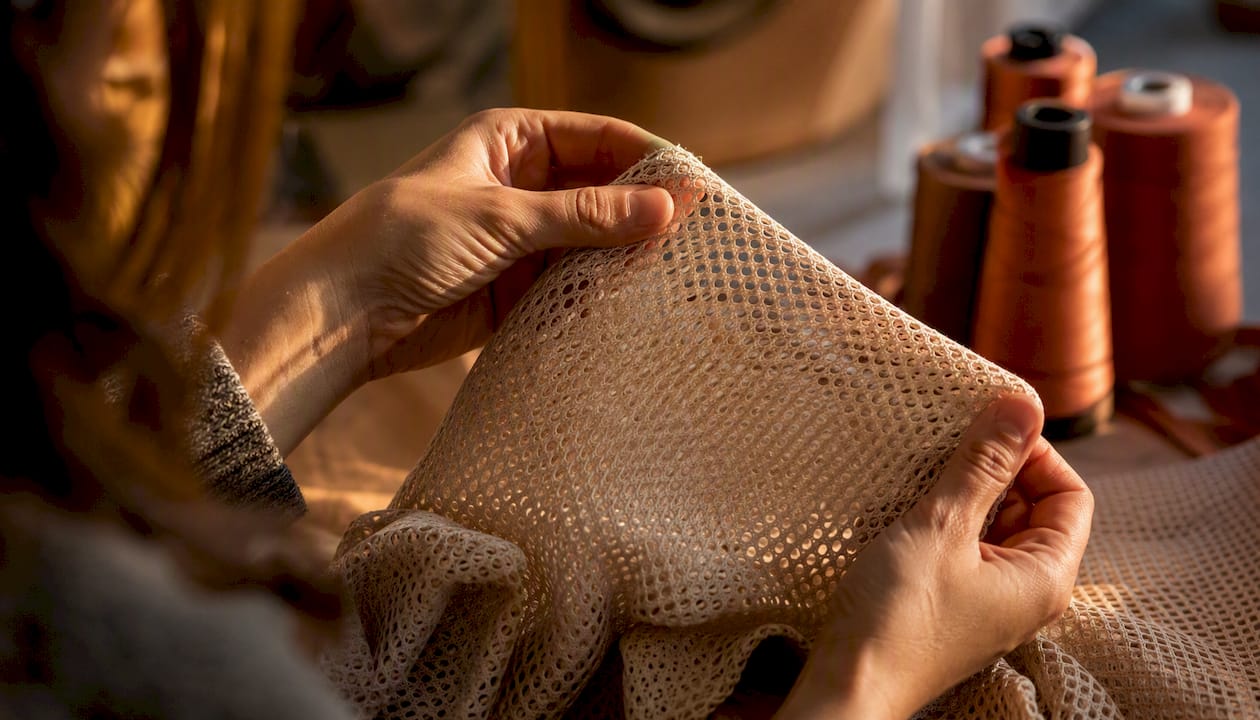
GSM and durability: lightweight apparel mesh runs roughly 80–150 GSM. Heavier industrial or architectural mesh can exceed 300 GSM. Higher GSM generally means better abrasion resistance and longer garment life, though it also adds weight.
Stretch and compression: knitted mesh stretches; woven mesh does not. Power mesh is a high-GSM knitted mesh with significant compression, used in shapewear and structured swimwear. Standard sports mesh has lower GSM and more open holes, prioritizing airflow over compression.
Common failure modes: runs (in low-quality knitted mesh), abrasion at seams, and colour fading from UV or repeated washing. Coated meshes resist abrasion and UV better than uncoated versions.
| Property | Low value | High value |
|---|---|---|
| HPI | Large holes, high airflow, visible | Fine holes, more coverage, less airflow |
| GSM | Light, less durable | Heavy, more durable |
| Stretch | Woven/stable | Knitted/compressive |
| Coating | None (lighter) | PVC/fluoropolymer (weather-resistant) |
Stat to know: mesh typically features 6–16 HPI, and that single number predicts whether a fabric will feel open and airy or close and compressive before you ever touch a swatch.
Where mesh fabric shows up — common uses across categories
Mesh appears across apparel, home, industrial, and medical contexts, and the same word covers radically different materials depending on the application.
Apparel:
- Sports jerseys and athletic tops: open-knit polyester mesh, 6–10 HPI, prioritising airflow
- Shapewear and lingerie: power mesh (high-GSM knitted nylon), 12–16 HPI, providing compression and opacity
- Swimwear inserts: raschel-knit nylon or polyester, chlorine-resistant, moderate stretch
- Fashion overlays and dresses: fine tulle or woven mesh, often polyester, used for layering effects — see how it appears in pieces like the lace overlay dress at 16thavenue
Home:
- Window and door screens: coated fiberglass or aluminium mesh, 18×16 mesh count (standard North American screen)
- Laundry bags: lightweight polyester mesh, protects delicate items in the wash
- Decorative overlays: fine woven or knitted mesh used in curtains and table runners
Industrial and medical:
- Filtration media: woven stainless steel or polyester mesh, precise aperture control
- Surgical mesh: medical-grade polypropylene or polyester, used in hernia repair and pelvic floor reconstruction
- Architectural metal mesh: expanded aluminium or stainless steel panels used as building cladding and sunscreens
How to care for mesh fabric properly
Mesh is more forgiving than most people expect, but heat and snagging are its two real enemies.
-
Machine washing: use a mesh laundry bag and the gentle or delicate cycle. Cold water (30°C or below) prevents shrinkage and colour loss. Turn garments inside out to reduce surface abrasion.
-
Hand washing: the safest option for fine or embellished mesh. Use cool water and a mild detergent; avoid wringing or twisting, which distorts the grid structure.
-
Drying: lay flat or hang to dry. Never put mesh in a hot dryer — heat can melt or distort synthetic fibres, especially polyester and nylon. Reshape the garment while damp if it has stretched.
-
Stain treatment: blot, never rub. Apply a small amount of mild detergent directly to the stain, let it sit for a few minutes, then rinse with cool water. Rubbing pushes the stain deeper into the open structure.
-
Ironing and steaming: most mesh should not be ironed directly. If pressing is needed, use a pressing cloth and the lowest heat setting. Steam is generally safer than direct contact heat.
-
Storage: fold loosely or hang. Avoid storing mesh items compressed under heavy garments — sustained pressure can permanently distort the hole structure. Keep away from rough surfaces that can snag.
Pro Tip: Place mesh shoes or swimwear in a small mesh laundry bag before washing — it protects the fabric from snagging on zippers and hardware in the same load.
Environmental impact, certifications, and what to look for in Canada
Synthetic mesh has a real environmental footprint. Most polyester and nylon mesh originates from petroleum-based polymers, and standard versions are not accepted in Canadian municipal recycling streams — they require textile take-back programmes or specialised recycling facilities.
- Recycled polyester (rPET) mesh is made from post-consumer plastic bottles and carries a lower carbon footprint than virgin polyester. Look for the GRS (Global Recycled Standard) label to verify the recycled-content claim.
- OEKO-TEX Standard 100 certifies that the fabric has been tested for harmful substances — relevant for mesh worn close to the skin (shapewear, swimwear, lingerie).
- ISO 9001 covers supplier quality management systems. A mesh supplier with ISO 9001 certification has documented process controls and traceability, which matters when you need consistent aperture size or colourfastness across production runs.
- Dyeing impact: piece-dyeing and yarn-dyeing both use significant water and chemicals. Dope-dyeing (colouring the polymer before extrusion) uses less water and produces more consistent colour — ask suppliers which method they use.
- End-of-life: metal mesh (stainless steel, aluminium) is recyclable through standard scrap metal channels. Coated or laminated meshes (PVC-laminated polyester, fluoropolymer-coated fiberglass) are harder to recycle because the coating bonds to the substrate.
Choosing a mesh with OEKO-TEX certification does not guarantee a low environmental footprint — it guarantees the fabric is free of harmful residues. Sustainability and chemical safety are related but separate claims; a fabric can pass OEKO-TEX and still be made from virgin petroleum-based fibre with no recycled content.
How to choose the right mesh for your project
Construction, HPI, and GSM form an interrelated system — adjusting one changes the others. Work through this checklist before ordering samples:
- Intended use: apparel, filtration, screening, or structural? Each category has a default construction type.
- Breathability needed (HPI): 6–10 HPI for maximum airflow; 12–16 HPI for coverage with breathability.
- Durability (GSM): lightweight apparel mesh sits around 80–150 GSM; heavier industrial mesh exceeds 300 GSM.
- Stretch requirement: knitted mesh for stretch and compression; woven mesh for dimensional stability.
- UV and chemical resistance: outdoor or pool use requires UV-stabilised or chlorine-resistant fibre; coated mesh for architectural use.
- Colourfastness: request ISO wash-fastness and lightfastness test results from the supplier.
- Cost target: polyester is the most affordable; nylon costs more but offers better elasticity and abrasion resistance; metal and coated meshes are the most expensive.
- Sample tests to request: wash test (3–5 cycles), abrasion test, colourfastness to light, and dimensional stability after washing.
When to prefer natural blends or coated meshes: if skin sensitivity is a concern, a cotton-blend or OEKO-TEX-certified mesh reduces irritation risk. For outdoor or architectural use, a PVC-laminated or fluoropolymer-coated mesh will outlast an uncoated version significantly. For fabric comfort guidance that goes beyond mesh, 16thavenue’s fabric guides cover the broader selection process.
Why dyeing and colourfastness matter more than most buyers realise
Most buyers focus on construction and HPI and treat dyeing as a finishing detail. That is a mistake in performance apparel.
Modern synthetic mesh starts as a petroleum-derived polymer that is extruded into filaments. The point at which colour is introduced changes everything downstream:
- Dope-dyeing (solution dyeing): pigment is added to the polymer melt before extrusion. The colour is locked into the fibre core, producing excellent colourfastness and consistent shade across production runs. UV and wash fastness are significantly better than surface-dyed alternatives.
- Yarn dyeing: colour is applied to the yarn before knitting or weaving. Good uniformity, but the dye sits on the fibre surface and is more vulnerable to fading.
- Piece dyeing: the finished fabric is dyed. Fastest and cheapest, but colour penetration is shallowest and fastness is lowest.
For activewear, swimwear, and any mesh used in visible overlays, colourfastness failures show up quickly — faded panels, uneven colour at seams, and bleed onto adjacent fabrics.
Two supplier questions to ask:
- What dyeing method is used, and what is the wash-fastness rating (ISO 105-C06)?
- What is the lightfastness rating (ISO 105-B02)?
Two sample tests to request:
- Wash fastness: run 5 machine cycles at 40°C and compare colour against the original swatch.
- Lightfastness: expose a swatch to UV for 20 hours and check for fading.
Visible seams and mesh overlays in fashion garments are especially unforgiving — a slight shade difference between the mesh panel and the base fabric becomes obvious after a few washes if the dyeing method differs between components.
A note from 16thavenue on mesh in our product range
At 16thavenue, mesh shows up most often in two categories: swimwear and breathable footwear. Both are applications where the fabric’s open structure is doing real work, not just adding visual texture.
When browsing mesh-based items in an online catalogue, check the product spec lines for fibre content and care instructions before purchasing. A swimwear piece labelled “polyester mesh” without a chlorine-resistance note may fade faster in pool use than one made from nylon or a treated polyester. For footwear, look for descriptions that specify the mesh type — “breathable mesh upper” on a sport sneaker tells you the upper is open-knit and will ventilate well, but it also means the upper is more vulnerable to abrasion than a solid leather or synthetic panel.
Prefer OEKO-TEX-certified mesh items when they are available, particularly for swimwear and lingerie worn close to the skin. If a product page does not list certification, check the care label on arrival — many certified fabrics carry the OEKO-TEX hang tag.
Mesh-based styles worth browsing at 16thavenue
If this guide has you thinking about mesh in your wardrobe, 16thavenue carries several pieces where the fabric is central to the design. The one-piece mesh swimwear bikini uses mesh panelling for coverage with ventilation — a good example of power mesh doing structural work in swimwear. For footwear, the breathable sport sneakers feature an open-knit mesh upper that keeps feet cool during activity.
Before adding to cart, check the product description for fibre content, care instructions, and any certification notes. Free shipping is available to most destinations, and the full collection is updated seasonally — worth checking back when new swimwear and active styles arrive.
Sources
- What Is Mesh Fabric: Properties, How its Made and Where | Sewport
- Review article on classifications and preparation processes of mesh-fabrics (SAGE Journals)
- What Is Mesh Fabric? (Silverbobbin)
- Mesh Fabric Specification Guide: How to Choose the Right Weight, Mesh Count & Fiber for Your Product Line
- ISO 9001 — quality management