


What is mood dressing: how to dress for happiness
TL;DR:
- Mood dressing involves choosing clothes based on desired emotional states rather than trends or occasion requirements.
- It activates psychological benefits through sensory comfort and symbolic meaning, supporting daily self-care.
Mood dressing (also called dopamine dressing or emotional dressing) is the intentional practice of choosing clothes based on how you want to feel, not what is trending or expected. You are not dressing for the occasion. You are dressing for your emotional state. Three ways to try it this morning, no wardrobe overhaul required:
- Swap your usual neutral scarf for one in a warm terracotta or cobalt blue.
- Reach for the softest knit you own instead of whatever is closest.
- Put on a structured blazer or wide-leg trouser if you need to feel grounded and capable.
That is it. The concept is backed by a growing body of psychology research, including the work of University of Hertfordshire professor Karen Pine, whose studies show that clothing can change cognitive performance and social perception. The underlying theory is called enclothed cognition: garments carry symbolic meaning, and wearing them activates the mental states we associate with them. 16thavenue carries a curated range of knitwear, outerwear, and accessories that work well as mood-dressing starting points, particularly for Canadian seasons.
Table of Contents
- What is mood dressing, really, and how is it different from trend dressing?
- Why does dressing for your mood actually work?
- Which style elements actually move the needle on mood?
- How to build a simple daily mood-dressing routine
- Six mood-based outfit starters you can copy right now
- Common misconceptions and where mood dressing has limits
- Canada-specific advice: fabrics, layering, and where to shop
- Key takeaways
- Clothing as a daily act of self-respect
- Build your mood-dressing wardrobe with 16thavenue
- Useful sources
What is mood dressing, really, and how is it different from trend dressing?
Most of us dress reactively: we grab what fits the weather, the meeting, or the Instagram moment. Mood dressing flips that. The question shifts from What is appropriate? to What do I need today?
Emotional dressing is the broader umbrella. Under it sit two distinct styles. Dopamine dressing leans maximalist: bold colour, clashing prints, statement silhouettes chosen to generate a visible energy spike. Quieter mood dressing is more internal, favouring soft textures, muted palettes, and familiar fits that anchor rather than excite. Both are valid. The difference is the intention behind the choice, not the volume of colour on your body.
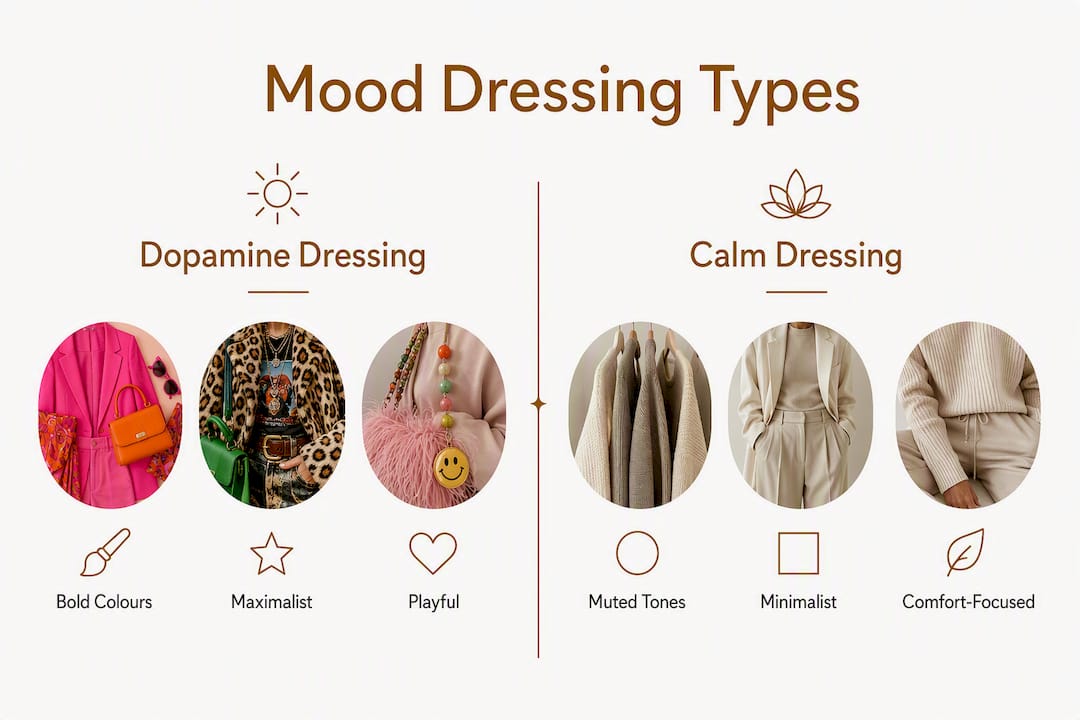
Trend-driven dressing asks: What is everyone wearing? Occasion-based dressing asks: What is expected of me? Mood dressing asks: What state do I want to inhabit today? That inward focus is what separates it from the other two, and it is also why it works as a genuine self-care practice rather than a style exercise.
The term enclothed cognition was introduced in a landmark study published in the Journal of Experimental Social Psychology and describes the systematic influence that clothes have on the wearer’s psychological processes. Mood dressing is essentially enclothed cognition applied deliberately, every morning, as a habit.
Why does dressing for your mood actually work?
The mechanism is not mystical. Clothes produce two simultaneous effects: a sensory signal and a symbolic one.
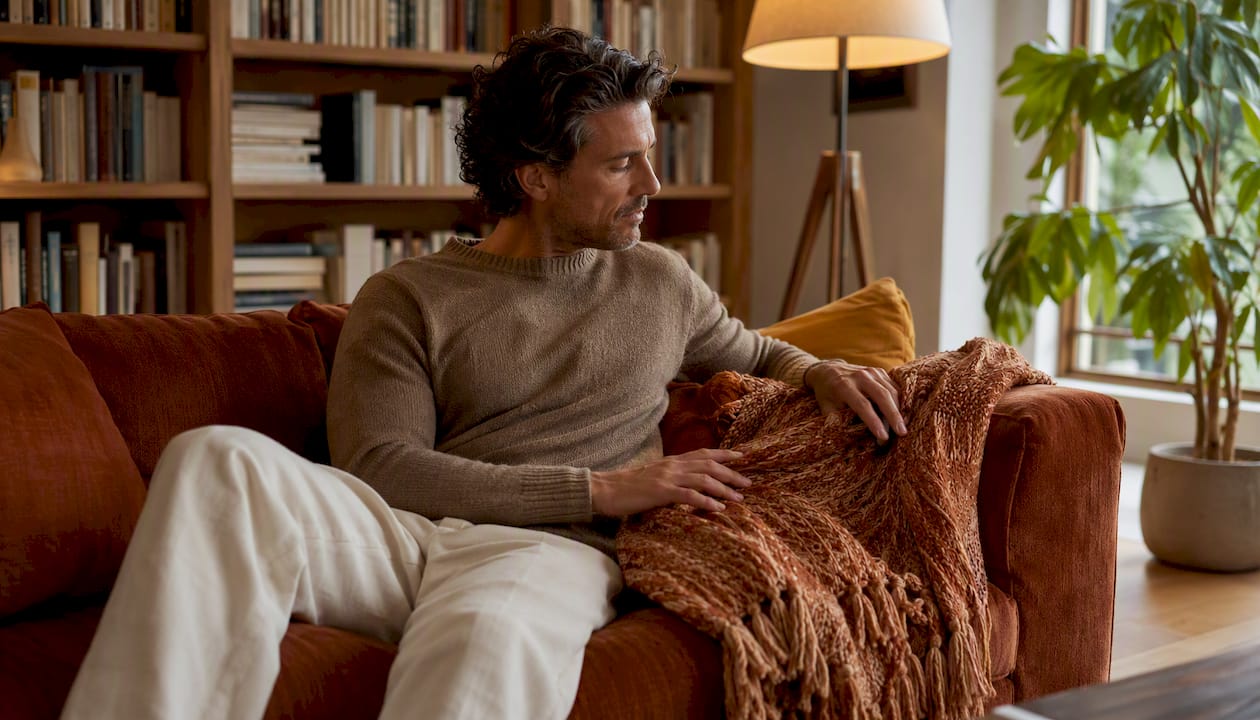
The sensory signal is immediate. A scratchy collar, a waistband that pinches, or a fabric that traps heat all create low-grade physical stress. That stress competes with any emotional benefit the garment’s colour or cut might offer. Conversely, a soft merino against your skin or a relaxed silhouette that moves with you sends a steady “safe” signal to the nervous system. Physical comfort is a precondition for the mood benefit, not an afterthought.
The symbolic signal works through association. A structured blazer does not make you more competent, but it activates the mental schema you have built around competence, formality, and authority. That activation is measurable. In the lab coat studies that informed enclothed cognition research, participants who wore a coat labelled as a doctor’s coat performed better on attention tasks than those wearing the same coat labelled as a painter’s smock. The garment was identical; the meaning was not.
Practical implications worth knowing:
- Colour cues are processed pre-consciously, before you have formed a thought about them.
- Texture affects the nervous system through touch receptors, making fabric choice a direct physiological lever.
- A consistent getting-dressed ritual reduces decision fatigue by replacing the open-ended question “What should I wear?” with a structured, emotionally anchored one.
- Intentional wardrobe choices shift getting dressed from a chore into a short self-care ritual, which compounds over time.
Understanding the role of psychology in fashion helps explain why certain garments feel like armour and others feel like a hug. Neither reaction is accidental.
Which style elements actually move the needle on mood?
Colour is the fastest lever, but it is not the only one. Here is a quick reference for the five most common emotional goals:
| Mood goal | Colour family | Texture | Silhouette | Accessory |
|---|---|---|---|---|
| Cheerful / energised | Warm yellow, coral, bright red | Lightweight knit, cotton | Relaxed, playful | Bold earrings, coloured bag |
| Grounded / stable | Earthy brown, olive, rust | Structured wool, denim | Tailored, fitted | Leather belt, ankle boot |
| Confident / capable | Deep navy, black, burgundy | Smooth, crisp | Structured blazer, wide leg | Minimal gold jewellery |
| Calm / clear-headed | Soft blue, sage, lavender | Linen, brushed cotton | Loose, unstructured | Simple scarf, stud earring |
| Cosy / comforted | Cream, warm grey, terracotta | Fleece, chunky knit, velvet | Oversized, draped | Soft wrap, knit hat |
When you are short on time, pick one focal element and commit to it. Colour is the fastest to read and the easiest to add via a single accessory. Texture is the most physically immediate. Silhouette takes the longest to register but has the strongest effect on posture and how you carry yourself through the day.
Pro Tip: If wearing a bright colour feels like too much, start with it below the waist or in a single accessory. A mustard tote or a coral scarf gives you the colour cue without the self-consciousness of a head-to-toe statement.
Pro Tip: Before you buy any new piece for mood dressing, check the fit and fabric carefully. Bright colours and beautiful cuts cannot compensate for a garment that itches or restricts movement. Comfort is the foundation.
How to build a simple daily mood-dressing routine
The 5-step routine below takes under five minutes once it becomes habit.
- Mood check. Before opening your wardrobe, pause for ten seconds. Name the state you are in and the state you want. “I feel flat; I want to feel capable” is enough.
- Pick one focal element. Choose colour, texture, or silhouette as your anchor for the day. Not all three. One.
- Comfort check. Hold the garment. Does it feel good against your skin? Does it fit without pulling or pinching? If not, swap it. A physically uncomfortable outfit will erode the mood benefit within an hour.
- Preview. Spend thirty seconds in front of a mirror. Not to critique, but to notice: does this feel like the version of you that you want to show up as today?
- Commit. Put it on and stop second-guessing. The ritual is the point.
The 3-3-3 rule for quick decisions
When you are genuinely pressed for time, the 3-3-3 rule gives you a structure: choose 3 focal pieces (top, bottom, outer layer or shoes), limit yourself to 3 colours or textures across the outfit, and cap the decision at 3 minutes. For Canadian winters, the outer layer is non-negotiable as a mood element because it is what you wear longest. A coat in a colour or texture you love does more daily emotional work than almost any other garment in your wardrobe.
Pro Tip: Do a mini wardrobe audit this weekend. Pull everything out and sort it into three piles: pieces that energise you, pieces that soothe you, and pieces that feel like you. Anything that fits none of those categories is worth reconsidering. Wardrobe rituals support identity coherence and make daily mood dressing significantly easier.
Six mood-based outfit starters you can copy right now
These are not aspirational editorial looks. They are copy-and-paste starting points built around pieces most people already own or can find easily.
Bright boost. A coloured knit (coral, yellow, or cobalt) over dark straight-leg jeans, with a single statement earring. Swap: if the knit feels too bold, use a neutral base and add the colour through a scarf or tote instead.

Calm anchor. Soft sage or muted navy wide-leg trousers, a cream ribbed top, a smooth lightweight scarf. Swap: in colder months, replace the scarf with a brushed-cotton turtleneck in the same muted palette.
Confidence layer. A well-cut blazer in deep navy or charcoal over a simple white tee and tailored trousers. Swap: if your workplace runs casual, a structured zip-up in a dark tone gives the same silhouette signal with less formality.
Cosy reset. An oversized chunky-knit sweater in cream or warm grey, relaxed joggers or wide-leg fleece pants, and a pair of cushioned sneakers. This one is for working from home or a slow Saturday. Swap: swap the joggers for a draped midi skirt if you need to step outside.
Grounded earth. Rust or olive cargo trousers, a fitted ribbed long-sleeve, and a leather or faux-leather belt. The earthy tones and structured waistline create a sense of stability without effort. Swap: a denim jacket in a warm wash works in place of the belt for the same grounding effect.
Soft power. A flowing midi dress in dusty rose or warm lilac, layered under a fitted denim or linen jacket. The contrast between soft colour and structured layer reads as composed and approachable. Swap: on a budget, a pre-loved blouse in a similar tone paired with dark trousers achieves the same balance. Pre-loved fashion is a practical route to building a mood-supporting wardrobe without overspending.
Common misconceptions and where mood dressing has limits
A few myths worth clearing up before you go all-in:
- Myth: You must wear bright colours to mood dress. Fact: Intentionality matters more than brightness. A perfectly fitted charcoal coat chosen because it makes you feel grounded is mood dressing. A neon yellow top grabbed without thought is not.
- Myth: Mood dressing is the same as dopamine dressing. Fact: Dopamine dressing is one expression of emotional dressing, typically the maximalist, colour-forward version. Mood dressing includes quieter, more subdued approaches.
- Myth: It only works if you have a large wardrobe. Fact: Three intentionally chosen pieces outperform thirty grabbed at random.
- Myth: Mood dressing means ignoring dress codes. Fact: Advanced practitioners choose pieces that satisfy both internal emotional needs and external context, such as a muted but well-cut blazer that reads professional while supporting confidence.
Workplace and cultural context
Most dress codes leave room for intentional choices within their constraints. A structured silhouette, a particular fabric, or a single accessory in a meaningful colour can all carry emotional weight without violating a uniform or conservative dress policy. The goal is not to dress for self-expression at the expense of context. It is to find the overlap between what is appropriate and what supports you.
When clothing is not enough
Mood dressing is a self-care tool, not a substitute for professional mental-health support. If you are experiencing persistent low mood, anxiety, or emotional distress, please reach out to a qualified professional or contact a crisis line such as the 988 Suicide and Crisis Lifeline or the Crisis Text Line.
Canada-specific advice: fabrics, layering, and where to shop
Canadian seasons make mood dressing both more challenging and more rewarding. Here is how to make it work across the year:
- Winter (November through March). Wool and merino are the most mood-supportive cold-weather fabrics: warm, soft, and tactilely grounding. A merino base layer under a structured coat keeps the sensory benefit even when the outer layer is purely functional. Prioritise a coat in a colour or texture you genuinely love, since it is the piece you wear most.
- Spring and fall. Mid-layers are your mood-dressing sweet spot. A chunky cardigan, a linen blazer, or a textured wrap can carry the full emotional weight of an outfit without the bulk of winter gear.
- Summer. Breathable cotton and linen in your chosen mood palette. Loose silhouettes in warm weather reduce physical friction, which protects the mood benefit.
For shopping, a few practical tips:
- Prioritise fabric feel over visual appeal when buying online. Read fibre content carefully and check return policies.
- Sustainable and durable pieces tend to hold their tactile quality longer, making them better long-term mood-dressing investments.
- Pre-loved and secondhand options are a budget-friendly route to higher-quality fabrics you might not otherwise afford.
- 16thavenue’s seasonal collections include woolen coats, knitwear, and accessories that translate directly into mood-dressing staples for Canadian winters, with free shipping to most destinations.
Key takeaways
Mood dressing works because intentional clothing choices activate specific emotional states through both sensory comfort and symbolic meaning, making getting dressed a reliable daily self-care practice.
| Point | Details |
|---|---|
| Core definition | Mood dressing means choosing clothes for how you want to feel, not for trends or expectations. |
| Why it works | Enclothed cognition and physical comfort together determine whether a garment shifts your state. |
| Start small | One focal element (colour, texture, or silhouette) is enough to begin; you do not need a new wardrobe. |
| Canadian seasons | A coat in a loved colour or texture does the most daily emotional work in cold climates. |
| 16thavenue | Curated knitwear, outerwear, and accessories at 16thavenue offer practical mood-dressing starting points for Canadian shoppers. |
Clothing as a daily act of self-respect
The part most articles skip: mood dressing is not about performing happiness. Some mornings the most honest mood-dressing choice is a soft, dark, enveloping knit because you need comfort, not cheerfulness. The practice is not about forcing a state. It is about meeting yourself where you are and choosing, deliberately, what you want to carry into the day.
What I find genuinely useful is the audit habit. Sorting a wardrobe by emotional resonance rather than occasion reveals something most people do not expect: a significant portion of what they own makes them feel nothing, or worse, vaguely wrong. Removing those pieces, or at least moving them out of daily reach, changes the morning experience more than any new purchase. Curating a wardrobe by emotional resonance reduces decision fatigue and turns getting dressed into a moment of actual intention.
The 3-3-3 rule is worth keeping on a sticky note inside your wardrobe door for the first few weeks. Not because the rule is magic, but because it interrupts the autopilot. Once the habit is formed, you will not need it.
Build your mood-dressing wardrobe with 16thavenue
The fastest way to start mood dressing is to add one tactilely satisfying, emotionally resonant piece to what you already own. For Canadian winters, that usually means outerwear or knitwear, the garments you live in from November through March.
16thavenue’s curated seasonal collections are built around exactly this kind of piece: the Women’s Trendy Autumn and Winter Woolen Coat is a strong mood-dressing anchor, structured enough to cue confidence, warm enough to deliver genuine sensory comfort, and available in tones that work across the earthy-to-bold spectrum. Pair it with a pair of cushioned, breathable sneakers for days when physical comfort is the priority. Free shipping applies to most destinations. Browse the full collection at 16thavenue.ca and start with one piece that genuinely makes you feel something.
Useful sources
Three authoritative references for readers who want to go deeper:
- Dopamine Dressing: Wear What Makes You Feel Good — National MS Society, Momentum Magazine. A clear, accessible overview of how intentional colour and clothing choices support emotional well-being.
- Enclothed Cognition — PMC/NIH — Peer-reviewed research on the psychological effects of clothing on the wearer’s cognition and behaviour.
- What Is Dopamine? — Mental Health America. Useful background on dopamine’s role in mood regulation, which underpins the dopamine dressing framework.