


Personal styling explained: what it is and how it works
TL;DR:
- Personal styling creates a practical wardrobe tailored to your body, color, and lifestyle. It offers benefits like saving time, reducing impulse purchases, and improving wardrobe harmony. Following the process with deliberate shopping habits sustains wardrobe growth and prevents fragmentation.
Personal styling is a professional service that builds a practical, wearable wardrobe around your body shape, colouring, and daily life. The goal is not to make you look like someone else. It is to make getting dressed feel effortless and consistent. A stylist evaluates what you already own, identifies what is missing, and creates a plan so every new piece you buy actually gets worn.
The core benefits, quickly:
- Time saved — a cohesive wardrobe means fewer decisions every morning
- Fewer impulse buys — purchases are guided by a plan, not a mood
- A wardrobe that works together — pieces are chosen for compatibility, not just individual appeal
Stylists typically assess body shape, skin tone, colour palette, lifestyle demands, and budget before making a single recommendation.
Table of Contents
- What does a personal stylist actually evaluate?
- How does a personal styling session actually work?
- Personal stylist vs. personal shopper: what is the difference?
- Why do people hire a personal stylist?
- How to prepare for a styling session
- How can you get styling help in Canada?
- Key takeaways
- A note on how 16thavenue approaches style curation
- Useful sources and further reading
- The part most styling guides skip
What does a personal stylist actually evaluate?
A personal stylist is client-centred, not brand-centred. Their job is to understand you, not to sell you a particular label. That distinction shapes everything about how the service works.
Common evaluation areas:
- Body shape and proportions (which silhouettes flatter and which create visual imbalance)
- Colour palette and skin tone analysis using warm/cool or seasonal frameworks
- Lifestyle needs: work dress code, commute, childcare, social calendar
- Existing wardrobe: what you wear constantly versus what sits untouched
- Fabric preferences and comfort thresholds
- Budget range and shopping habits
Services a stylist may offer:
- Colour analysis and seasonal palette consultation
- Wardrobe edit (removing pieces that no longer serve you)
- Outfit planning and repeatable outfit formulas
- Personal shopping or curated shopping lists
- Lookbooks and shoppable outfit boards
- Fit and tailoring guidance
- Make-up or hair consultation where applicable
The capsule wardrobe approach and the statement-piece approach represent two different philosophies. A capsule wardrobe prioritises a small set of neutral, highly compatible pieces. A statement-piece approach builds around bolder anchors. Most stylists blend both, but the ratio depends entirely on your lifestyle and personality.
Pro Tip: Before your first session, pull out the five outfits you wear on repeat. That shortlist tells a stylist more about your real preferences than any Pinterest board.
How does a personal styling session actually work?
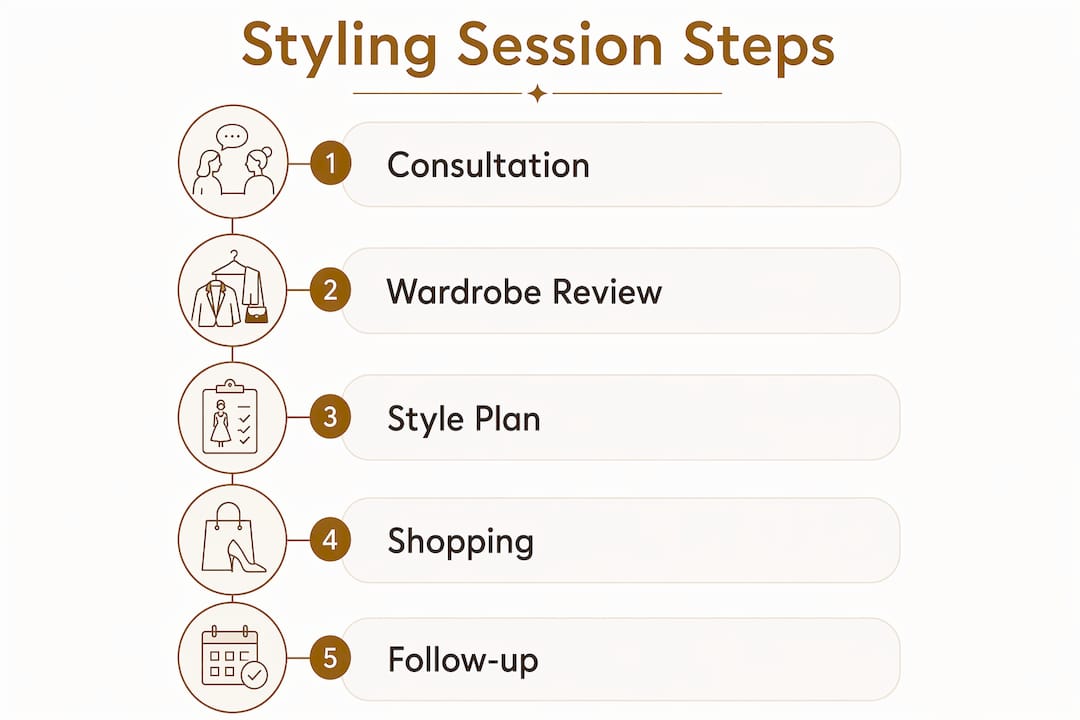
The process follows a clear sequence, whether you work with someone in person or virtually.
The typical flow:
- Initial consultation — the stylist learns your lifestyle, goals, and aesthetic preferences
- Wardrobe audit — existing pieces are reviewed; keepers, edits, and gaps are identified
- Style plan — a colour palette, silhouette guide, and outfit formulas are established
- Shopping or curation — the stylist sources pieces or builds a shoppable board for you to review
- Follow-up — outfit grids, a shopping list, or a check-in session to confirm the plan is working
Initial consultations commonly run 60–90 minutes, and virtual sessions follow the same cadence as in-person ones. Deliverables for virtual clients typically include shoppable outfit boards, outfit grids, and annotated shopping lists.
| Stage | Typical length | Common deliverables |
|---|---|---|
| Initial consultation | 60–90 minutes | Style questionnaire, goal summary |
| Wardrobe audit | 60–90 minutes | Keep/edit list, gap analysis |
| Style plan | Async or 60 minutes | Colour palette, outfit formulas |
| Shopping/curation | Varies | Shoppable board, shopping list |
| Follow-up | 60–90 minutes | Outfit grids, seasonal updates |

Pricing for online styling platforms varies widely based on stylist experience and session scope. Service formats range from single consultations to multi-session packages or ongoing seasonal check-ins.
Personal stylist vs. personal shopper: what is the difference?
A personal stylist and a personal shopper are not the same role, though people use the terms interchangeably. The distinction matters when you are deciding what kind of help you actually need.
A personal stylist works upstream. They analyse your wardrobe system, define your style direction, and educate you on what works for your body and life. The relationship is strategic and often ongoing. A personal shopper is transactional: they source and purchase specific items, often within a particular store or brand, for a defined occasion or need.
| Dimension | Personal stylist | Personal shopper |
|---|---|---|
| Primary focus | Strategy and education | Purchase execution |
| Timeframe | Ongoing or multi-session | Single event or one-off |
| Deliverables | Style plan, outfit formulas, wardrobe edit | Curated items, shopping bag |
| Relationship | Long-term, evolving | Short-term, task-based |
| Cost shape | Hourly or package | Hourly, flat fee, or commission |
Personal stylists serve everyday clients seeking functional wardrobes, not just celebrities or editorial shoots. That is a common misconception worth dropping.
When to choose which:
- Choose a stylist when you want a long-term wardrobe overhaul, a capsule wardrobe, or to stop repeating the same shopping mistakes
- Choose a personal shopper when you need specific items fast, such as a wedding guest outfit or a work trip capsule
Why do people hire a personal stylist?
The practical benefits go well beyond “looking put-together.” For women shopping online in Canada, the payoff tends to show up in three concrete ways.
Fewer returns. When purchases are guided by a style plan, you buy pieces that fit your existing wardrobe and your actual body. Impulse buys made without that filter are the ones that get returned. A structured shopping workflow reduces that cycle significantly.
Faster mornings. A wardrobe built on repeatable outfit formulas means combinations are obvious. You are not starting from scratch every day.
Cost-effectiveness over time. Buying fewer but better-fitting pieces that work together costs less than a closet full of items that never quite combine. Stylists prioritise compatibility, which means every addition multiplies your outfit options rather than sitting unused.
Consider a busy working parent. Their stylist might build a core of eight to ten pieces — two trousers, three tops, a blazer, a dress, and two outerwear options — that produce fifteen or more distinct outfits. No trend-chasing required. That is the wardrobe-system concept in practice.
Pro Tip: When evaluating whether a stylist’s suggestions are working, track how often you reach for new pieces in the first two weeks. Pieces you avoid immediately are usually a fit or compatibility issue worth flagging.
How to prepare for a styling session
Walking in prepared makes the session more productive and the recommendations more accurate.
What to bring or prepare:
- Your measurements (bust, waist, hips, inseam) — even approximate ones help
- Photos of outfits you love and outfits that felt wrong
- A short list of your typical weekly activities (office, gym, school pickup, evenings out)
- Your honest budget range for new purchases
- Access to your wardrobe, either in person or via photos for a virtual session
Questions worth asking a stylist before you book:
- What does your process look like from first session to final recommendations?
- Do you offer virtual sessions, and what do those deliverables look like?
- How do you handle pieces that do not work out after purchase?
- Do you charge per session or by package, and what is included?
- How do you approach clients with petite, tall, or plus-size proportions?
Pro Tip: Look at a stylist’s portfolio or editorial content before booking. If their aesthetic skews heavily toward one look — say, ultra-minimalist or maximalist — and that is not your direction, the fit may be off regardless of their skill level.
Organising your wardrobe before a virtual audit also saves time. A quick wardrobe organisation pass helps you and the stylist see what you actually own rather than what is buried.
How can you get styling help in Canada?
You have four main options, and they are not mutually exclusive.
In-person stylists offer the most hands-on experience — they can assess fit in real time and pull pieces directly. Availability varies by city; major centres like Toronto, Vancouver, and Montreal have the deepest pools of independent stylists.
Virtual styling services have closed most of that geographic gap. Sessions run via video call and deliver shoppable boards, outfit grids, and shopping lists. The format works well for online shoppers who already buy clothing without trying it first. Timing and deliverables mirror in-person sessions closely.
Retailer-curated collections are a practical middle ground. When a retailer builds seasonal collections around a neutral core and a limited palette, the decision load drops considerably. Browsing curated seasonal picks at 16thavenue works well alongside a stylist’s recommendations, since the pieces are already pre-filtered for compatibility.
DIY styling suits shoppers testing the approach on a small budget. A starter checklist:
- Choose a three-colour neutral palette (e.g., navy, cream, camel)
- Build five to seven core pieces before adding anything trend-driven
- Use outfit grids: photograph combinations so you can replicate them without thinking
- Reference a capsule wardrobe guide to structure your first edit
Virtual services are particularly well-suited to Canadian shoppers outside major cities, where in-person options are limited. You can also combine approaches: use a virtual stylist for strategy, then shop curated collections for execution.
Key takeaways
Personal styling turns a fragmented closet into a working wardrobe system built around your body, lifestyle, and goals.
| Point | Details |
|---|---|
| Core definition | Personal styling analyses your body, colouring, and lifestyle to build a cohesive, wearable wardrobe. |
| Typical timeline | Initial consultations run 60–90 minutes; full engagements include audit, plan, shopping, and follow-up. |
| Stylist vs. shopper | A stylist provides long-term strategy and education; a personal shopper handles one-off purchase execution. |
| Main benefits | Fewer returns, faster mornings, and cost-effectiveness from buying compatible pieces intentionally. |
| Getting started | Virtual styling works well for Canadian shoppers anywhere; retailer-curated collections complement stylist advice. |
A note on how 16thavenue approaches style curation
Personal styling principles are not exclusive to one-on-one consultations. At 16thavenue, the editorial and product curation process applies the same logic: seasonal collections are built around neutral cores, limited palettes, and pieces that layer and combine rather than stand alone. The style workflow guides on the blog walk through outfit-building steps that mirror what a stylist would recommend in a session.
For shoppers who want to start building a more intentional wardrobe right now, the Women’s Trendy Autumn and Winter Woolen Coat is a strong capsule anchor — a neutral outerwear piece that pairs across multiple outfit formulas. For casual days, the Women’s Casual Low Wedge Breathable Non-Slip Comfort Sport Sneakers fill the versatile footwear slot most stylists recommend covering early.
Useful sources and further reading
- What is a Personal Stylist — Federation of Image Professionals International — defines the role and scope of personal styling services
- What is personal styling? — Revivre Magazine — explains colour analysis and seasonal palette frameworks
- Personal stylist — Wikipedia — background on the professional distinction between personal and wardrobe stylists
- Style Method Co — virtual styling services — details on virtual session formats and typical timelines
- Glamhive — personal styling services — overview of pricing formats and service scopes
- 16thavenue: style curation guide — internal guide to discovering and building a personal style
- 16thavenue: step-by-step fashion styling guide — practical outfit-building steps for online shoppers
- 16thavenue: how to build a capsule wardrobe — actionable guide to starting a capsule wardrobe from scratch
The part most styling guides skip
Most articles about personal styling focus on the process: the consultation, the wardrobe edit, the shopping list. That is useful, but it misses the more interesting question — why do so many people go through that process and still end up back where they started six months later?
The answer is usually that they treated the stylist’s recommendations as a shopping list rather than a framework. They bought the pieces, wore them for a season, and then kept shopping the old way. The wardrobe fragmented again.
What actually sticks is when the client internalises the logic behind the recommendations: why certain silhouettes work for their proportions, why their palette is built around three neutrals and two accents, why every new piece needs to connect to at least three existing items before it earns a place in the closet. That understanding is what makes the investment compound over time rather than expire.
For online shoppers in Canada, the practical implication is this: a single styling session is worth more if you follow it with a deliberate shopping habit, not a shopping spree. Curated collections, outfit grids, and a clear colour palette are the tools that keep the system running between sessions. The stylist builds the framework. You maintain it.