


What is trend adoption: a clear guide for style makers
Trend adoption is the process by which people, brands, and markets gradually take up a new style, product, or behaviour, moving from a small group of early experimenters to the broader public over time. It rarely happens all at once.
- The shape: Adoption tends to follow an S-shaped curve, plotted against a bell-curve of adopter groups.
- The groups: Rogers’ diffusion model splits adopters into five categories, from innovators (2.5%) to laggards (16%).
- The payoff: Once you can see the pattern, you can spot a real fashion or product trend before it peaks, using signals covered later in this guide.
Key Takeaways
Trend adoption follows a predictable S-curve across five adopter groups, and spotting it early requires watching upstream signals rather than waiting for mainstream visibility.
| Point | Details |
|---|---|
| Adoption follows a curve | Expect slow uptake, a steep middle, then saturation, not a straight line. |
| Five adopter groups exist | Innovators (2.5%), early adopters (13.5%), early majority (34%), late majority (34%), laggards (16%). |
| The chasm causes most stalls | Early majority buyers need proof and reliability, not just novelty or hype. |
| Watch upstream, not feeds | Niche comments, save velocity, and platform migration signal trends before they saturate. |
| Trends need real utility | Fads run on attention alone; trends solve an actual problem and change behaviour. |
Table of Contents
- What is trend adoption in fashion and product terms?
- Who adopts trends first, and who waits?
- What are the stages of individual adoption?
- How long does a fashion or product trend actually last?
- Is it a trend or just a fad?
- Why do so many trends stall before going mainstream?
- How do you spot a trend before it peaks?
- Which pieces are worth adopting right now?
- What does the research actually tell us about adopting trends well?
- Frequently asked questions
- Sources
What is trend adoption in fashion and product terms?
Trend adoption describes how a new idea, garment silhouette, or product feature spreads through a population until it either becomes normal or fades out. Plotted over time, adoption almost always traces an S-curve: slow at first, steep through the middle as the mainstream catches on, then flat again once the market is saturated. Flip that same curve into a frequency distribution and you get the familiar bell shape used to sort adopters into groups, a model detailed in the diffusion literature.
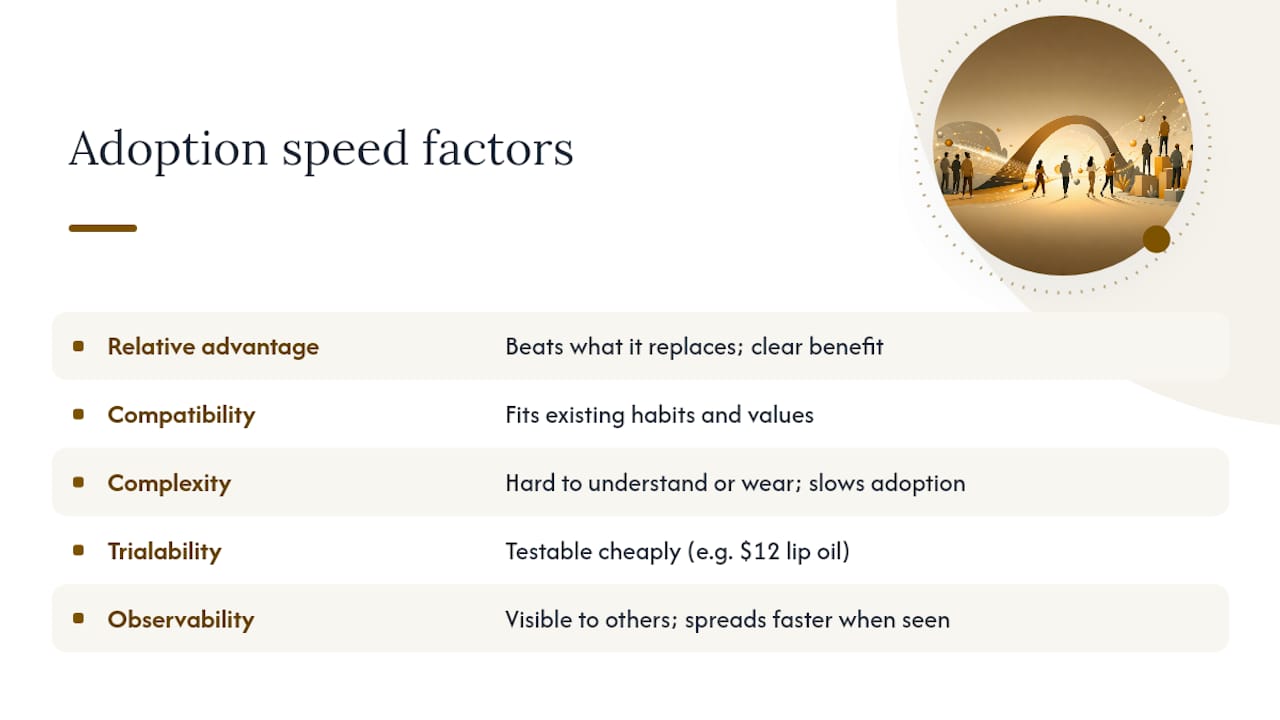
Five attributes determine how fast something climbs that curve. Relative advantage asks whether the new thing beats what it replaces, a cropped jacket that actually works in three seasons instead of one. Compatibility asks whether it fits existing habits and values, which is why a shoe brand that already sells comfort sneakers finds it easier to add a “recovery” line. Complexity matters because anything hard to understand or wear slows adoption, no matter how good it looks on a runway. Trialability, the ability to test something cheaply (a $12 lip oil versus a $400 coat), speeds things up. Observability, how visible the choice is to others, explains why a bold print spreads faster on a jacket than on underwear. Score a new aesthetic trend against those five factors and you get a decent read on how fast it will move.
Who adopts trends first, and who waits?
Rogers’ five adopter categories remain the clearest map of who buys in and when, and the canonical percentages still hold up decades after they were proposed:
- Innovators (2.5%): High risk tolerance, often financially cushioned, first to buy the runway piece or the untested product feature before anyone confirms it works.
- Early adopters (13.5%): Opinion leaders others watch closely. They wait for a small amount of proof, then move fast, and their choices shape what gets called “trendy” next season.
- Early majority (34%): Pragmatic and evidence driven. They need to see the style on real people, not just influencers, before they commit.
- Late majority (34%): Skeptical and price sensitive. They adopt once something is close to standard, often when it hits mass retail markdowns.
- Laggards (16%): Value tradition and low risk over novelty, adopting only once an item is no longer considered a trend at all.
In fashion, this plays out visibly: the innovator buys the designer version at full price, the early adopter wears a high street interpretation within a season, the early majority waits for a trendsetting style to show up in mainstream stores, and laggards pick it up once it is simply “normal.” Product innovation follows the same script: think of how quickly recycled fabrics moved from niche labels to mainstream apparel racks once the early majority decided the fabric performed as well as conventional options.
What are the stages of individual adoption?
Rogers’ model also tracks what happens inside one person’s head before they buy in, and this individual sequence matters as much as the group-level curve.
- Knowledge: The person becomes aware something exists, often through a search, a social feed, or a friend wearing it.
- Persuasion: They form an opinion, usually shaped by reviews, social proof, or seeing someone they admire wear or use it.
- Decision: They choose to adopt or reject, frequently triggered by a small trial purchase or a free sample.
- Implementation: They actually use the product or wear the item regularly, which is where fit, comfort, and durability get tested.
- Confirmation: They either reinforce the choice by repeating it or reverse it after a bad experience.
Some product-adoption frameworks insert an activation step between trial and long-term use, tracking whether someone actually integrates a new skincare step or app feature into a routine rather than trying it once and forgetting it. Persuasion responds well to social proof and reviews; implementation responds better to clear instructions, sizing guides, or onboarding tips than to more advertising.
How long does a fashion or product trend actually last?
Most trends move through four phases: emergence, growth, mainstream peak, and decline. Emergence is quiet, confined to niche creators or small labels. Growth is where the early majority notices and volume picks up fast. Mainstream peak is saturation, when you see the item everywhere from runway to retail. Decline follows once novelty wears off or a newer alternative appears.
Duration varies enormously by category. A microtrend, a specific nail art style or a viral phone case, can run its full course in weeks to months. A durable trend, like the shift toward relaxed tailoring or long-lasting hybrid sneakers, can hold for several years.
Trends move fastest when the cost of trying them is low and platforms reward novelty. They stretch out when there’s real utility behind them and the supporting infrastructure, manufacturing, retail, marketing, can keep up with demand.
A trend backed by genuine comfort or function tends to outlast one riding purely on visibility.
Is it a trend or just a fad?
The fastest way to tell them apart is to ask whether the underlying behaviour actually changes or whether it is just attention. Trends solve a real want or need and hold up once the novelty fades; fads are driven by visibility alone and collapse once attention moves elsewhere. Practitioners suggest checking whether early adopters build habits, tools, or routines around the idea, a sign it has staying power rather than fading with the algorithm.
| Signal | Likely a trend | Likely a fad |
|---|---|---|
| Behaviour | Changes habits and sticks after the hype fades | Disappears once attention moves on |
| Utility | Solves a real problem or comfort gap | Purely aesthetic or novelty driven |
| Adoption pattern | Builds steadily across categories | Spikes then crashes fast |
Take three examples. Sustainable, durable outerwear is a trend, it solves a real cost-per-wear problem. A single viral colour of nail polish tied to one video is usually a fad. A microtrend like a specific sleeve shape sits somewhere in between, often trend-adjacent but short-lived. If you can afford to wait six to twelve months at low cost before committing, watching is usually smarter than jumping in immediately.
Why do so many trends stall before going mainstream?
Geoffrey Moore’s “chasm” concept describes the gap between early adopters, who buy on vision, and the early majority, who buy on proof. Many products and styles die right there because the evidence early adopters accept, buzz, novelty, social signalling, does not satisfy the pragmatic early majority, who want references, reliability, and simplicity before they commit.
Brands trying to cross that gap tend to succeed when they:
- Secure visible references from ordinary users, not just influencers or insiders.
- Demonstrate reliability through repeat availability, consistent sizing, or consistent quality.
- Reduce complexity, fewer confusing variants, clearer sizing, simpler care instructions.
- Enable low-risk trialability, samples, smaller sizes, or return-friendly policies.
Individuals deciding whether to jump on something themselves can use a simpler four-step check:
- Identify the actual utility. Does it solve a problem you have?
- Check observability. Is it something you’ll actually see and use daily, or a one-off?
- Gauge the cost of waiting. Will price or availability change much if you wait a season?
- Look for peer references, not just posts. Has someone you trust tried it and stuck with it?
How do you spot a trend before it peaks?
Watch upstream, not downstream. By the time an algorithmic feed surfaces something widely, it is often already near saturation, and the participation window can close fast. Treat trend spotting as ongoing monitoring rather than prediction, tracking a short list of leading indicators the way you’d track any strategic signal.
Three places to watch:
- Niche communities and comment sections, where repeating vocabulary shows up before hashtags do.
- Save and bookmark velocity, since content people save (rather than just like) signals intent to act later.
- Format migration, watching an idea move from TikTok to Reels to Shorts to LinkedIn, a sequence that gives useful lead time on saturation risk.
Pro Tip: Run a quick three-question filter before acting on anything you spot: Does it solve a real want? Does the evidence show up in at least three separate places, not just one viral post? Can you realistically execute on it with the resources you have? Skip anything that fails even one.
Evidence spread across multiple independent sources is a far stronger signal than one post with a lot of engagement.
Which pieces are worth adopting right now?
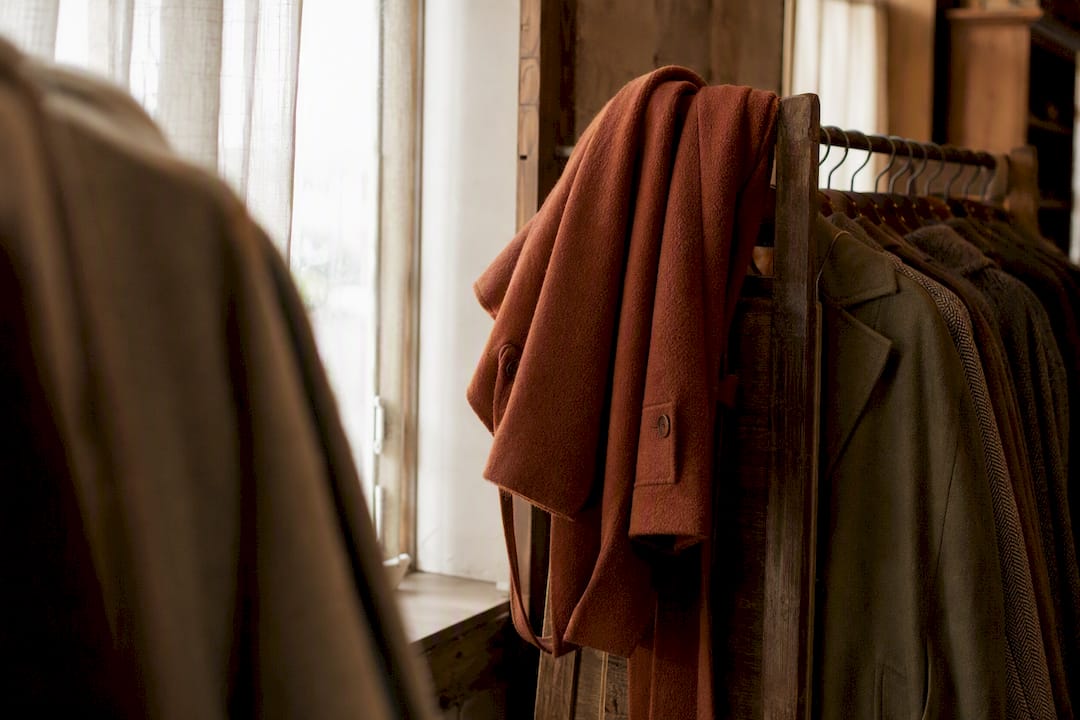
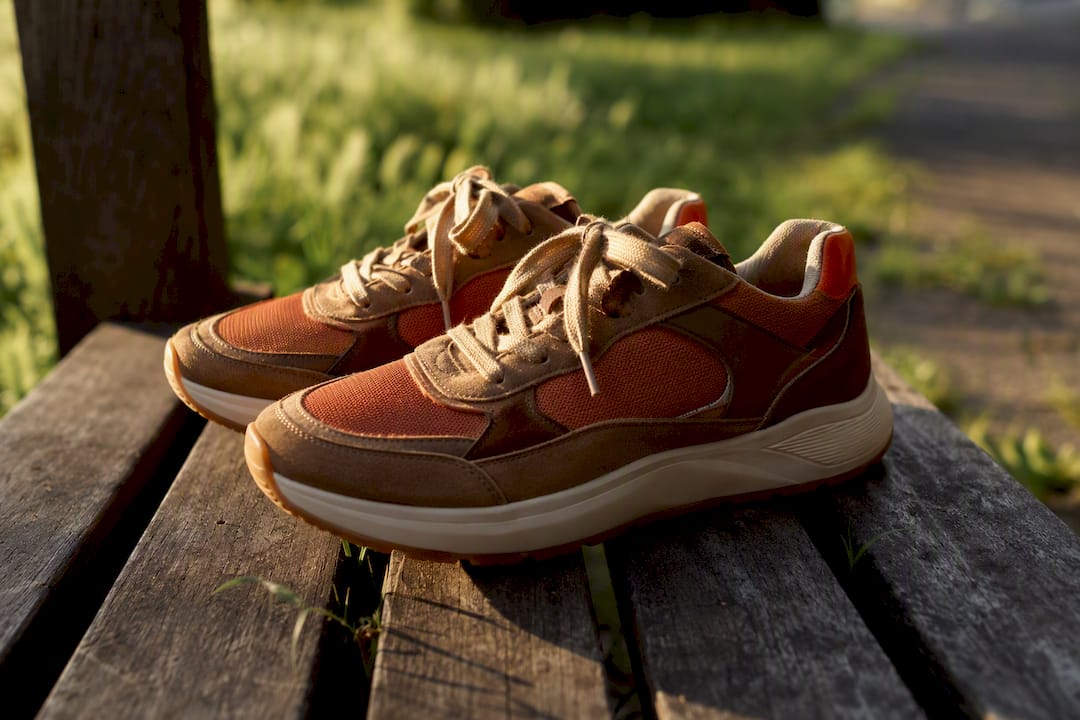
If the utility and observability checks above point you toward action rather than watching, seasonal pieces are usually the lowest-risk place to start. A woolen coat built for autumn and winter checks the durable-trend box: it solves a real comfort problem and holds its relevance across several seasons rather than fading with one social cycle. If you’re testing a lower-commitment style shift, a pair of comfort sport sneakers built for daily wear lets you trial a trend-forward silhouette without betting on something purely novelty-driven. 16thavenue curates both seasonal staples and trend-forward pieces specifically so you can apply the trialability principle yourself, testing a style at low cost before deciding whether it earns a permanent spot in your wardrobe.
What does the research actually tell us about adopting trends well?
Most advice on trends focuses on prediction, guessing what’s next. That’s the wrong frame. The stronger read from Rogers’ model and current practitioner guidance is that trend adoption rewards monitoring discipline over forecasting talent. Anyone can spot a trend after it’s mainstream; the actual skill is noticing it while it’s still confined to niche comment sections and low-velocity saves.
The conventional advice, “follow what’s trending,” skips the harder and more useful question: is this a trend or a fad, and where does it sit on the adoption curve right now? That distinction changes what you should actually do. If something is still with the innovators, watching costs you nothing. If it’s already crossed into the early majority, waiting probably costs you more than acting.
What most people underestimate is the chasm. It’s not a marketing footnote, it’s the single biggest reason good ideas, in fashion and in product design alike, never reach the people who’d actually benefit from them. Prioritize proof over hype, every time.
Frequently asked questions
What is trend adoption in simple terms? It’s the process of a new idea, style, or product spreading from a small group of early users to the wider public, usually tracked as an S-curve moving through five adopter groups.
What drives trend adoption the most? Relative advantage and observability tend to matter most in fashion and product contexts. If something is clearly better than what it replaces and easy for others to see, it spreads faster.
What’s the difference between a trend and a fad? A trend changes behaviour and solves a real need, so it holds up after the hype fades. A fad runs on attention alone and collapses once visibility drops.
Why do some trends never go mainstream? Many stall at the “chasm” between early adopters, who buy on vision and novelty, and the early majority, who need proof, reliability, and simplicity before committing.
How can I tell if a trend is worth adopting early? Check whether the evidence shows up across multiple sources, not just one viral post, and weigh whether waiting six to twelve months would cost you much. If the cost of waiting is low, observing first is usually the smarter move.
Sources
- Chapter 6 – Trend Lifecycles and Adopter Categories
- Diffusion of innovation theory
- How to spot a trend before it peaks (and decide if it’s worth it) | Later
- Diffusion of Innovations: Rogers’ 5 Adopter Categories and the Technology Adoption Lifecycle
- What’s the product adoption curve & Why’s it important?